The collision of ships at sea represents one of the most complex scenarios in maritime disaster management. Unlike port accidents, collisions in international waters lack immediate response infrastructure, which multiplies the risks of sinking, fuel spills, and loss of life. Accurate reconstruction of these events is vital for prevention.
Technical Reconstruction of Impact and Sinking ⚓
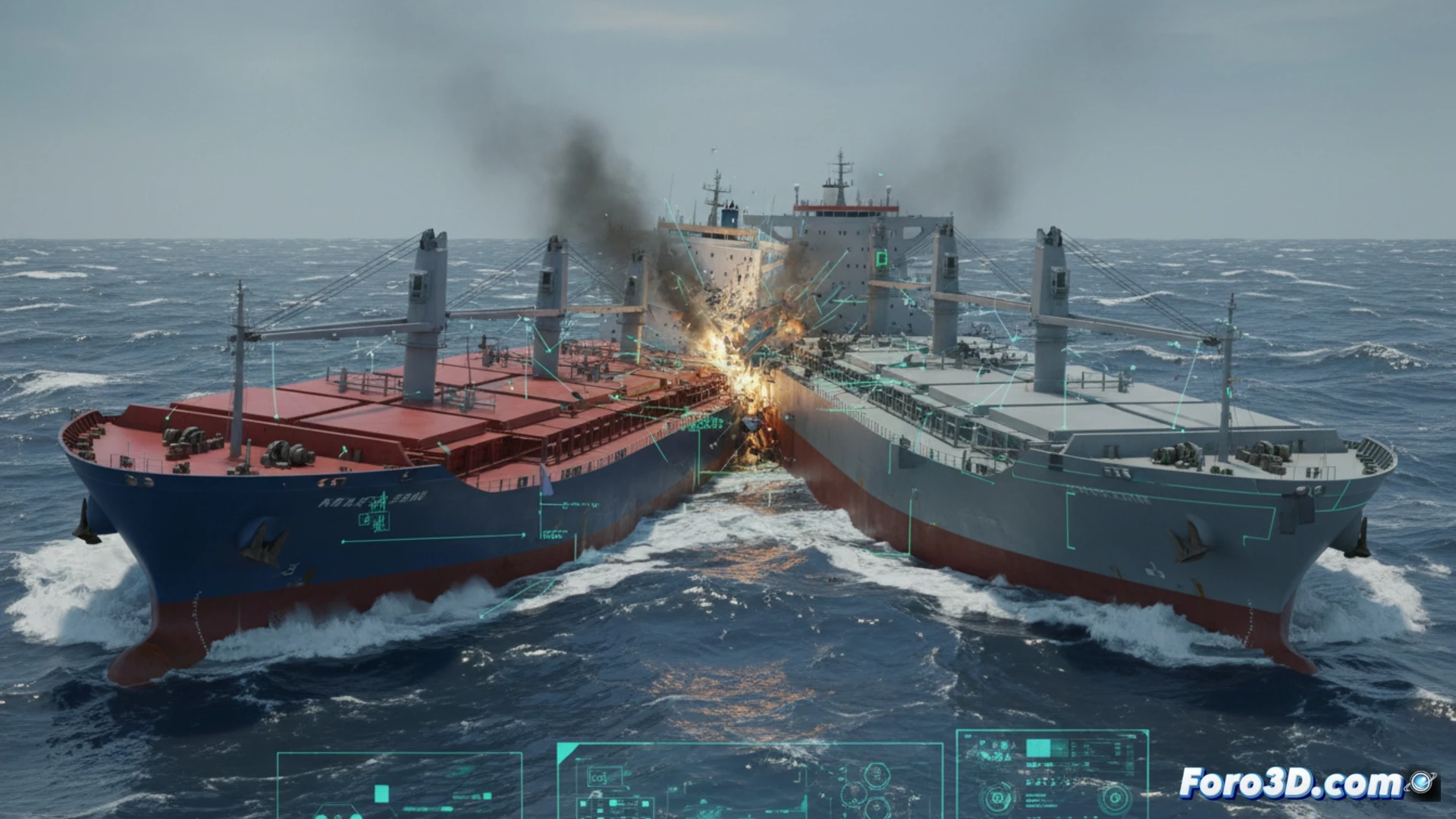
The analysis of the incident begins with the creation of high-fidelity digital twins. These 3D models replicate the mass, center of gravity, and structural resistance of each vessel. By simulating collision dynamics, impact forces and crack propagation in the hull are calculated. The tool allows visualizing the exact sequence of compartment flooding, assessing the ship's stability in real time. Subsequently, the sinking and dispersion of pollutants are modeled, integrating variables such as ocean currents and wind, to optimize evacuation routes and the location of lifeboats.
Lessons for Safety from 3D Modeling 🛟
Beyond disaster simulation, these digital reconstructions allow identifying failures in navigation and communication protocols. By recreating the collision from different angles and speeds, concrete improvements can be proposed in hull design to absorb impacts, as well as in early warning systems. 3D analysis thus becomes a virtual laboratory for training crews and designing more effective responses, reducing fatalities in future incidents at sea.
How do real-time wave and visibility variables influence the accuracy of a 3D simulation to predict collision dynamics between ships in international waters?
(PS: Simulating disasters is fun until the computer crashes and you are the disaster.)