The manipulation of biological agents in high-containment laboratories carries an inherent risk: the accidental rupture of the primary container. In the field of disaster analysis, studying the crushing of a bacteriological container is crucial for understanding the kinetics of release. This article explores how 3D simulation allows modeling the structural collapse of the container, the cracking of the material, and the initial dispersion of the pathogen in the immediate environment.
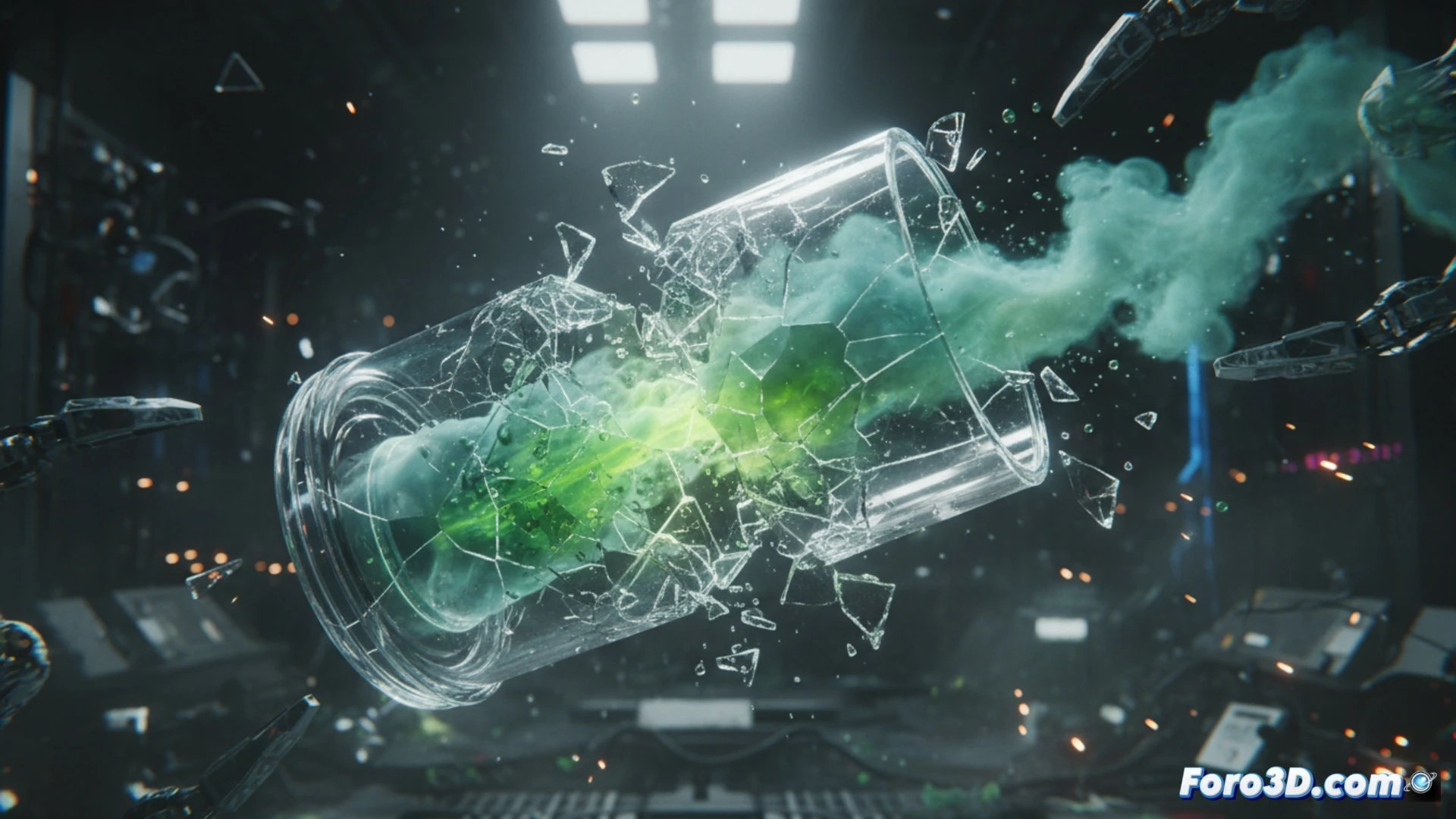
Mechanical Modeling and Fluid Dynamics in the Rupture 🧪
The simulation begins with the characterization of the container using finite elements, defining properties such as the thickness of the glass or polycarbonate and the internal pressure. By applying a crushing load, the software calculates the fracture point and the energy released. Subsequently, a computational fluid dynamics (CFD) model is integrated to track the particles of the biological agent. The analysis visualizes how the laboratory geometry, ventilation grilles, and air currents affect the dispersion cloud, allowing prediction of high-risk zones in seconds following the incident.
Lessons for Safety and Evacuation 🚨
Visualizing this disaster in 3D transforms theory into a tangible prevention tool. The models reveal that the location of extraction hoods and the response speed are determining factors for containing the leak. By recreating the crushing scenario, safety teams can optimize evacuation routes and decontamination protocols, reducing personnel exposure time. Ultimately, the simulation not only documents the failure but trains the user to mitigate a real catastrophe.
How can a 3D simulation model predict and visualize the dispersion of pathogen aerosols after the rupture of a bacteriological container in a high-containment laboratory to improve emergency protocols in biological disasters?
(PS: Simulating disasters is fun until the computer crashes and you are the disaster.)