A toxic spill in the subsoil is not visible to the naked eye, but its consequences can be devastating for aquifers and public health. At Foro3D, we analyze how to model the underground contamination plume through three-dimensional simulations, allowing us to visualize the advance of the toxic substance through geological strata and predict its impact on drinking water catchment areas.
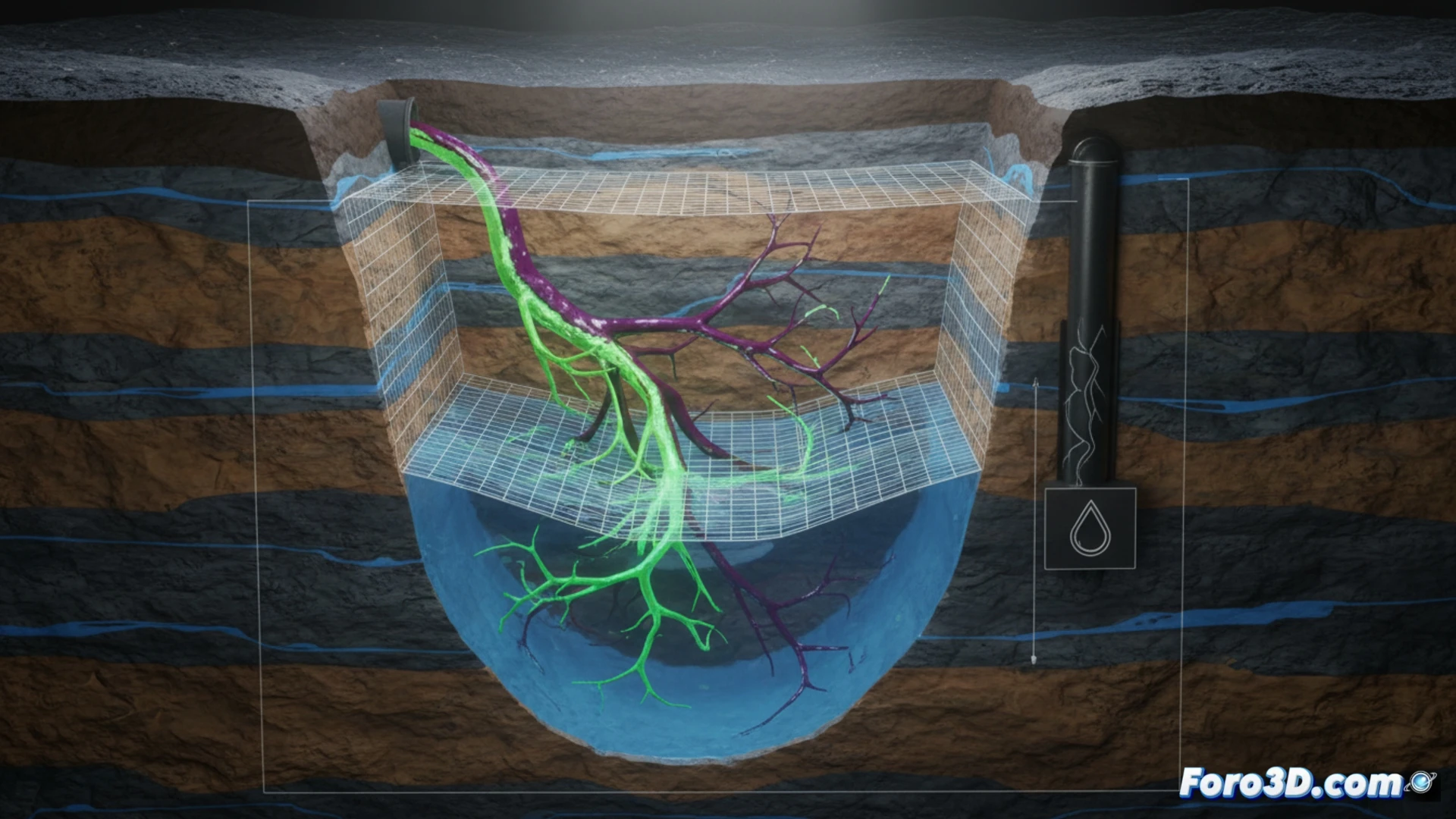
Geotechnical modeling of the contaminant plume 🌍
To recreate the scenario, we start from a digital terrain model that includes the permeability of the water table layers, the porosity of the rocky substrate, and the directions of underground flow. Tools such as MODFLOW or FEFLOW allow integrating real hydrogeological data and generating 3D animations that show how the toxic compound moves and dilutes. Reactive barriers, extraction wells, or neutralizer injection can be simulated, evaluating their effectiveness before a real intervention.
Awareness through disaster visualization 🚨
These simulations are not only useful for engineers and geologists, but are key educational tools for communities and emergency managers. Seeing in 3D how a spill advances towards a municipal well or a wetland generates an immediate understanding of the risk. At Foro3D, we advocate for this approach: turning abstract data into images that alert and educate, promoting a faster and more effective response to silent ecological catastrophes.
How can a 3D simulation of the underground flow of a toxic spill anticipate aquifer contamination and help design mitigation strategies before an irreversible disaster occurs.
(PS: Simulating catastrophes is fun until the computer crashes and you are the catastrophe.)