3D fabric simulation has evolved beyond fashion design. Tools like Marvelous Designer and Clo 3D allow precise modeling of fabric behavior under tension. In forensic contexts, recreating a textile tear is key to understanding the dynamics of an incident. Analyzing the concordance between simulated tears and real evidence can determine the sequence of forces applied during an abduction, offering objective data on material resistance and failure points.
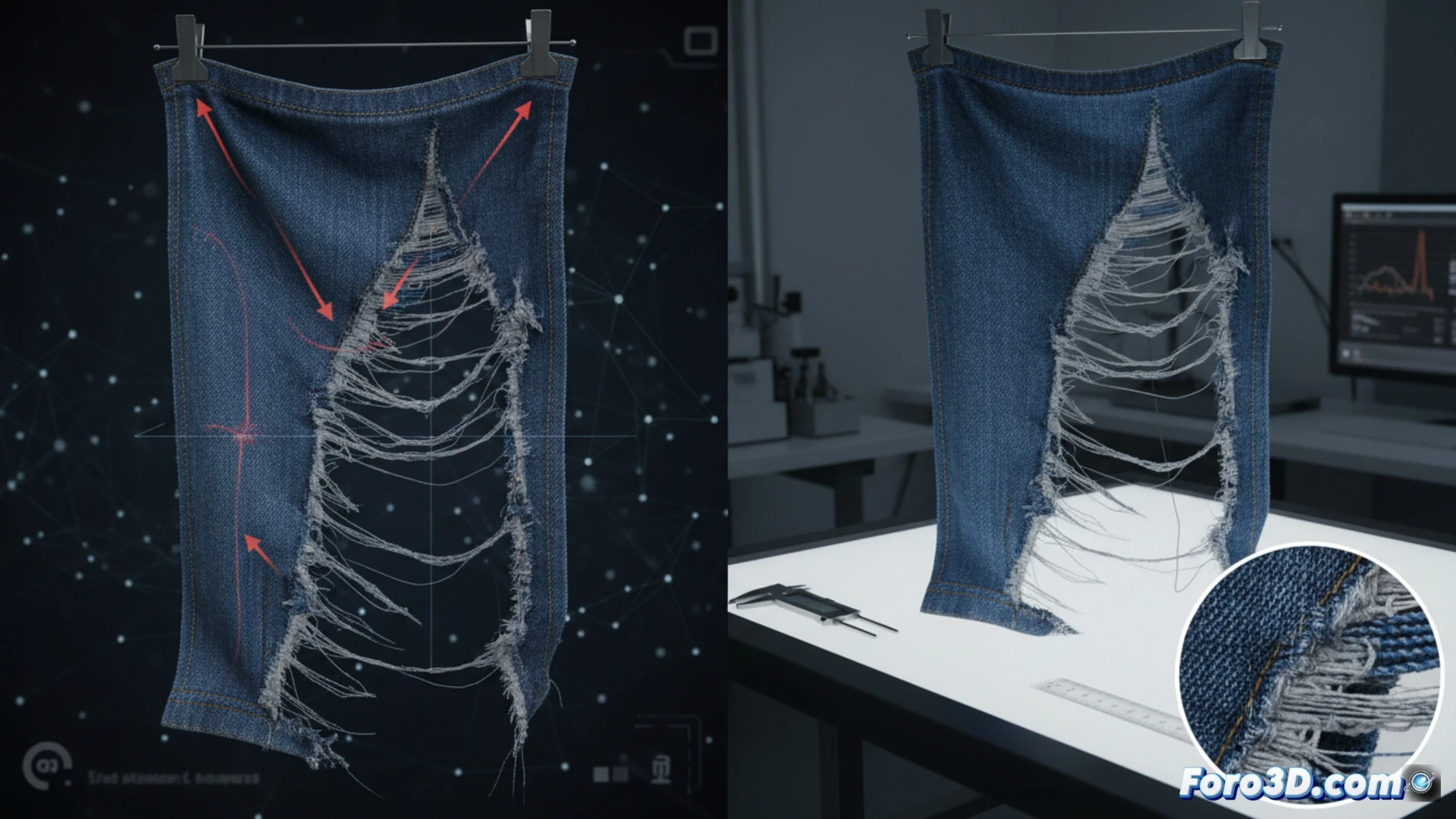
Technical Process of Tension and Deformation Simulation 🧵
To reconstruct a textile tear, the first step is to parameterize the fabric in the software. Properties such as Young's modulus, shear stiffness, and thread density are defined. Then, movement constraints are applied (fixing points on a surface) and the model is loaded with directional force vectors simulating a struggle. The simulation algorithm calculates plastic deformation until the breaking point is reached. By comparing the resulting tension mesh with the tear marks on the actual garment, we can validate or discard hypotheses about the mechanics of the abduction, such as the direction of the pull or the type of grip.
Implications for Design and Investigation 🔍
Beyond reconstruction, this technique allows technical fashion designers to create fabrics with controlled break points for safety applications. For the investigator, the concordance between simulation and physical evidence offers a level of detail that the human eye cannot perceive. This multidisciplinary approach transforms a simple textile tear into a source of quantifiable data, bridging the gap between materials physics and the narrative of an event.
Can textile simulation tools like Marvelous Designer replicate with forensic precision the tear patterns of a fabric to determine the cause of a tear at a crime scene?
(PS: Designing fashion in 3D has the advantage that you never have to sew a button.)