The profession of a mining technician exposes the professional to lethal dangers: collapses at work faces, firedamp explosions, accumulation of respirable dust, and structural stress. 3D simulation allows modeling these catastrophic scenarios with physical precision, offering a safe virtual environment to train responses to gallery collapses, uncontrolled detonations, and the propagation of toxic particles in real time.
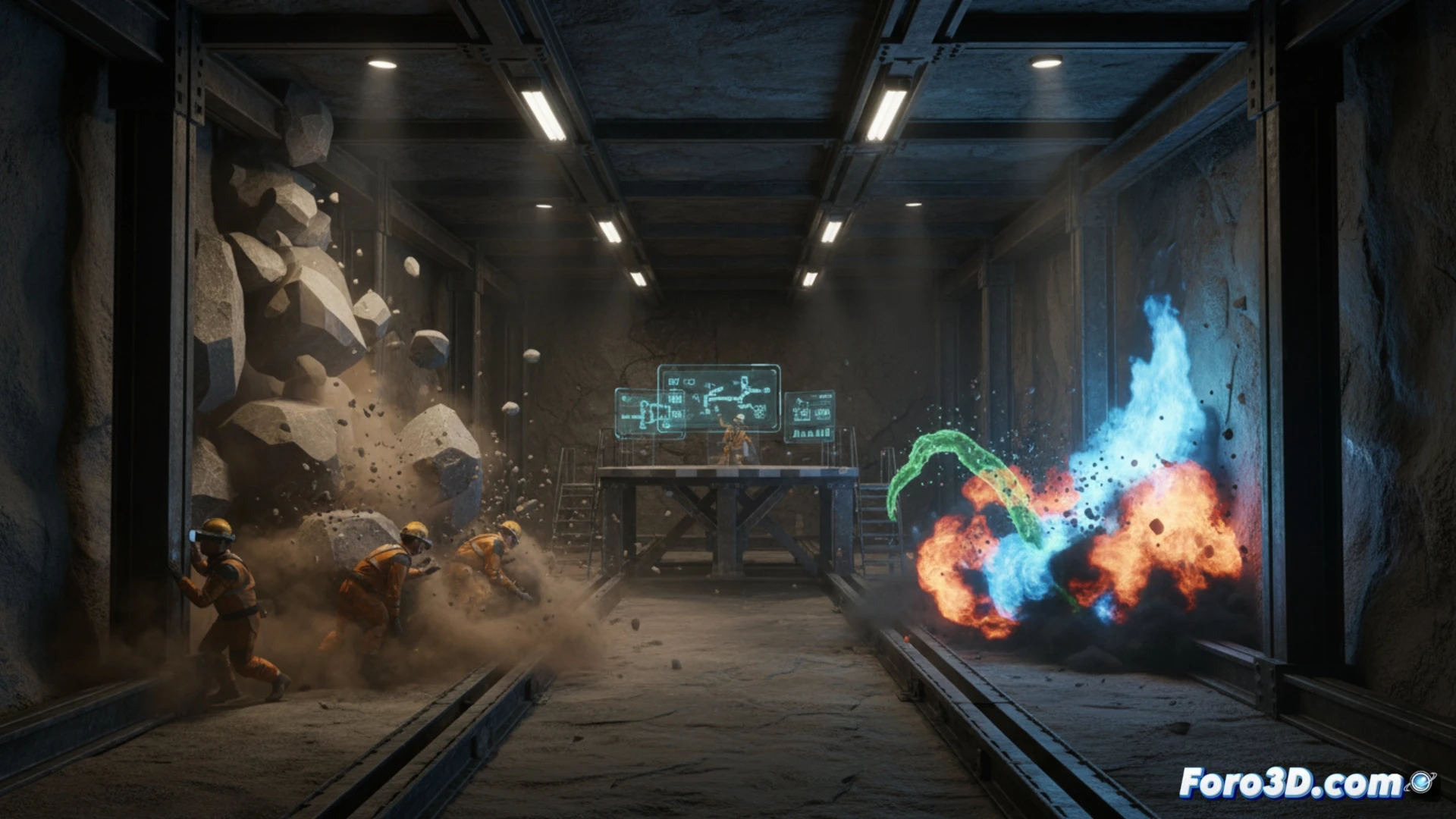
Modeling critical scenarios: dust propagation and structural stress 💥
Current 3D simulation tools integrate fluid dynamics and finite element analysis to recreate the dispersion of explosive dust clouds and the fatigue of tunnel supports. By visualizing dynamic evacuation routes that adapt to ground deformation, technicians can practice decision-making under pressure. Furthermore, explosion simulation allows studying the shockwave and debris generation, improving safety protocols without risking human lives or material resources.
Beyond training: prevention through digital twins 🛡️
The true revolution lies in applying these simulations before a catastrophe occurs. Digital twins of a mine, fed with data from gas, vibration, and pressure sensors, can anticipate areas of high structural risk or gas accumulation. For the mining technician, this means moving from reactive to predictive supervision, reducing the work stress associated with uncertainty and transforming mining safety into a scientifically controlled process.
How can 3D simulation of mine collapses and explosions improve technicians' response capacity to risk situations without creating a traumatic training environment that diminishes their performance in real emergencies?
(PS: Simulating catastrophes is fun until the computer crashes and you are the catastrophe.)