The work of a building inspector involves constant exposure to hostile environments and degraded structures. Hazards range from falls from roofs or unstable scaffolding to inhalation of asbestos or silica fibers. Traditional documentation, based on photographs and notes, proves insufficient for analyzing the dynamics of these accidents. 3D modeling technology offers a precise solution for reconstructing these scenes, allowing prevention experts to identify structural failures and exposure routes with millimeter accuracy.
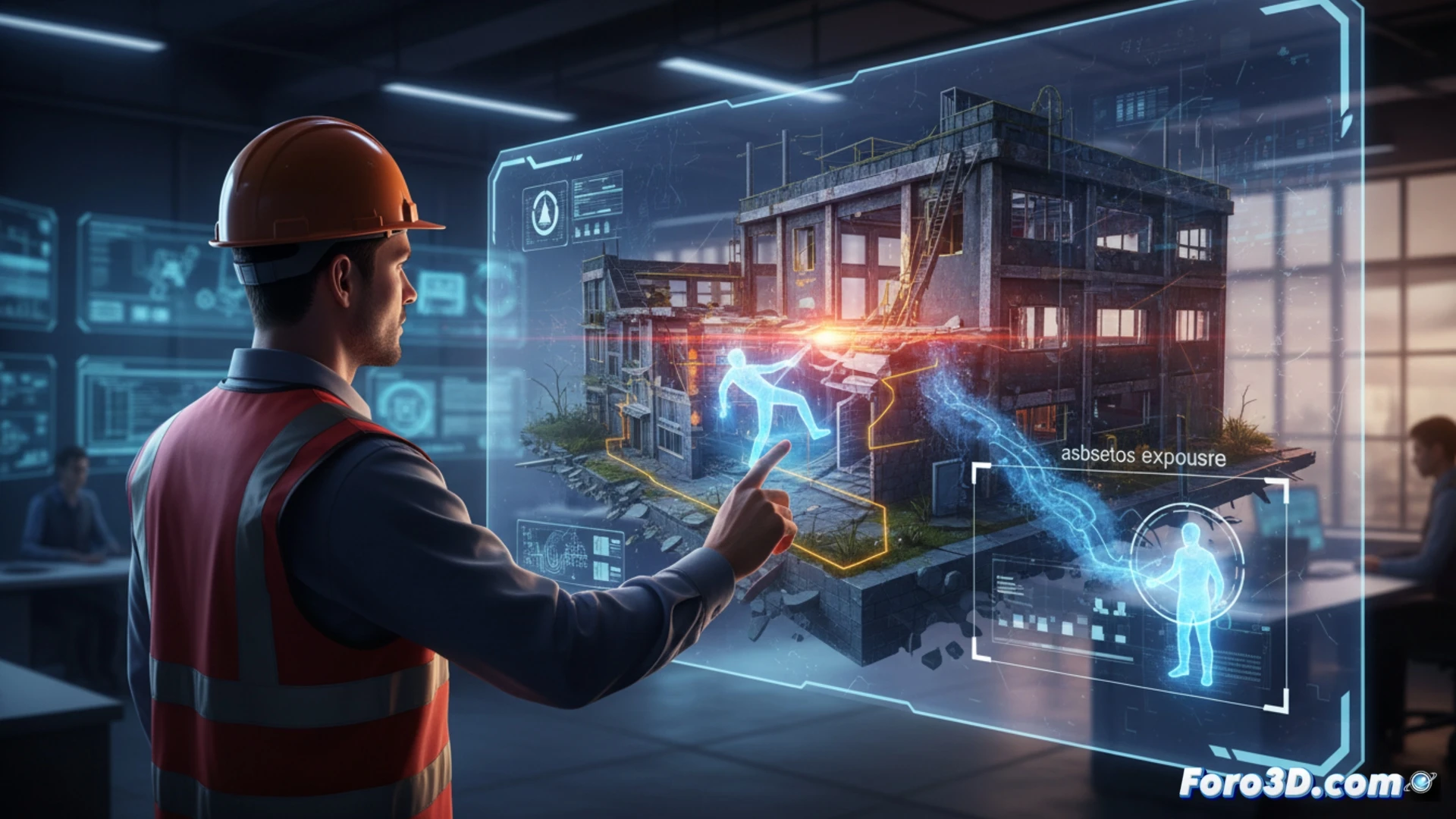
Virtual reconstruction of high-risk scenarios 🏗️
Through laser scanning and photogrammetry, it is possible to generate digital twins of collapsed roofs or confined spaces. These models allow simulating fall trajectories from scaffolding, evaluating the actual height and impact against obstacles. Additionally, ventilation conditions in basements or attics can be recreated to map the dispersion of silica dust or asbestos fibers. Integrating data from electrical sensors into the 3D model helps locate electrocution risk points, providing an objective basis for expert investigation and the design of safe entry protocols.
Prevention based on spatial data 🛡️
3D simulation transforms occupational safety training. Instead of static manuals, inspectors can virtually practice navigating debris or identifying asbestos panels in a controlled environment. This technique not only improves knowledge retention but also allows safety teams to adjust rescue protocols before a real incident occurs. By turning risk into a measurable and reproducible model, the industry moves towards a more rigorous and visual prevention culture.
Is it possible to train building inspectors to recognize and assess structural risks in real-time through immersive 3D simulations without exposing them to real hazardous environments?
(PS: In scene analysis, every scale witness is a little unsung hero.)