The craft of upholstery involves a series of physical risks, ranging from needle pricks to overexertion from lifting heavy furniture. In the field of process simulation, modeling these tasks in a virtual environment allows for the identification of critical danger points. This article explores how to develop an interactive 3D simulation that faithfully represents forced postures and tool handling, with the aim of optimizing prevention and safety training in the workplace. 🛋️
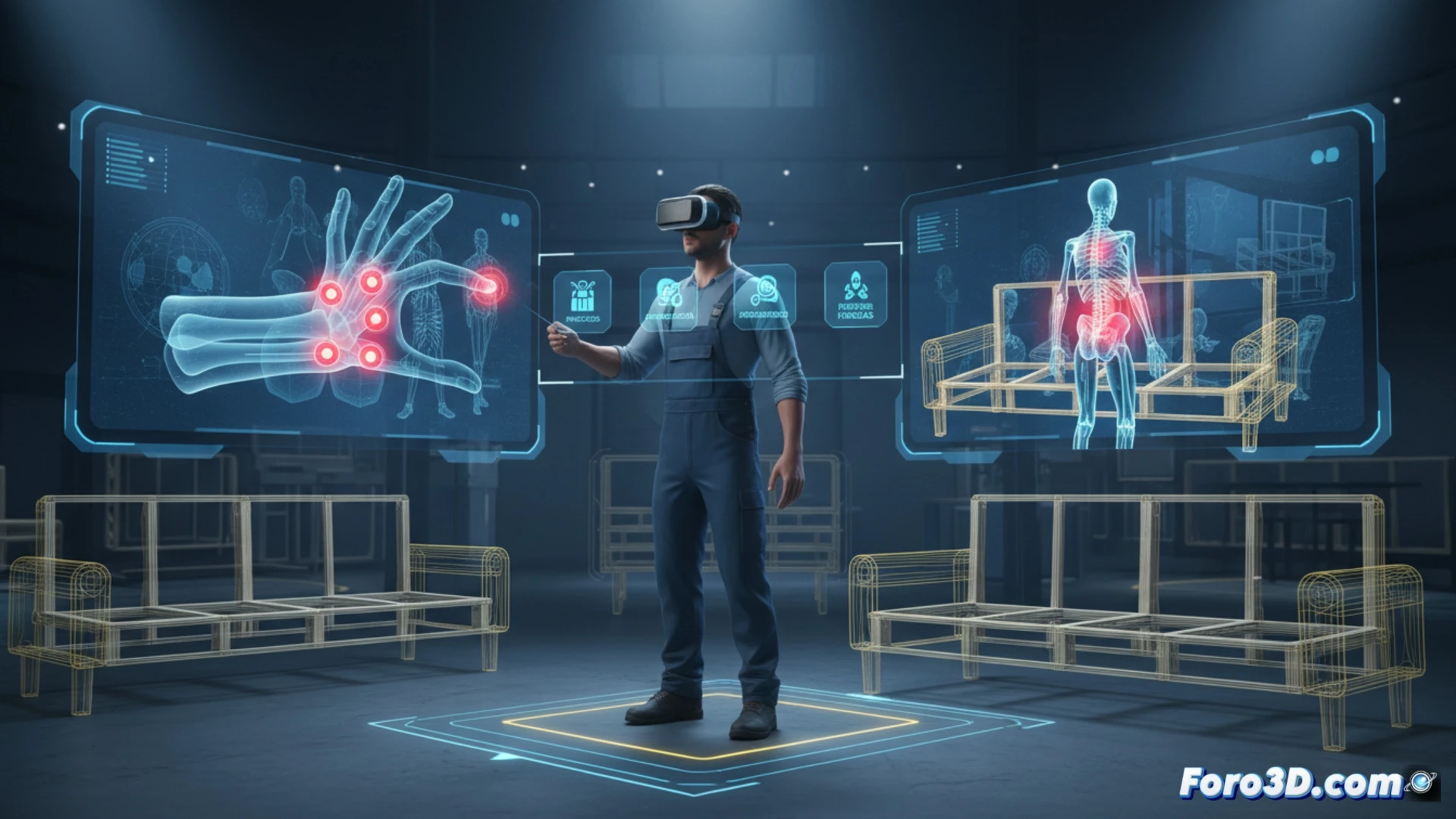
Modeling postures and tools in the virtual environment 🛠️
To create an effective simulation, the key tools of the upholsterer must be accurately modeled, such as curved needles, pruning shears, upholstery hammers, and pneumatic staplers. The next step is to integrate a digital mannequin that reproduces the most common forced postures: prolonged leaning over the frame, kneeling work to staple the base, and trunk twisting when stretching the fabric. The simulation software must allow adjusting joint angles and applied forces to calculate ergonomic risk in real time. Additionally, the 3D scene should include the particle cloud of foam dust and textile fibers, visualizing their dispersion to assess respiratory exposure.
Virtual training to reduce accident rates 🎯
Once the model is built, the simulation becomes an invaluable teaching tool. The worker can practice the safe lifting of a 40 kg sofa using an avatar, receiving visual feedback on spinal alignment. They can also learn to place their hands away from the hammer's trajectory or to use a finger guard when handling needles. By repeating these actions in an environment free from real consequences, correct muscle memory is fostered, and the incidence of cuts, punctures, and musculoskeletal injuries in the workshop is reduced.
How the biomechanics of an upholsterer's repetitive movement when hammering tacks can be modeled in 3D to predict and prevent cumulative overexertion injuries
(PS: Simulating industrial processes is like watching an ant in a maze, but more expensive.)