The trade of bell ringer, traditional and of great cultural value, hides a high-risk labor reality. Falls from heights exceeding 30 meters, exposure to noise peaks surpassing 120 decibels, and entrapment in pulley mechanisms are just some of the daily dangers. Analyzing these risks through process simulation allows for the creation of safe virtual environments for training and prevention.
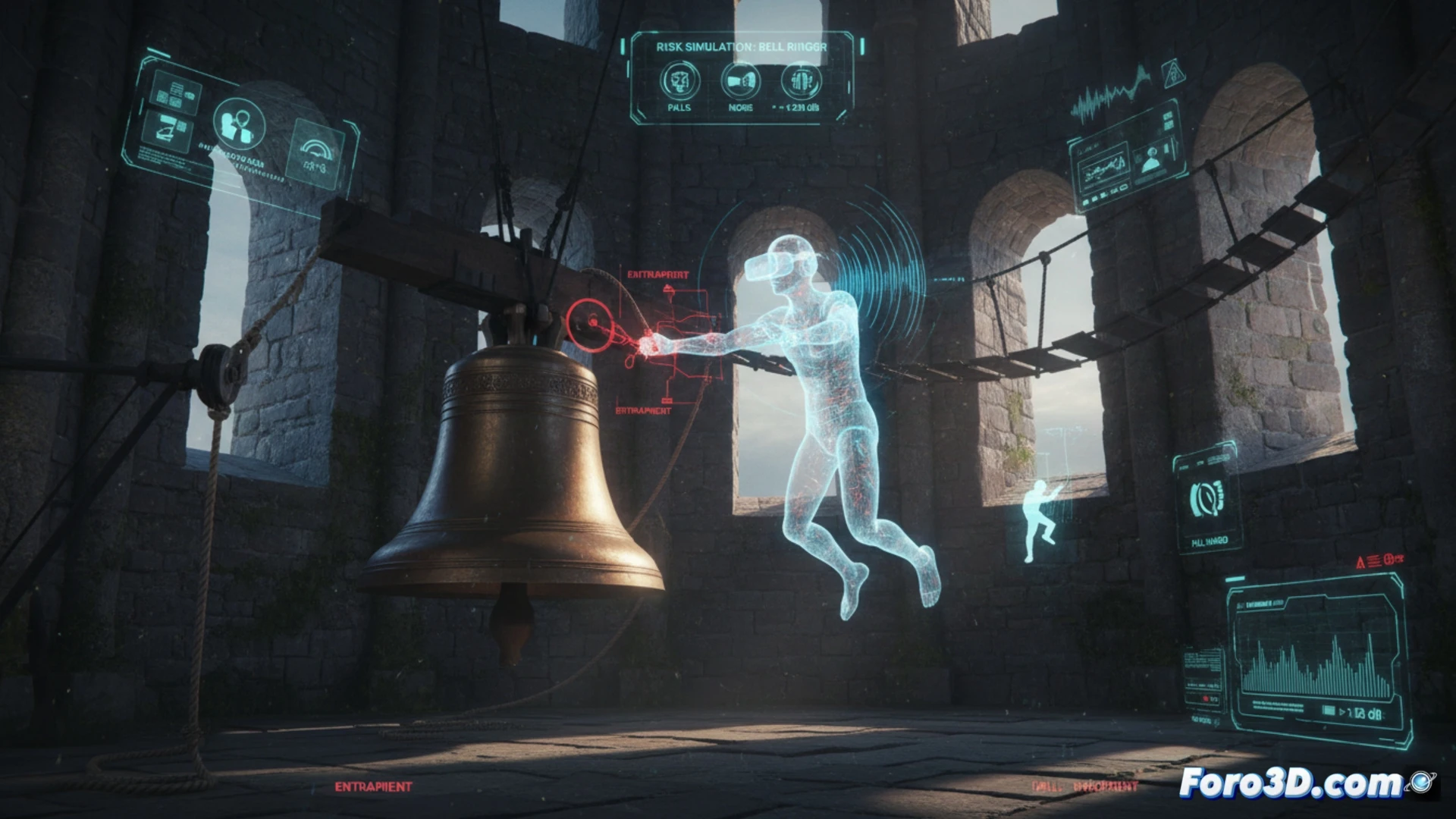
Technical Modeling of the Environment and Risk Dynamics 🔔
To develop an effective 3D simulation, it is necessary to accurately model the geometry of the bell tower, including spiral staircases, wooden beams, and the system of ropes and counterweights. The physics engine must replicate the inertia of moving bells, calculating striking trajectories and danger zones. Additionally, a spatial audio system is implemented that simulates progressive hearing loss when approaching the bells, while the first-person camera allows the user to experience the vertigo of heights and fatigue from forced postures when pulling the ropes.
Active Prevention Through Immersive Virtual Reality 🎧
This simulation tool not only documents risks but also trains the user in safety protocols. The user must virtually equip themselves with a fall arrest harness and hearing protectors before accessing the tower. If they ignore warning signs or approach a moving bell, the system activates visual and audible alerts. This experiential learning approach drastically reduces the likelihood of real accidents, transforming an ancient trade into a model of modern occupational safety.
How can a 3D simulation of occupational hazards predict and mitigate the most common accidents in the trade of bell ringer, such as falls from heights exceeding 10 meters, by integrating biomechanics variables and adverse weather conditions in immersive virtual environments?
(PS: Simulating industrial processes is like watching an ant in a maze, but more expensive.)