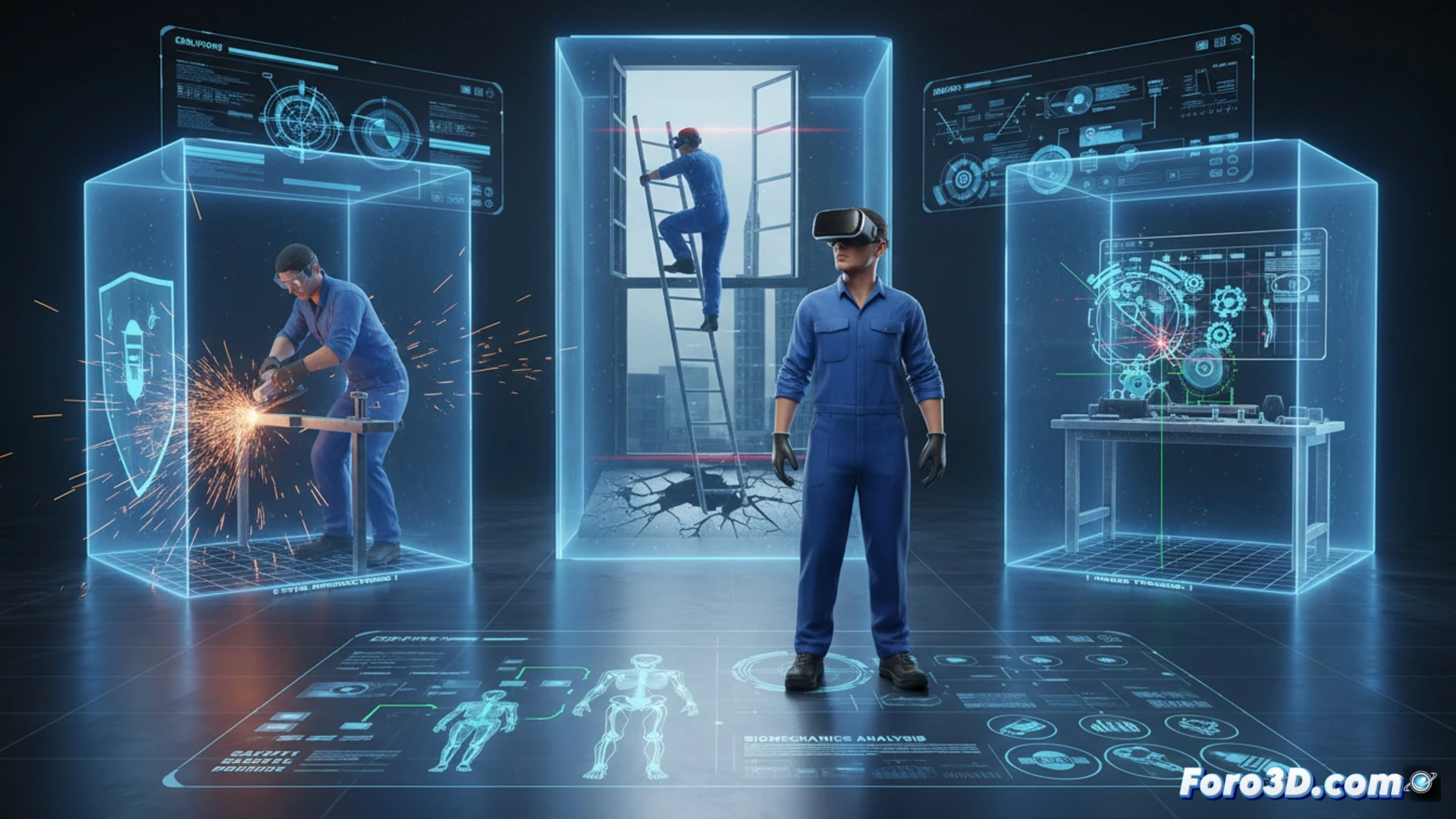
The locksmith trade combines manual precision with physical effort, exposing the worker to cuts from tools, projection of metal shavings, awkward postures, and falls from ladders. Modeling these scenarios in a 3D environment allows visualizing each hazard in isolation, analyzing the biomechanics of movements, and training safety protocols without exposing the operator to real risks.
Modeling critical processes and collision analysis 🔧
In the simulation, tasks such as cutting with an angle grinder, drilling into metal frames, and handling heavy doors are digitally recreated. The physics engine detects collisions between the tool and the workpiece, calculating chip trajectories and reaction forces. Awkward postures are evaluated using a virtual skeleton that measures joint angles, while the ladder is modeled with dynamic instability to reproduce falls. The system allows modifying variables such as the door weight or working height to observe how the risk of overexertion or tipping changes.
Interactive training for a preventive culture 🛡️
This approach transforms prevention into an immersive experience. The locksmith can repeat dangerous maneuvers in the virtual world, receiving visual alerts when adopting incorrect postures or failing to secure the ladder. By simulating the impact of a chip or a tool strike, the need for protective equipment is internalized without suffering real consequences. 3D simulation not only documents risks but also builds safety reflexes applicable in the workshop.
As a locksmith, when simulating a work scenario with an angle grinder in 3D, which physical variable, such as rotational speed or attack angle, do you consider most critical for predicting the risk of fragment projection, and how would you model it in the simulation?
(PS: Simulating industrial processes is like watching an ant in a maze, but more expensive.)