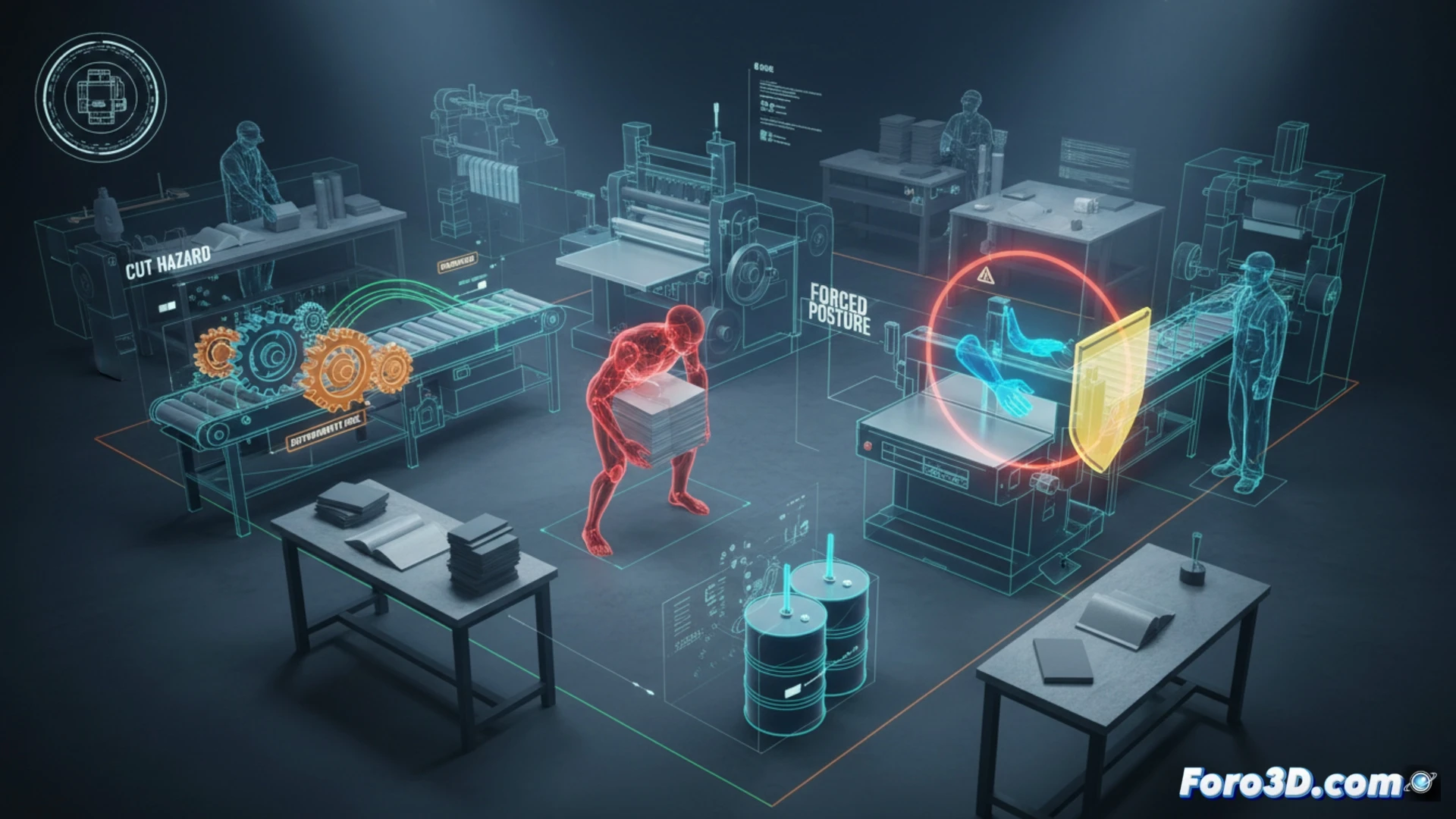
Artisanal and industrial bookbinding hides dangers ranging from guillotine cuts to entrapment in mechanical presses. Using process simulation tools, we can model a virtual workshop to identify these risk hotspots. By digitally recreating the workflow, we can analyze exposure to volatile adhesives, forced postures when handling sheets, and overexertion from stacking paper loads, all without endangering a single worker.
Modeling danger zones and workflows 🛠️
When building the digital twin of a bookbinding machine, the geometry of guillotines and blades must be prioritized. Simulation allows defining volumetric exclusion zones around the blades, triggering virtual alerts when an avatar approaches. Similarly, hydraulic presses are modeled to detect pinch points. For chemical risks, computational fluid dynamics are incorporated to simulate the dispersion of solvent vapors and high-melting-point glues, identifying the necessary ventilation. Ergonomic analysis is performed through motion capture on the avatar, measuring joint angles during the gathering and sewing process.
Virtual training and real prevention 🎯
The real value of this simulation lies not only in workshop design but also in its use as a training tool. A worker can practice the safe operation of the guillotine or the correct lifting of paper reams in an immersive environment. By making a mistake in the simulation, such as inserting a hand into the cutting zone, immediate feedback is generated with no physical consequences. This transforms occupational risk prevention into an interactive process, reducing accident rates before the worker even sets foot in the real workshop.
It is possible to accurately model in 3D the behavior of an industrial guillotine and the interaction of a worker to predict the risk of entrapment or cutting before the accident occurs.
(PS: Simulating industrial processes is like watching an ant in a maze, but more expensive.)