The oil sector is one of the most hostile work environments on the planet. Workers face daily explosions and hydrocarbon fires, exposure to toxic gases such as H2S, entrapment, falls into the sea, and extreme fatigue. We analyze how 3D simulation allows recreating these catastrophic scenarios to improve prevention and safety.
Technical modeling of catastrophe scenarios 🔥
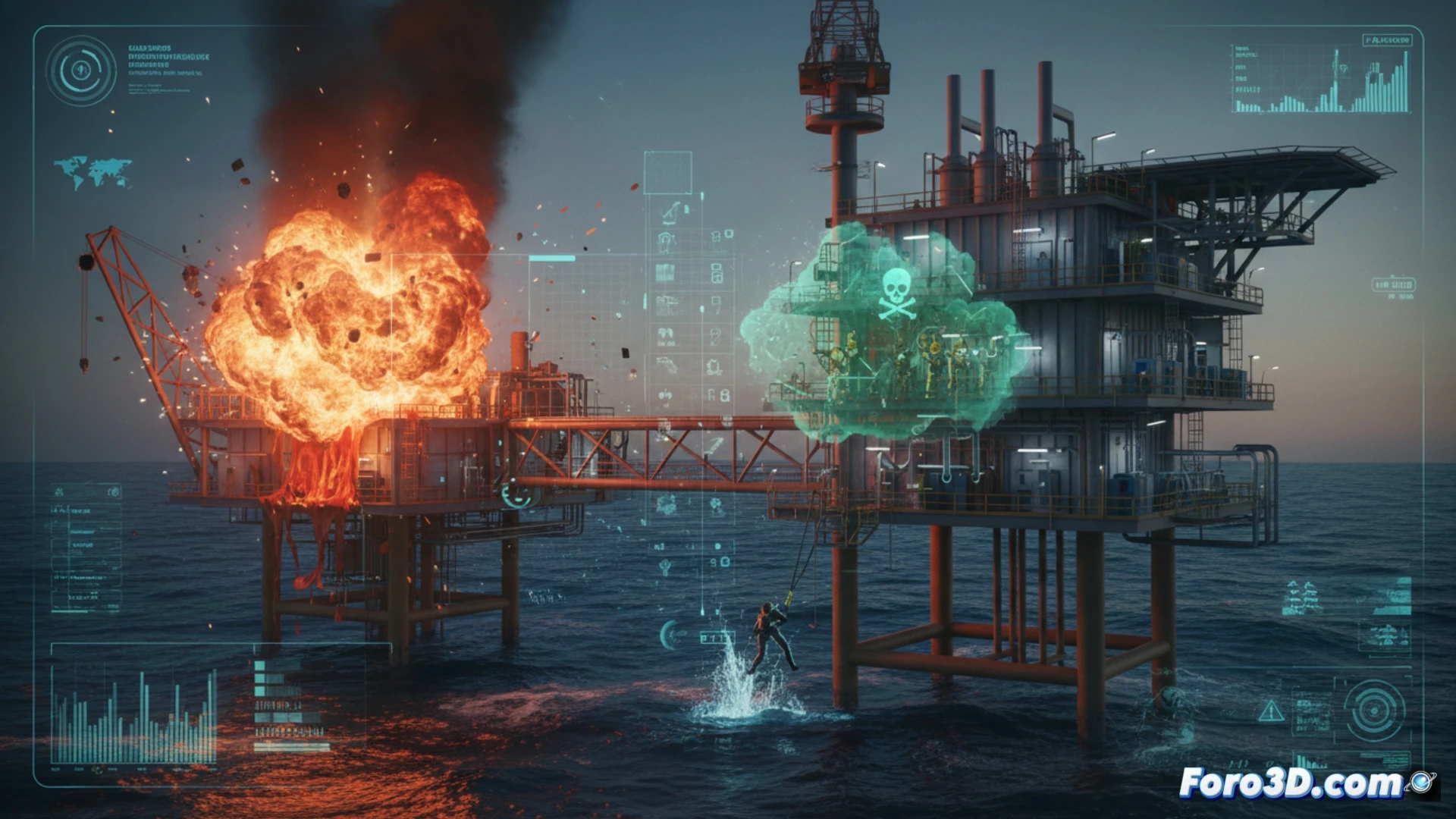
The digital recreation of an offshore platform requires precise modeling of its drilling modules, high-pressure pipelines, and crude oil storage areas. Using realistic physics engines, we can simulate an explosion due to hydrocarbon accumulation, visualizing the shockwave and fire spread. It is also possible to model the dispersion of toxic gases such as hydrogen sulfide, identifying critical evacuation zones. The simulation of falls from heights exceeding 30 meters and rescue in open waters completes an immersive training environment that reduces the real risk of drowning.
Fatigue and weather as aggravating factors 🌊
12-hour shifts in extreme weather conditions, with waves and hurricane-force winds, multiply the risk of human error. 3D simulation allows integrating variables of constant noise and visual fatigue into training scenarios. By visualizing evacuation protocols in real-time, operators learn to react to a fire or an H2S leak without being exposed to real danger. This technology not only saves lives but also optimizes emergency plans before a catastrophe occurs.
What is the most effective 3D simulation protocol for training workers in the early detection of gas leaks before an explosion occurs on an oil platform?
(PS: Simulating catastrophes is fun until the computer crashes and you are the catastrophe.)