The trade of industrial printing presents a lethal combination of physical and chemical risks that are often underestimated in safety manuals. From chronic exposure to solvents and inks to the danger of being caught in rotary presses, each workstation is a critical point. Our proposal is to transfer these scenarios to a 3D digital twin to analyze workflows, forced postures, and the handling of paper rolls weighing up to 500 kg.
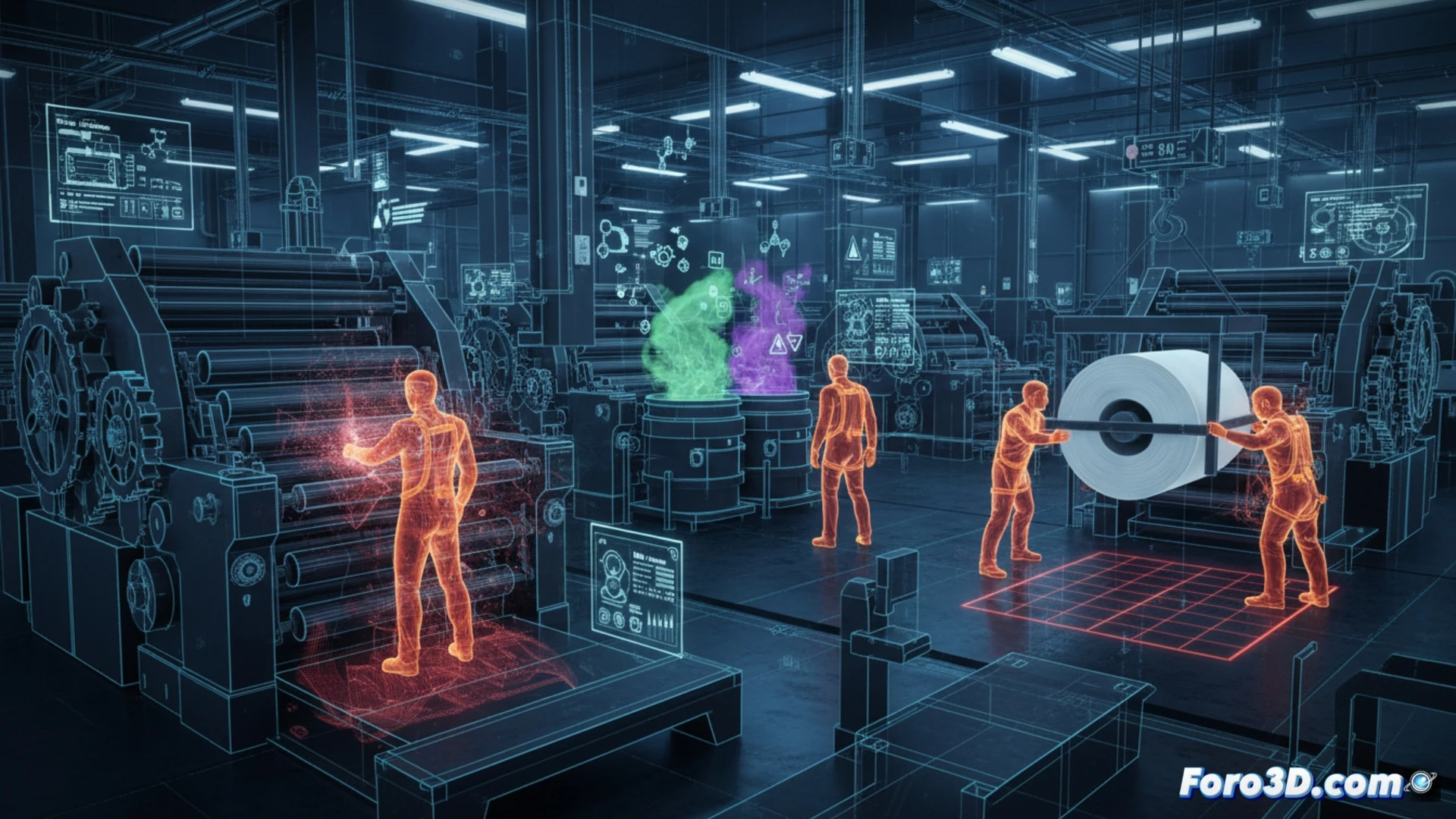
Modeling critical points and risk animation 🏭
In the simulation, three key zones have been recreated. The first is the offset press area, where the nip point between rollers is visualized using a semi-transparent warning cone. The second zone is the ink mixing booth, with an overlay of chemical particles that changes color according to the toxicity level (green to red). The third is the roll transport aisle, where an animated humanoid avatar shows the biomechanics of a lumbar strain when lifting the load, contrasting it with the correct posture using a forklift.
Data visualization for a preventive culture 🛡️
The value of this 3D model lies not only in its aesthetics, but in the ability to overlay real-time data. An HUD (Heads-Up Display) panel shows noise levels in decibels (85-95 dB) near the presses and the concentration of VOCs (Volatile Organic Compounds) in the environment. By activating inspection mode, the user can walk through the plant and see how an incorrect posture over 8 hours leads to a simulated musculoskeletal injury, turning theory into an immersive prevention experience.
How can the 3D simulation of occupational hazards in an industrial printing plant predict and mitigate exposure to volatile chemical compounds and mechanical entrapments before accidents occur?
(PS: at Foro3D we optimize routes like we optimize polygons: until the computer says enough)