The craft of pastry making, despite its artisanal nature, hides a high accident rate that often goes unnoticed. Burns from contact with ovens and hot utensils, deep cuts from blades and metal molds, and forced postures maintained for hours create a constant risk scenario. To address this issue, the process simulation niche offers a powerful tool: 3D modeling of a pastry shop's workflow to identify, visualize, and mitigate these hazards before they materialize into a real accident.
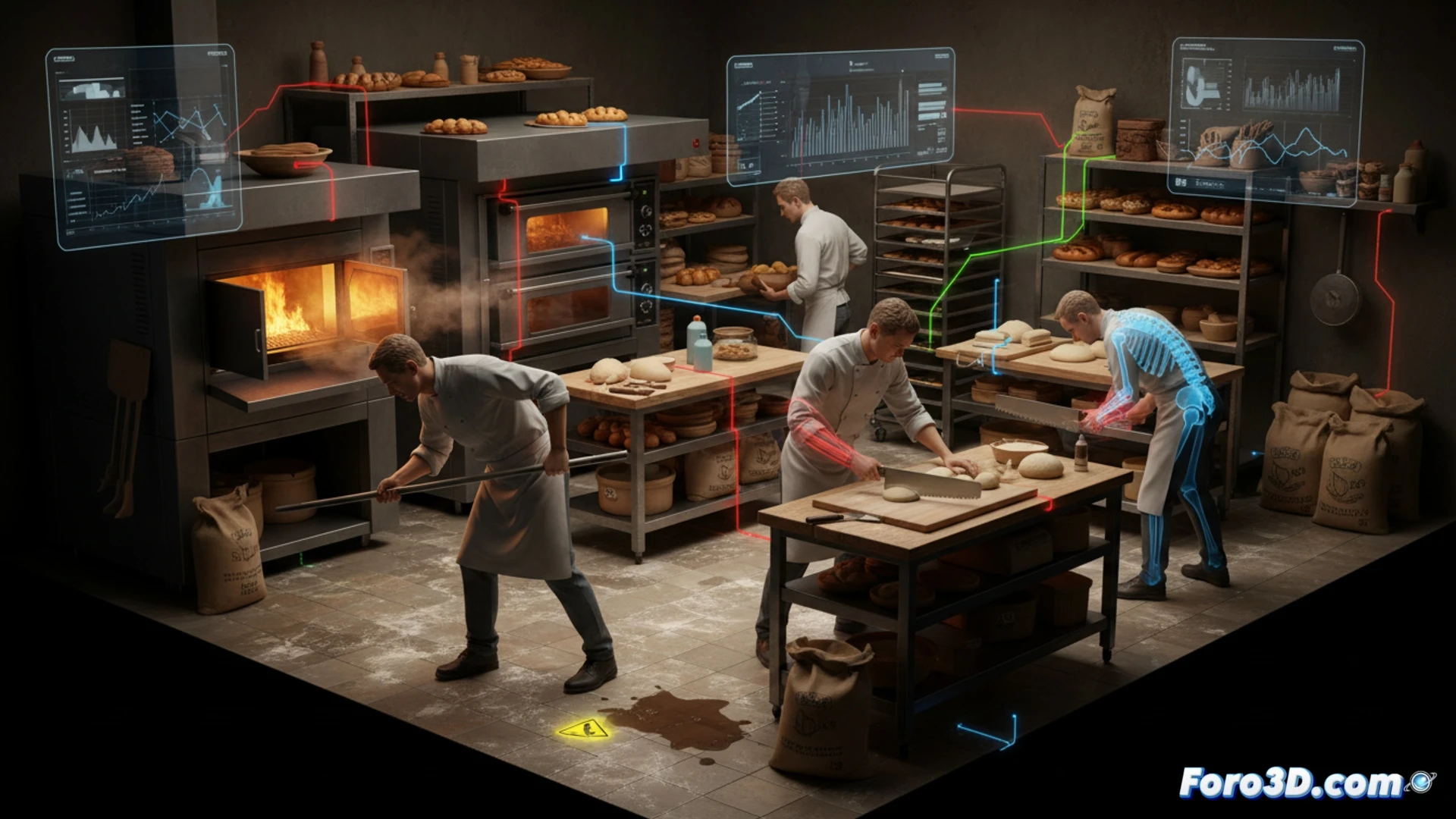
Station modeling and critical trajectory analysis 🔥
In our simulation model, we divide the workshop into three key stations: kneading and cutting area, baking area, and packaging area. The simulation captures the pastry chef's trajectory, revealing conflict points. For example, hot zones around the oven are visualized using dynamic heat maps, and knife trajectories during dough cutting are traced to identify unsafe movements. Additionally, forced postures are modeled using a biomechanical avatar that measures back and knee angles during kneading, alerting to accumulated fatigue. The slippery floor is represented with variable friction coefficients, allowing real-time fall simulations when crossing areas with cream or flour splashes.
Workshop redesign through preventive protocols 🛠️
The simulation not only identifies the problem but also proposes concrete solutions. By relocating baking trays to an ergonomic height and moving the packaging area away from the ingredient cart's path, overexertion and collisions are reduced. Including a protocol for active breaks and task rotation in the model minimizes the impact of sustained postures. Finally, by simulating the placement of anti-slip mats and signage for hot zones, the 3D model becomes an interactive safety manual, demonstrating that prevention can be designed digitally before being applied in the real workshop.
How can the flow of steam and projection of hot oil be modeled in 3D to predict burn risk zones in an artisanal pastry shop?
(PS: Simulating industrial processes is like watching an ant in a maze, but more expensive.)