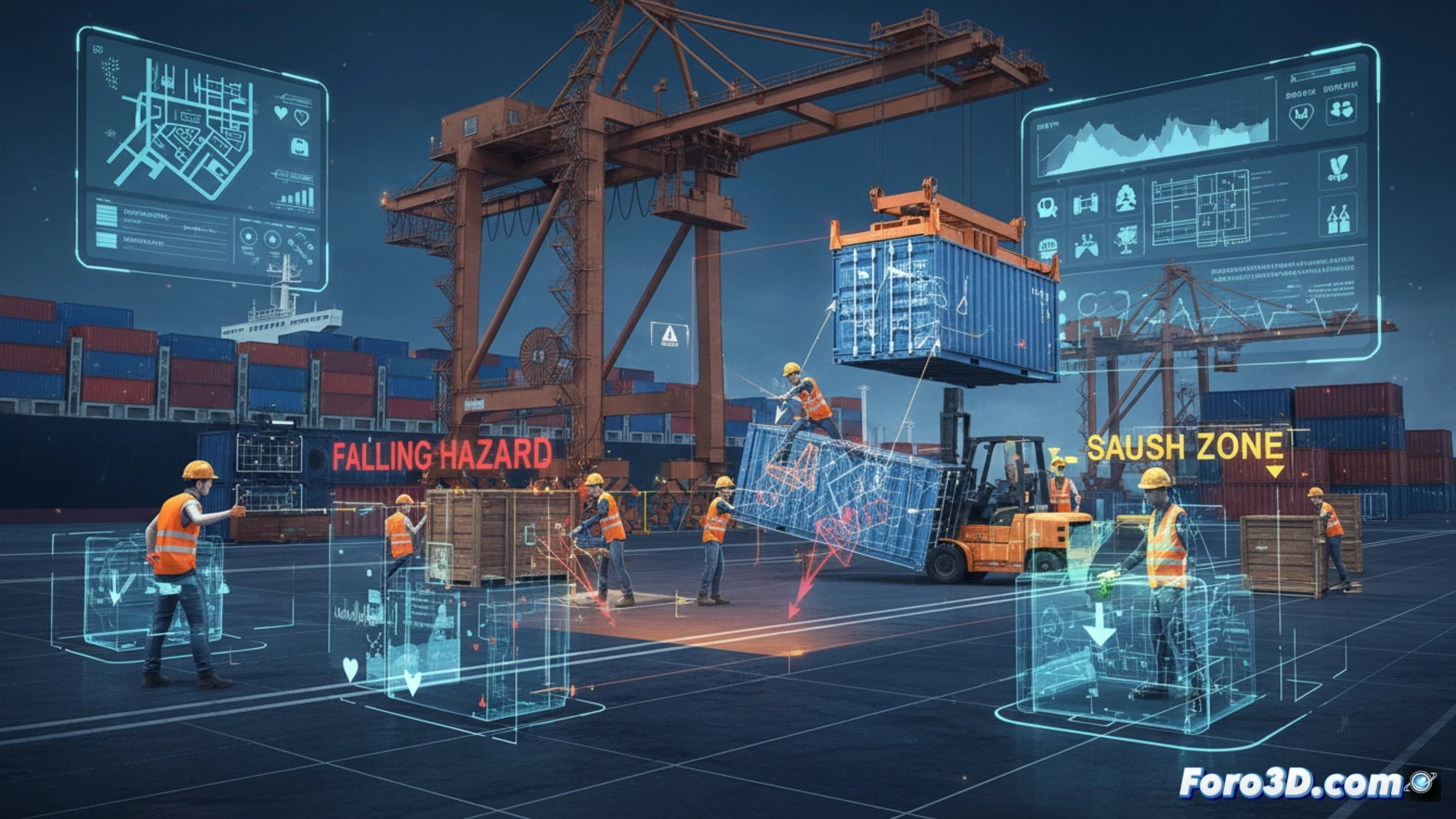
The job of a stevedore in the port environment has a high accident rate due to the handling of heavy loads and the use of industrial machinery. The main risks include falling suspended loads causing crushing, entrapment between goods, impacts with moving elements, overexertion from manual lifting, falls from height in holds, and collisions with cranes or forklifts. 3D simulation allows visualizing these scenarios to anticipate incidents.
Modeling risk scenarios with digital twins 🚢
The virtual recreation of the port using digital twins offers a precise tool to analyze the interaction between the stevedore, the suspended load, and the machinery. Gantry cranes, slings, and containers can be modeled to animate fall trajectories and pinch points. Additionally, biomechanical animations allow studying lumbar overexertion during manual handling of packages and simulating slips on wet decks. This facilitates the validation of safety protocols before implementing them in the real environment.
Towards safer port logistics with 3D visualization ⚙️
The incorporation of 3D simulations in stevedore training reduces exposure to real risks during learning. By visualizing in detail the movements of machinery and danger zones, workers internalize better postural and signaling practices. This approach, based on logistics environment data, transforms workplace safety into a preventive and measurable process, reducing accidents from falls and entrapments in daily port operations.
How can 3D simulation of occupational hazards for port stevedores predict and mitigate the most common accidents during heavy load handling and machinery use in high-accident-rate environments?
(PS: 3D bottlenecks are like traffic jams: you see them coming but can't avoid them)