The trade of lathe operator involves critical dangers such as entrapment in moving parts, projection of hot chips, and exposure to intense noise. To address this issue, process simulation allows recreating these scenarios in safe virtual environments. This article explores how to develop a digital twin of the lathe that models each risk, from tool cuts to falling heavy parts, optimizing preventive training.
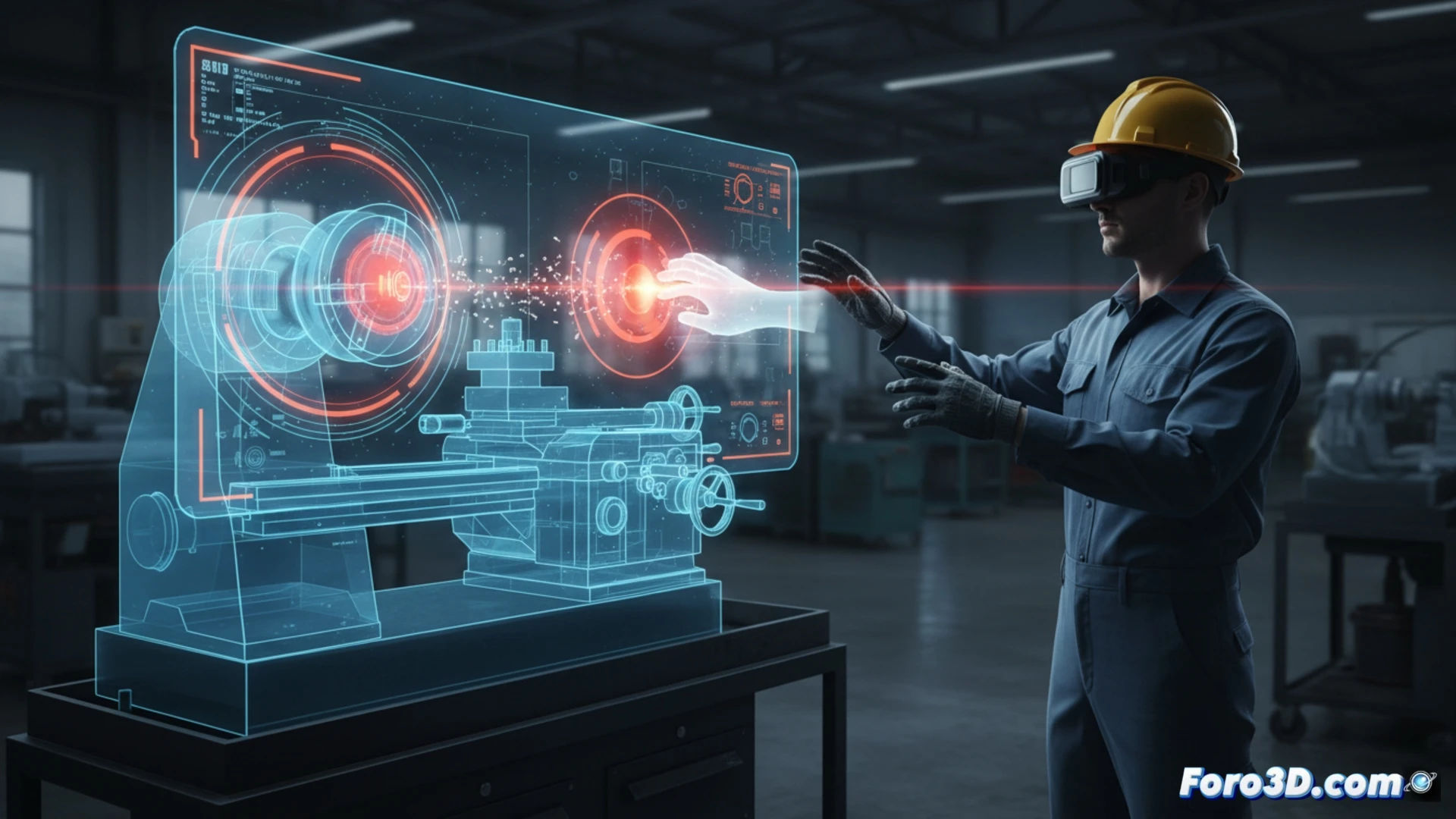
Technical modeling of the risk environment ⚙️
To create an effective simulation, the lathe must be modeled in 3D with its critical components: rotating chuck, tool carriage, and spindle. Collision animation should include trajectories of incandescent chips and projections of metal fragments, using particle physics. It is crucial to program entrapment zones with virtual sensors that trigger visual and audible alerts, replicating noise levels of up to 90 dB. Additionally, scenarios of parts falling from the bed must be integrated, with realistic weights and gravity to simulate impacts and crushing.
Prevention through digital twins 🛡️
The real value of this simulation lies in reducing actual accidents. By training operators in a virtual environment where chips fly or the lathe catches tools, safety protocols are internalized without exposing anyone to danger. The simulation allows practicing the use of eye protection, chip guards, and emergency stop systems, transforming theory into immersive experience. This approach turns the lathe operator's workstation into a digital prevention laboratory.
How the progression of a hot chip from its detachment to impact on the operator can be modeled in 3D to evaluate the effectiveness of protective screens on a lathe.
(PS: Simulating industrial processes is like watching an ant in a maze, but more expensive.)