Horse training is one of the professions with the highest accident rates due to unpredictable animals, yet it lacks data-driven prevention tools. A scientific visualization team has developed an interactive 3D model that replicates the rider's biomechanics and the horse's reactions, allowing real-time simulation of falls, kicks, and bites. The system uses real accident records to generate risk heat maps for the arena and stable, offering a visual guide for prevention.
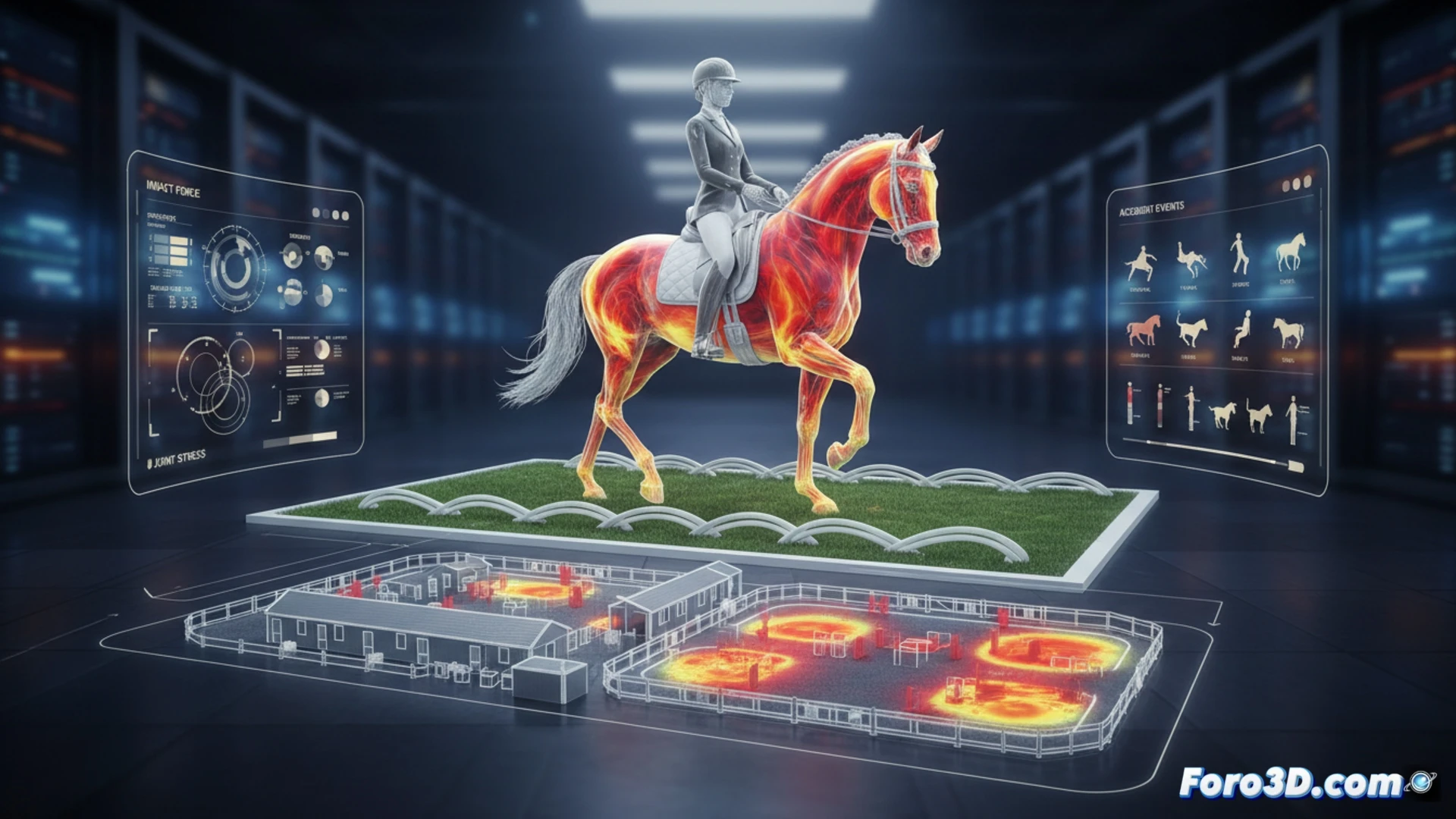
Biomechanical modeling and simulation of impact trajectories 🐴
The simulator integrates key parameters such as the horse's height, its reaction speed, and the trainer's safety distance. For falls, rigid body dynamics models are applied to calculate impact energy and the most likely fracture zones based on the rider's position. Kicks and bites are represented as force vectors with variable ranges, while the animal's stress is modeled through erratic movement patterns. Heat maps are updated in real time, highlighting high-risk areas in the stable and arena, based on documented accident frequencies.
Visual prevention for a high-risk profession 🛡️
This tool not only helps train novice trainers in safe virtual environments but also allows experts to redesign work protocols. By visualizing the biomechanical consequences of a kick or a fall from a large horse, an evidence-based prevention culture is fostered. The next step will be to incorporate data from real sensors placed on horses and riders to refine predictive models and reduce accident rates in this ancient profession.
How can a heat map generated from real-time biomechanical data predict and prevent the most common injuries in a trainer during a 3D simulation of occupational risks?
(PS: fluid physics for simulating the ocean is like the sea: unpredictable and you always run out of RAM)