The profession of a sailor has a high accident rate due to hostile environments and heavy machinery. The most common risks include falls into the water, entrapment in lines, impacts from loose objects, hypothermia, and fatigue from long watches. In the Process Simulation niche, it is possible to recreate these scenarios in a 3D digital twin to train the crew without exposing them to real danger.
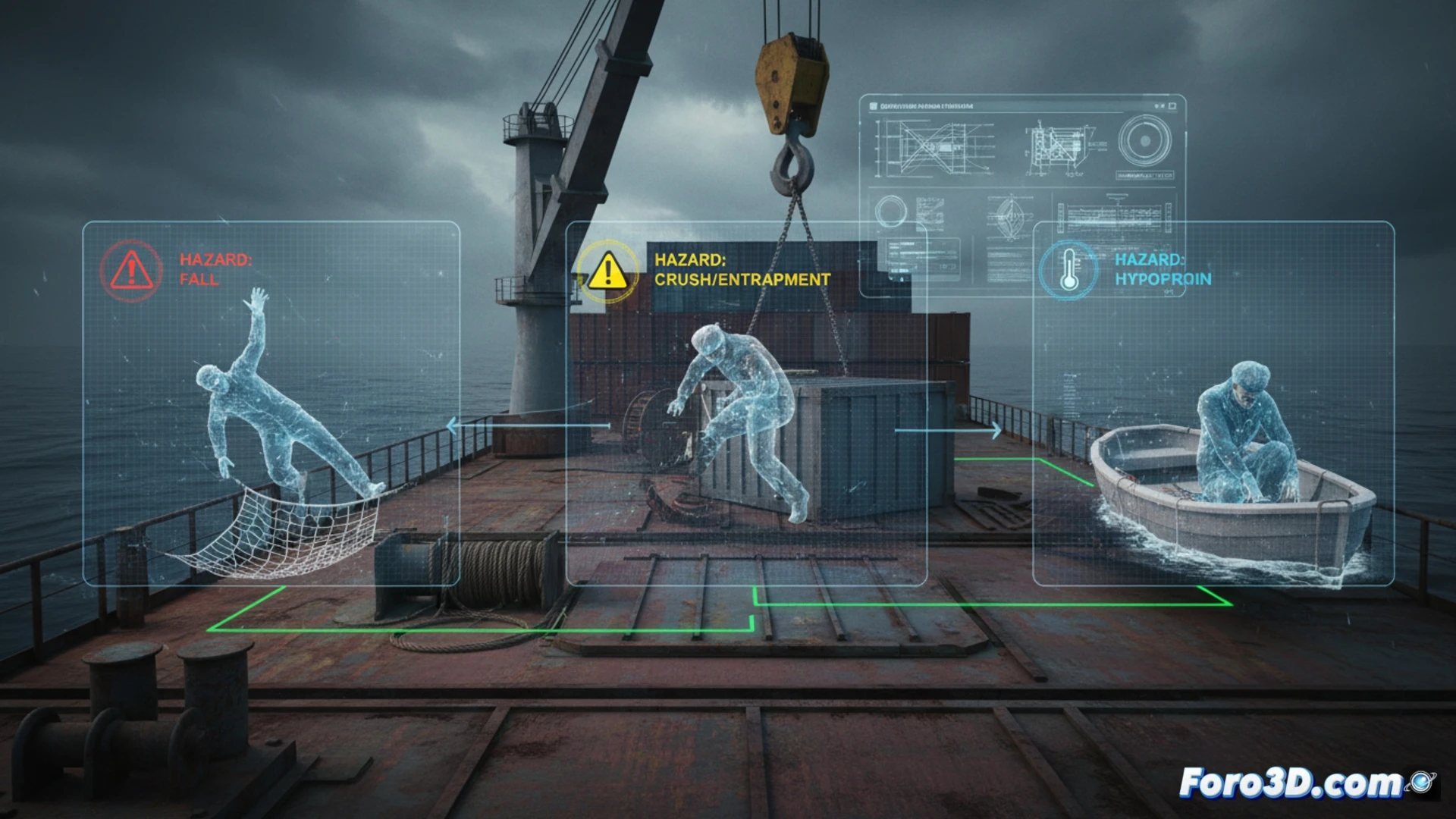
Modeling the environment and critical events in Unity 3D ⚙️
To develop the simulation, a ship deck must be modeled with high physical fidelity, including tensioned lines, windlasses, companionway ladders, and masts. The physics engine must simulate the ship's roll to generate unstable conditions. Random events are programmed, such as a line breaking (entrapment) or a wave strike (fall into the water). The fatigue system is implemented through a HUD that measures watch time, reducing the user's visual acuity if they do not rest. Exposure to noise and vibrations is simulated with auditory effects and camera shakes, forcing the user to use virtual protective gear.
Prevention through immersive virtual reality 🎧
The real value of this simulation lies in the safe repetition of emergency situations. A sailor can practice rescuing a colleague who has fallen overboard or the procedure to free someone trapped in a capstan, all in a VR environment that replicates fatigue and hypothermia through time limits and visual fog. This allows shipping companies to certify safety protocols without putting lives at risk, reducing real accidents at sea.
How can 3D simulation improve safety training for sailors to anticipate and mitigate the most critical risks on deck, such as falls or entrapment in heavy machinery?
(PS: Simulating industrial processes is like watching an ant in a maze, but more expensive.)