Industrial charcuterie concentrates mechanical, biological, and environmental hazards that turn every task into a safety challenge. Cuts from blades and stuffing machines, entrapment in mixers, falls on greasy floors, and exposure to sub-zero temperatures in cold rooms are just a few of the critical risks. Modeling this environment in 3D allows you to visualize the workflow and anticipate accidents without exposing real workers.
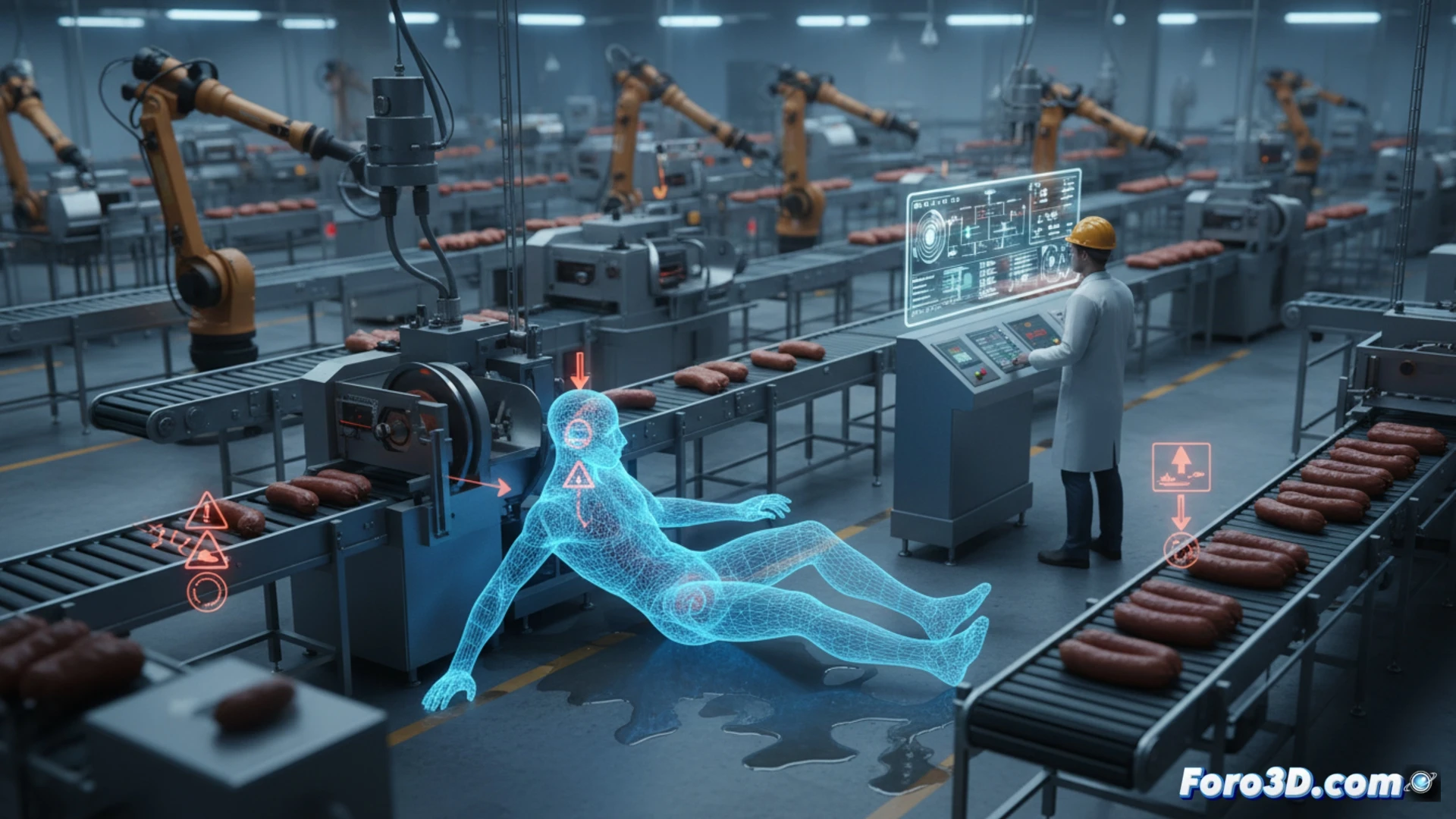
Modeling critical points and accident dynamics 🛠️
To simulate the charcuterie worker's station, we start with a cutting room scenario featuring stainless steel surfaces and floors with a greasy texture. The 3D mesh must include a piston stuffer with an open feed zone, a cold meat slicer with an unprotected circular blade, and a cold storage room with an automatic closing door. We assign physical properties: a reduced friction coefficient on floors (0.3) to replicate slips, and precise collisions on the stuffer's gears to simulate entrapments. Animating an avatar performing repetitive loading and unloading movements allows us to detect awkward postures and lower back overexertion. We incorporate a particle system to represent biological aerosols when handling raw meat, and a thermal gradient showing the loss of manual dexterity after 10 minutes in a chamber at -18 degrees Celsius.
Towards an immersive prevention culture 🧊
3D simulation not only documents the risk but turns it into a training experience. By virtually touring the charcuterie, the operator identifies blind spots on the stuffer, learns to step on anti-slip mats, and practices locking blades before changing them. This approach reduces the gap between regulatory theory and daily practice. Modeling the hazard is the first step to deactivating it.
How can 3D process simulation predict and mitigate the biological risk of cross-contamination in a cooked meat product packaging line?
(PS: Simulating industrial processes is like watching an ant in a maze, but more expensive.)