The trade of a plasterer combines artisanal precision with constant exposure to physical and environmental hazards. Each workday involves handling fine dust, working at height on scaffolding, adopting forced postures for hours, and managing sharp tools. Analyzing these risks in a real environment is complex and dangerous. Therefore, process simulation emerges as the ideal tool to model each variable, from particle dispersion to the biomechanics of movement, allowing for detailed study without endangering workers.
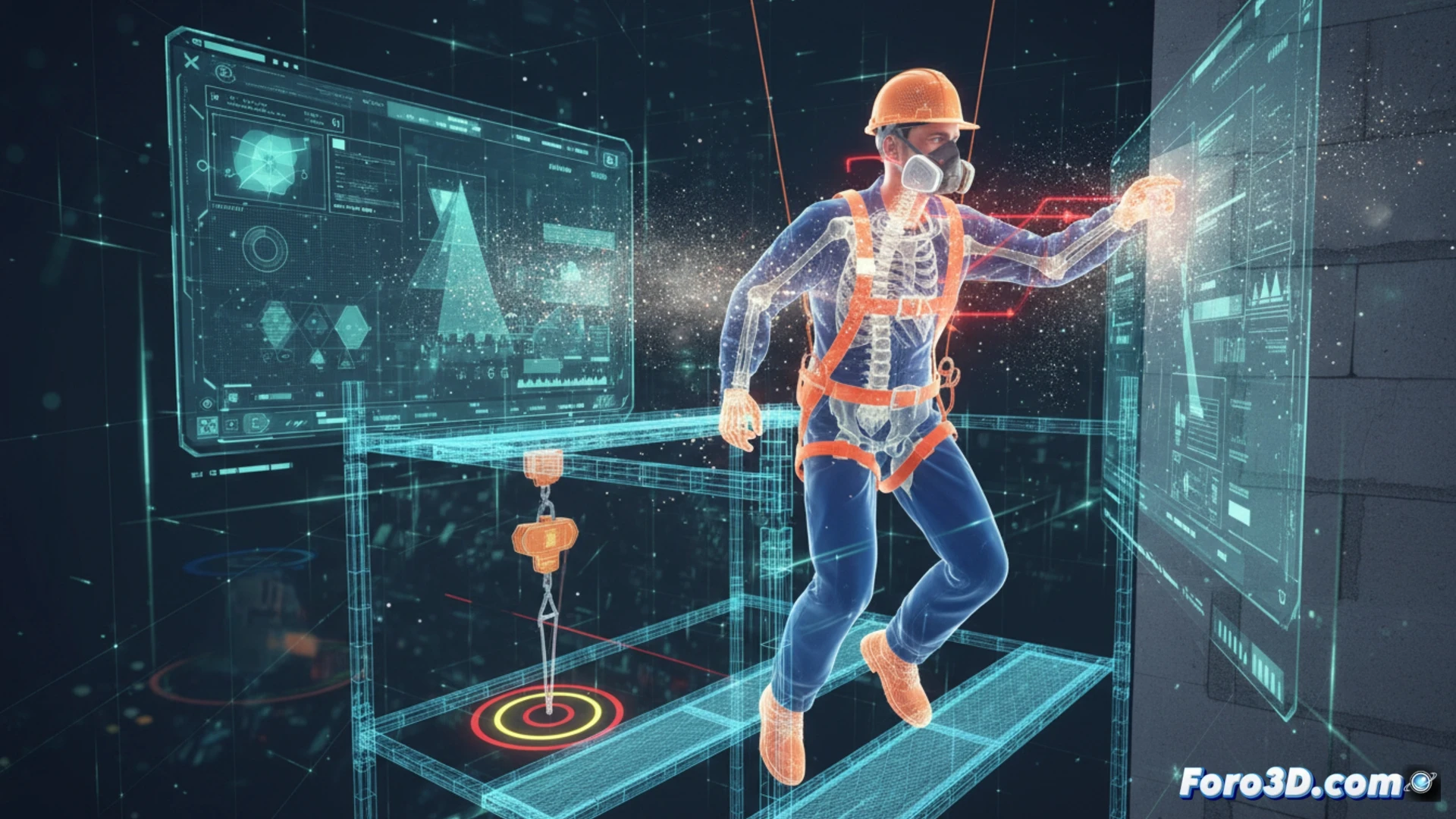
Technical Modeling of Hazards and Physical Variables in the Virtual Environment 🛠️
To build a realistic 3D simulation, it is necessary to integrate several technical modules. First, a particle system that emulates the dispersion of plaster dust, calculating its concentration in the avatar's respiratory area based on wind direction and the type of mixture. Second, a physics engine that evaluates scaffolding stability and the probability of a fall based on the worker's center of gravity and load. Third, an analysis of forced postures using a virtual skeleton that measures joint angles in the shoulders and lumbar spine, flagging deviations that exceed ergonomic thresholds. Finally, a collision system to detect cuts from spatulas or knives, activating visual alerts in the interface. This model allows running hundreds of iterations of the same task to identify the moments of greatest risk.
Redesigning Protocols: From Observation to Active Prevention 🔍
The real value of this simulation lies not only in visualizing danger but in allowing experimentation with solutions. A virtual plasterer can test different scaffolding heights, work rhythms, or mixing techniques to minimize dust dispersion. The system records metrics such as time in a critical posture or fall distance, offering concrete data to redesign procedures. Thus, training ceases to be theoretical and becomes an interactive laboratory where every mistake is a lesson without physical consequences, transforming workplace safety into an optimizable and measurable process.
How can a 3D occupational hazard simulator anticipate and mitigate the specific dangers of a plasterer on site, such as exposure to plaster dust or falls from scaffolding, without replacing practical experience at the construction site?
(PS: Simulating industrial processes is like watching an ant in a maze, but more expensive.)