The job of a bellhop in hotels and luggage logistics presents occupational risks that go beyond the obvious. Overexertion when handling heavy suitcases, forced postures, falls on stairs, and stress from fast service are critical factors. In the environment of industrial 3D production, we can model these scenarios to visualize the load on the spine and propose concrete ergonomic solutions, reducing the incidence of musculoskeletal disorders.
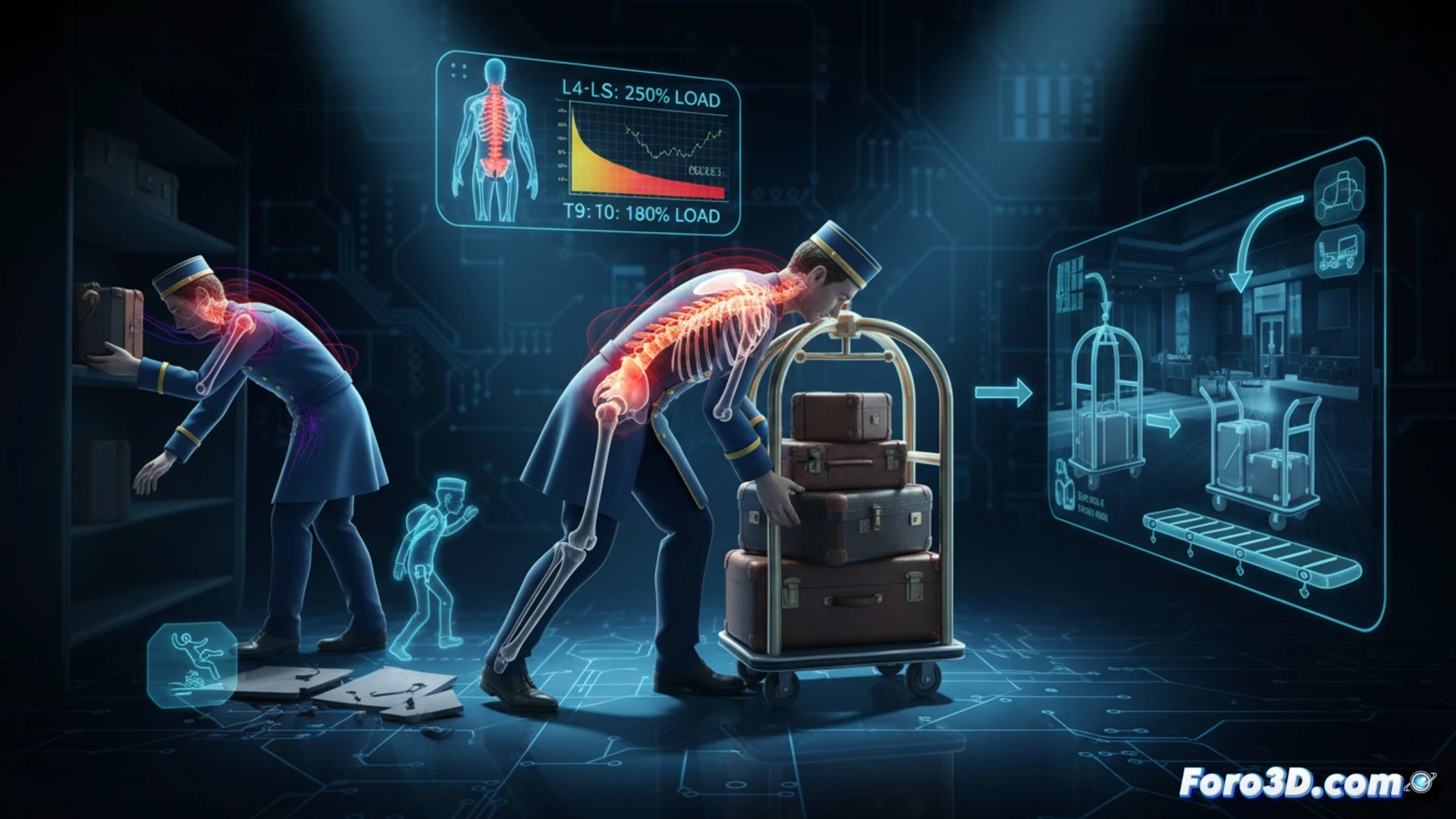
Visualization of loads and forced postures with biomechanical modeling 🏋️
Using 3D simulation software, it is possible to recreate the complete work cycle of a bellhop. The travel paths between the counter and the room are modeled, identifying critical points such as sharp turns on stairs or slippery floors. The animation of the spine allows comparing a correct posture (knees bent, back straight) against an incorrect one (excessive lumbar flexion), quantifying the pressure on the intervertebral discs. This analysis reveals that lifting a 20 kg suitcase with improper technique multiplies the lumbar load by five, a key piece of data for designing prevention protocols.
Optimization of the logistics flow to reduce stress and aggression 🚀
Beyond biomechanics, 3D simulation allows redesigning workflows to mitigate stress from fast service. By modeling waiting times and travel routes, bottlenecks can be identified that force the bellhop to run or perform dangerous maneuvers. Implementing virtual changes such as rest landings on stairs or luggage transfer zones reduces fatigue and minimizes the risk of occasional aggression by avoiding forced interactions in tight spaces. Industrial 3D ergonomics thus becomes an occupational health tool.
How can 3D simulation predict and mitigate the risks of overexertion injuries in the job of a bellhop, considering variables such as luggage weight, movement frequency, and worker posture?
(PS: bottlenecks in 3D are like traffic jams: you see them coming but you can't avoid them)