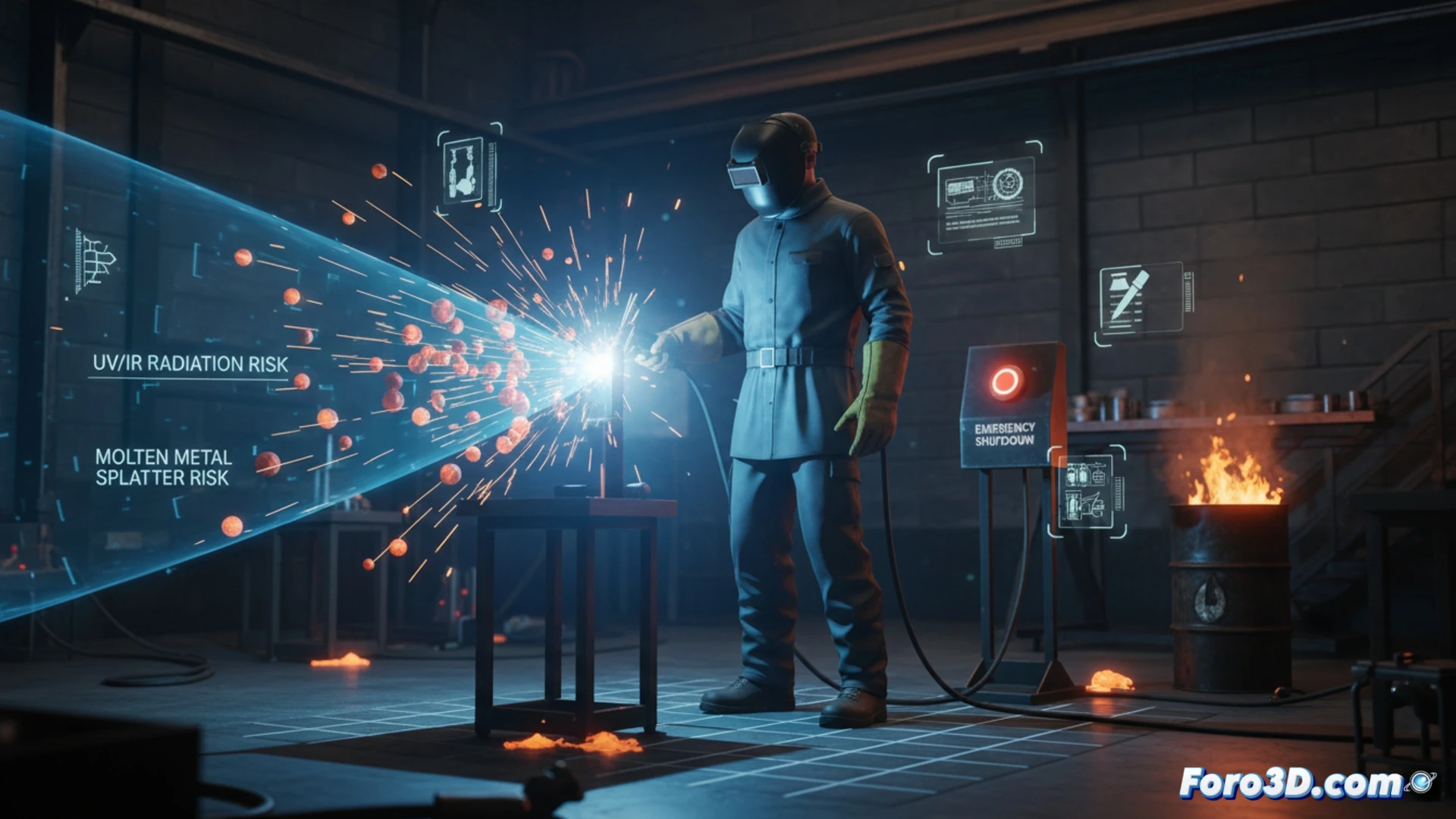
Welding is one of the industrial trades with the highest occupational risk burden, from arc flash burns to inhalation of toxic metal fumes. In the Process Simulation niche, we propose an interactive 3D model that replicates the welder's workstation, allowing visualization of hazards such as UV/IR radiation, molten metal splashes, and fire sources, all without exposing the user to the real environment.
Hazard modeling and virtual environment 🔥
The simulation is built on a digital twin of the workshop, where each risk is represented with visual and auditory indicators. The welding arc emits a pulsating glow that marks the hazardous radiation zone, while animated particles simulate the dispersion of manganese and chromium fumes. Molten metal splashes are modeled as ballistic trajectories that impact nearby surfaces, and noise is integrated as an acoustic heat map. The user navigates the space in first person, activating safety protocols: placing a helmet with an auto-darkening filter, localized fume extraction, and using fireproof screens. Each incorrect action generates a text alert and a penalty in the exercise score.
Prevention without real risks 🛡️
This approach transforms occupational safety training, eliminating the paradox of learning to weld while being in danger. By failing in the simulation, the worker learns from their mistakes without physical consequences, internalizing the correct sequence of protections. Integration of OSHA and UNE-EN regulatory data allows the model to be updated with new risks, such as exposure to nanoparticles. The result is immersive training that reduces real accidents and prepares the operator for an environment where prevention is as critical as technical skill.
How can 3D simulation of welding risks improve retention of safety procedures among novice operators compared to traditional training methods?
(PS: Simulating industrial processes is like watching an ant in a maze, but more expensive.)