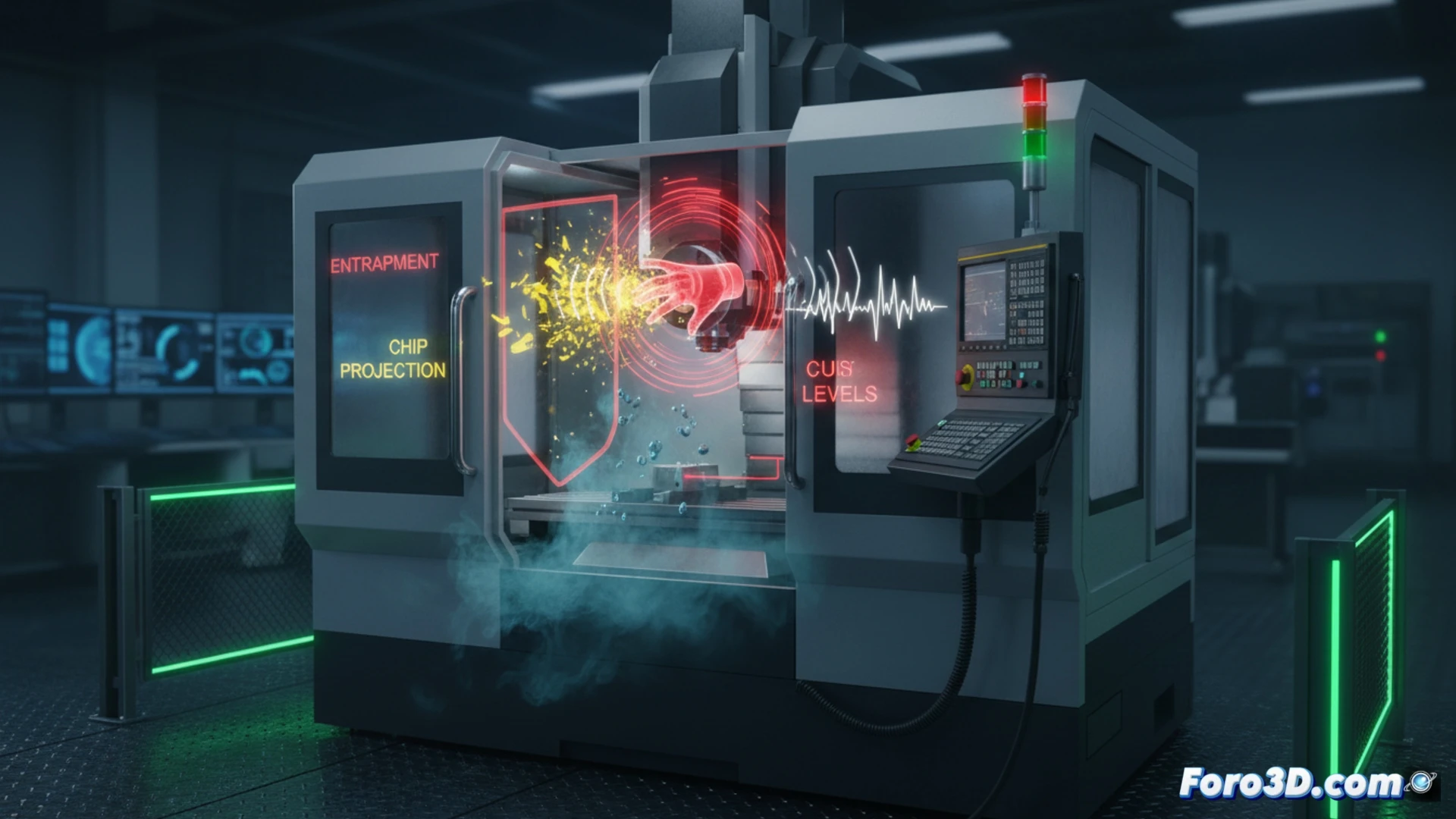
The milling profession presents critical hazards that, if poorly managed, can lead to serious accidents. Entrapment by the rotating tool, projection of hot chips, cuts from sharp edges, exposure to oil mists, and noise exceeding 85 dB are just some of the documented risks. Added to this are overexertion from handling heavy parts and falls due to floors soaked with coolant. Analyzing these points through 3D simulation allows visualizing each threat before it occurs.
Risk modeling and safe workflows in a 3D environment 🛡️
For an effective technical representation, the CNC milling machine must be modeled with geometric detail, including the spindle, the sliding table, and the flood cooling system. Risk points are marked with semi-transparent red spheres: one on the spindle to indicate the entrapment zone, another on the cutting area for chip projection, and a third on the floor for slippery surfaces. The simulation of safe protocols includes the lockout/tagout (LOTO) sequence for tool change, the activation of transparent anti-spark screens, and the operator's evacuation route. PPE, such as safety glasses, hearing protectors, and non-slip footwear, are integrated as interchangeable 3D assets for interactive training.
3D visualization as a tool for preventive culture 🎯
Beyond complying with regulations, 3D simulation transforms workplace safety into a tangible process. An operator can virtually walk through the milling station, identify the machine's blind spots, and practice responding to a chip projection without being exposed to real danger. This methodology not only reduces accident rates but also optimizes the layout of the industrial plant by validating safety distances and workflows before physical installation. In a sector where every detail counts, prevention modeled in 3D is the most profitable investment.
How can 3D simulation of milling risks anticipate and prevent entrapment by rotating tools in industrial production environments?
(PS: simulating an industrial plant is like playing The Sims, but without pools to remove the ladder)