Accident prevention in professional kitchens is a constant challenge, especially for assistants who face risks such as cuts, burns, and falls. Process simulation using 3D environments allows these hazards to be recreated safely and in a controlled manner. This article explores how to digitally model an industrial kitchen to anticipate accidents, optimize ergonomics, and train staff in the early identification of risk situations, reducing workplace accidents. 🍳
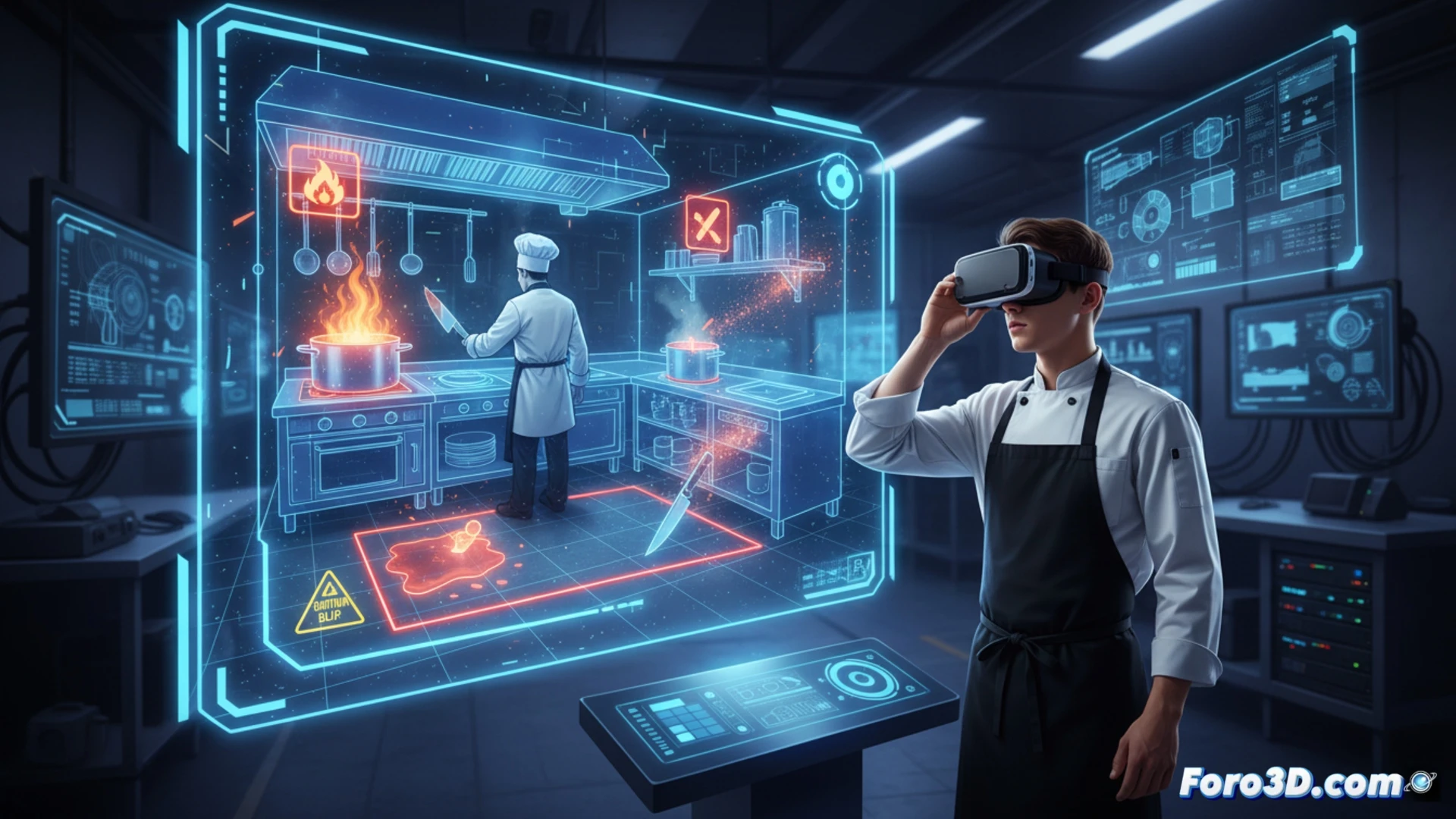
Modeling risk scenarios and ergonomic avatars 🧑🍳
To simulate the specific risks of a kitchen assistant, interactive 3D scenarios must be built that include hot surfaces, slippery floors, and cutting areas. It is possible to program realistic physics so that a knife or peeler generates a visual alert when approaching the avatar's hand. Repetitive movements and forced postures when washing heavy pots can be analyzed using ergonomic avatars that measure joint angles and applied forces. Additionally, semi-transparent danger zones can be designed around fryers and ovens, activating notifications when the virtual user gets too close, thus forming an immersive, data-driven training system.
Proactive prevention through real-time visual alerts ⚠️
The key to this simulation is not just to reproduce the accident, but to prevent it. By integrating virtual sensors that detect oil splashes or water spills, the system can generate instant visual alerts on the user interface. This trains the assistant to react before damage occurs. The simulation turns prevention theory into a practical and repeatable experience, where every virtual mistake becomes a lesson with no real consequences, improving the safety culture in the hospitality sector.
Is it possible to faithfully replicate the behavior of hot oils, slippery surfaces, and knives in a 3D simulation so that a kitchen assistant develops safety reflexes without real risks?
(PS: Simulating industrial processes is like watching an ant in a maze, but more expensive.)