Occupational safety regulations require technology and electrical installation companies to rigorously control the risks of electrocution, arc flash, and falls from height. However, traditional training does not always replicate the severity of a real accident. This is where 3D visualization and modeling of hazardous environments become key tools for digital compliance, allowing the simulation of regulatory risk scenarios without exposing workers.
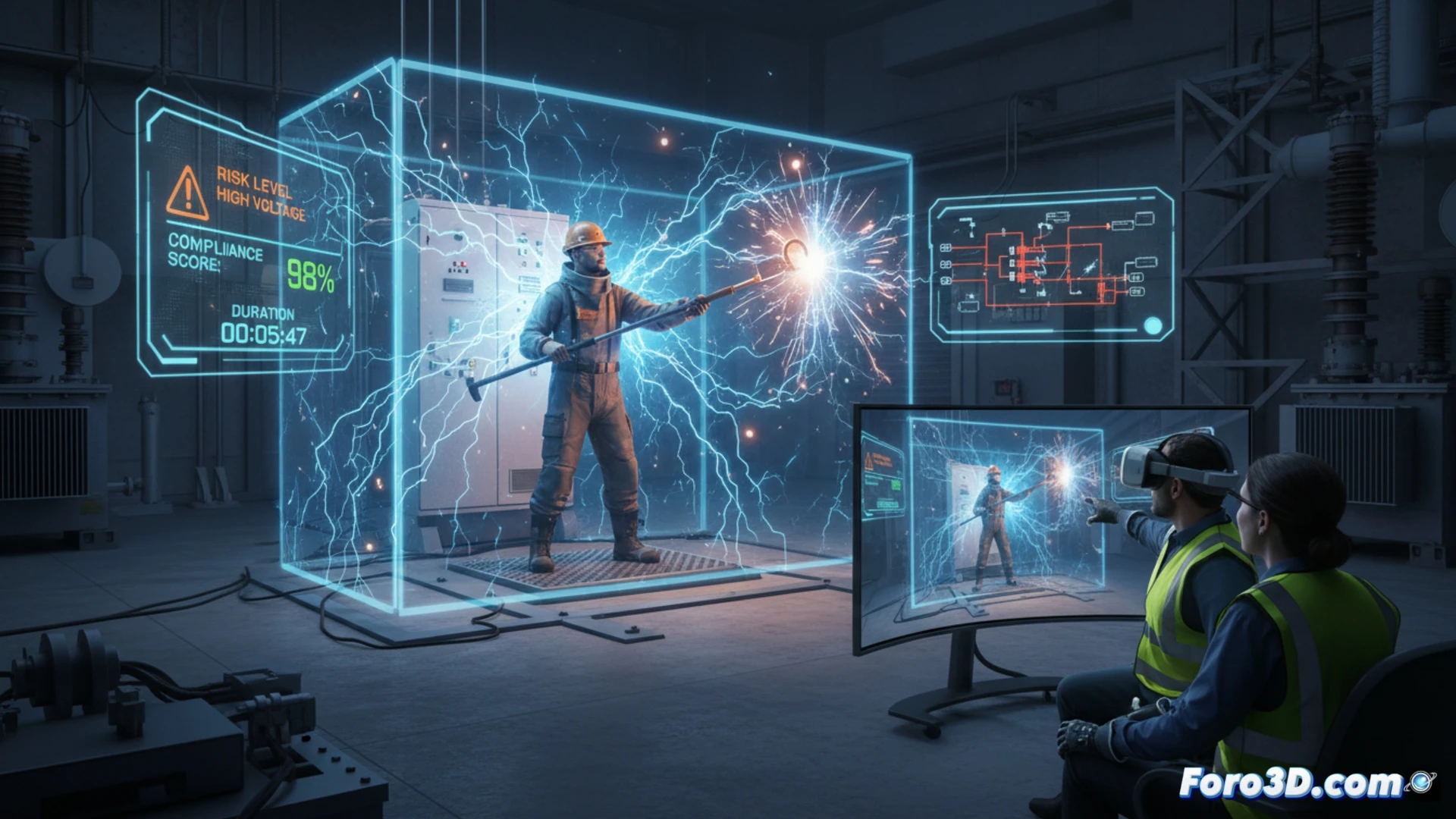
3D modeling of electrocution and arc flash scenarios ⚡
Using simulation software, it is possible to accurately recreate the conditions of an energized electrical panel, including the projection of an arc flash at 20,000 degrees Celsius. Volumetric modeling allows visualizing perimeter safety zones (approach distances) and the effects of current on a digital mannequin. Additionally, lockout/tagout (LOTO) protocols can be integrated into 3D environments, where the electrician virtually interacts with insulated tools, verifying compliance with NFPA 70E or Spanish Royal Decree 614/2001 before executing the actual maneuver.
Fall prevention and regulatory compliance at height 🪜
Falls from ladders or scaffolding represent the second leading cause of mortality in the trade. Virtual reality applied to compliance allows for digital auditing of the correct installation of lifelines, harnesses, and anchor points. By simulating a sloped roof or an electrical pole, the system can detect violations in real time, such as a poorly adjusted harness or a ladder with an incorrect angle. This technology not only trains the operator but also generates a verifiable record for occupational risk prevention audits.
How can 3D simulation of electrical risks be integrated into labor compliance protocols to ensure effective training and reduce accident rates in technological environments?
(PS: verification systems are like print supports: if they fail, everything collapses)