Dirty thunderstorms, or volcanic lightning, are one of nature's most spectacular and least understood phenomena. They occur when friction between ash particles, rock fragments, and ice crystals within an eruption column generates a massive separation of electrical charges. This process unleashes lightning bolts wrapped in black smoke and lava, which can now be analyzed using state-of-the-art scientific visualization software.
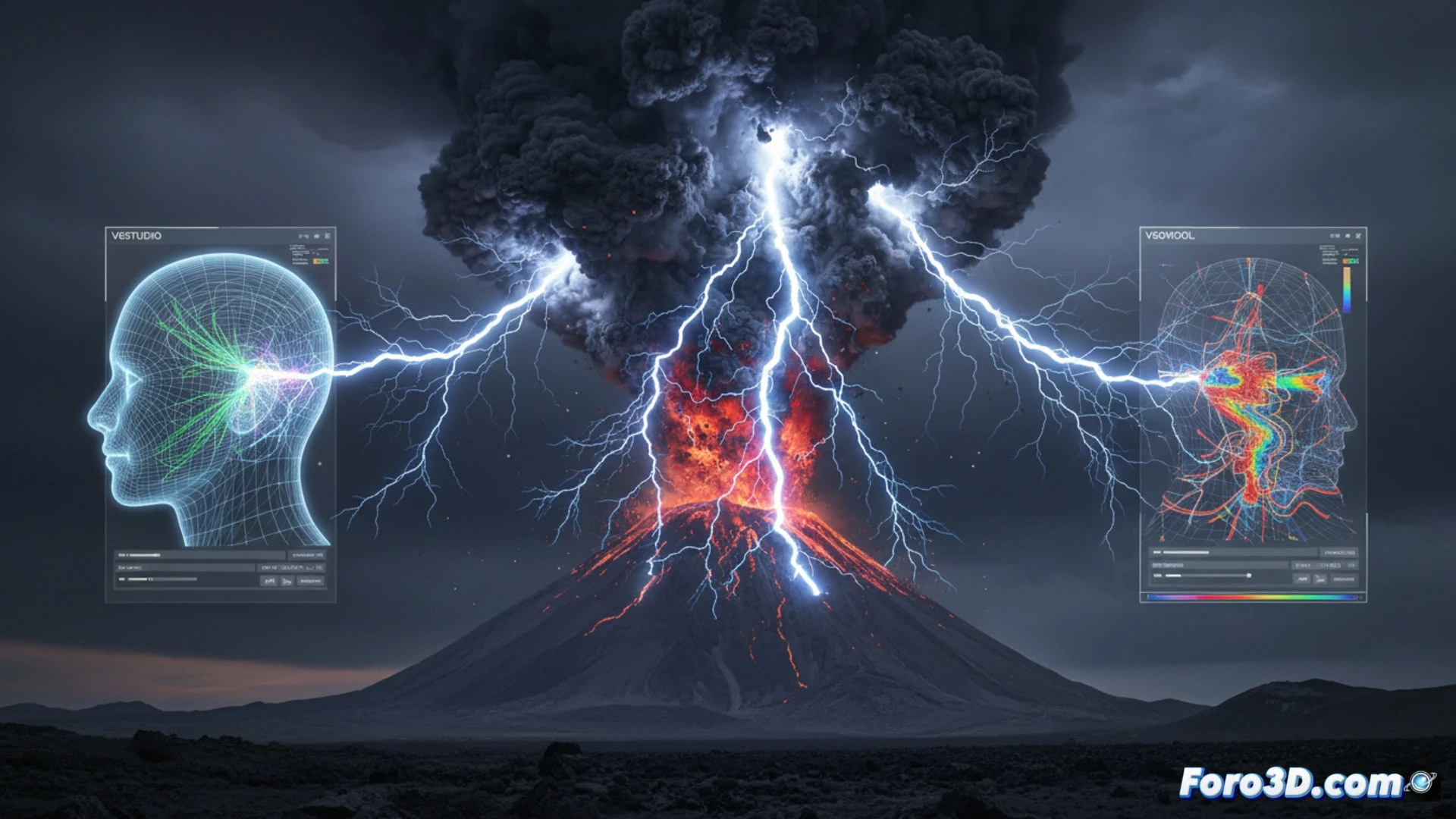
Technical workflow: Tomography, segmentation, and multiphysics ⚡
Analyzing this phenomenon requires a multidisciplinary workflow. First, computed tomography data from ash columns is used, processed in Volume Graphics VGSTUDIO MAX to generate high-fidelity volumetric models. Subsequently, Materialise Mimics allows for segmenting the different material phases (solid particles, ice, and void), creating a precise 3D mesh. Finally, this geometry is exported to COMSOL Multiphysics, where the bio-electromagnetism of the system is simulated, modeling the dielectric friction between particles and the formation of plasma channels that lead to electrical discharges.
Applications in volcanology and risk prediction 🌋
Understanding the charge dynamics within a volcanic plume is crucial for modern volcanology. These simulations allow correlating the intensity of electrical activity with the volume of expelled ash, offering a remote method for estimating the hazard level of an eruption. Far from being just a visual spectacle, 3D modeling of these black lightning bolts opens the door to early warning systems based on electromagnetic data, thus protecting aviation and communities near the volcano.
What technical limitations does the integration of COMSOL electromagnetic data with VGSTUDIO volumetric reconstruction present for modeling the dynamics of discharges in a dirty thunderstorm?
(PS: Modeling manta rays is easy; the hard part is making them not look like floating plastic bags)