The trade of a tile setter shares many similarities with that of a floor layer in terms of exposure to physical hazards. Tasks involve cutting with tiles and electric cutters, forced postures maintained while kneeling or squatting, manual handling of heavy loads, and constant exposure to dust and adhesive pastes. These factors make this occupational profile an ideal candidate for analysis through 3D process simulation.
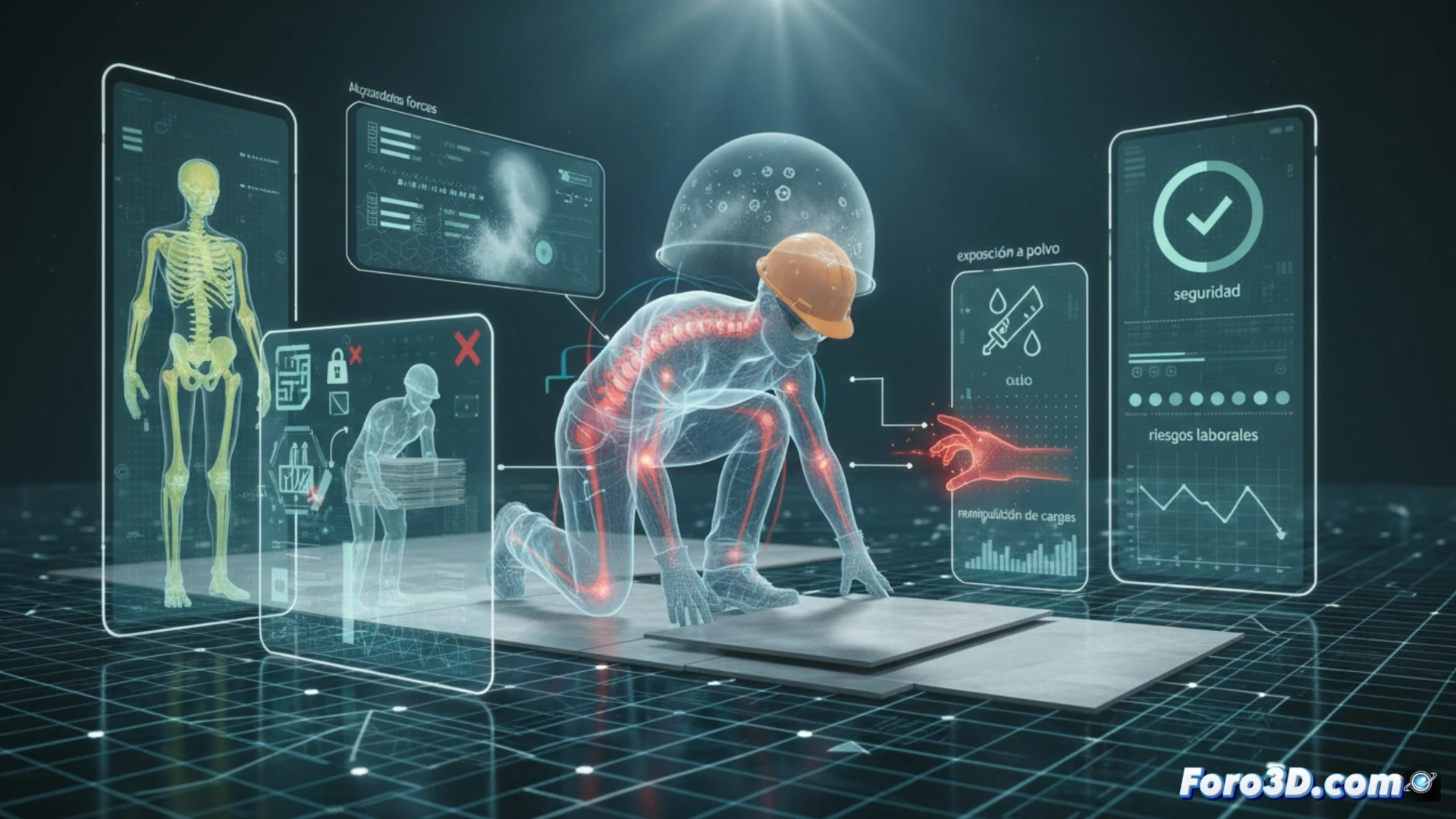
Virtual task modeling: cutting, lifting, and forced posture 🛠️
3D process simulation allows for digitally recreating the complete workflow of the tile setter. We can model the worker's interaction with the tile cutter to analyze cutting trajectories and laceration risk. It is also possible to evaluate the biomechanics of kneeling or squatting postures during setting, calculating joint pressure on the knees and lumbar spine. By including anthropometric data, the simulation identifies the exact moments where muscle fatigue becomes critical, allowing for redesigning the work cycle to include breaks or posture changes.
Virtual training: safety without real exposure 🎮
One of the most valuable advantages of this approach is the ability to train operators in an immersive virtual environment. New tile setters can practice the safe handling of the electric cutter or the correct lifting of loads without suffering a real accident. The simulation allows for repeating high-risk scenarios, such as cutting pieces on unstable surfaces, until the worker internalizes the safety protocol, drastically reducing accident rates on site.
How the risk of slipping during the installation of ceramic pieces on wet surfaces can be modeled in 3D to train tile setters in accident prevention.
(PS: Simulating industrial processes is like watching an ant in a maze, but more expensive.)