An agricultural plantation reports systematic damage to its crops due to chemical contamination. The main hypothesis points to microplastics dispersed in the technical irrigation system, either due to filter failure or external sabotage. To solve the case, a technical workflow is implemented that digitally reconstructs the movement of these particles, allowing the identification of obstruction points and anomalous deviations in the pipes.
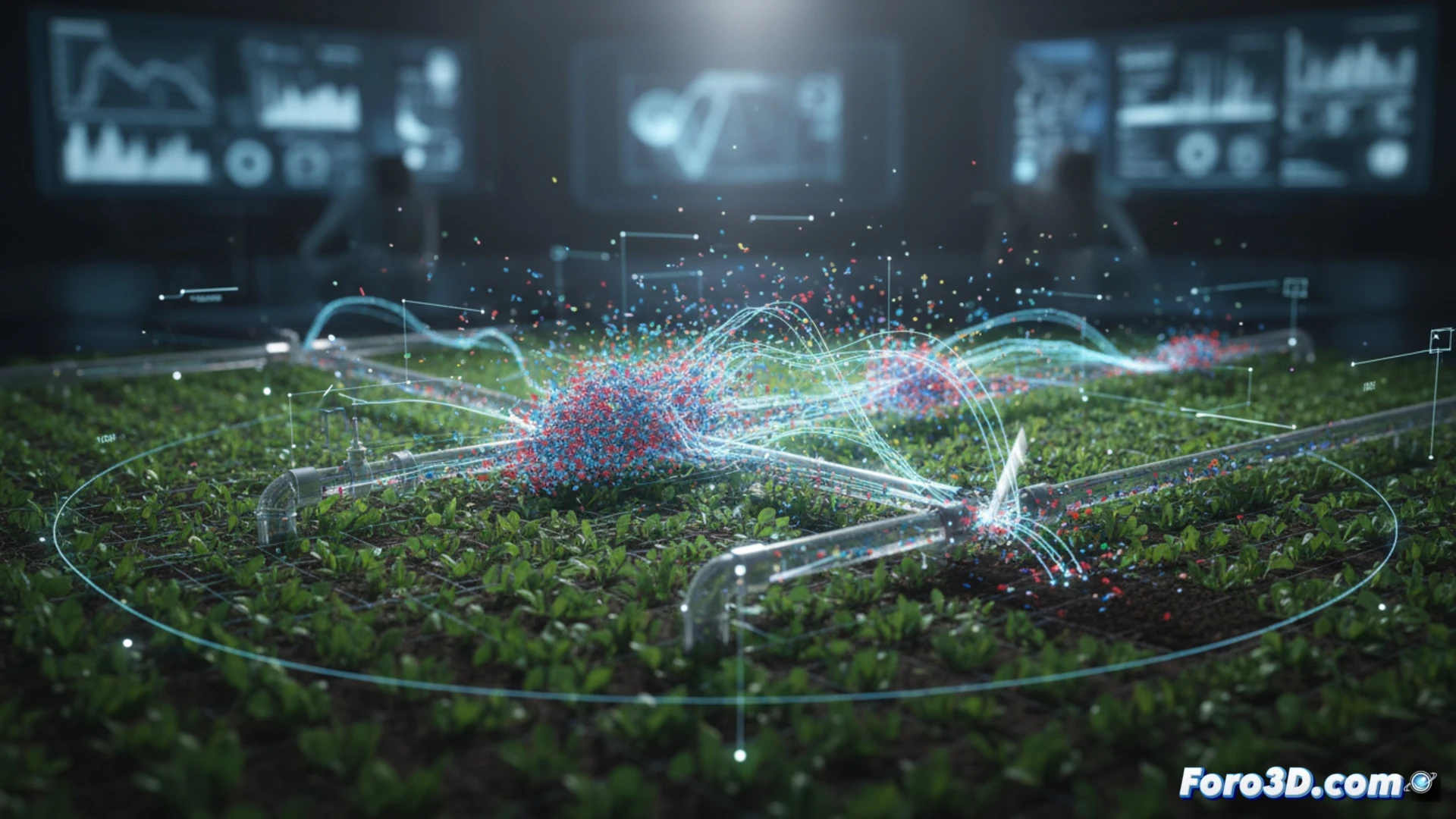
Workflow in OpenFOAM and MeshLab for Virtual Trajectories 🛠️
The process begins with the digitization of the irrigation system geometry through 3D scanning or CAD plans, which are imported into OpenFOAM to generate the computational mesh. The properties of the fluid (water) and the microplastic particles (density, size, and irregular shape) are defined. The Lagrangian simulation resolves the individual trajectories of each particle, considering turbulence and drag forces. The results are exported as point and vector files to MeshLab, where the virtual paths are visualized. The trajectories are colored according to speed or concentration, facilitating the detection of areas where particles accumulate or deviate unexpectedly.
Forensic Analysis with ImageJ to Identify Failures or Sabotage 🔍
The virtual trajectories are processed in ImageJ using its 3D analysis module. Threshold filters are applied to isolate particles that do not follow the expected laminar flow. By overlaying the simulated paths onto the original system design, anomalous deviations are identified that indicate partial obstructions in filters or the presence of an unauthorized external injection point. This method allows distinguishing between a technical failure (gradual accumulation) and sabotage (sudden and localized dispersion pattern), providing quantitative evidence for the investigation.
Is it possible to model in real time the behavior of microplastics in drip irrigation systems to distinguish between accidental contamination and intentional sabotage?
(PS: Simulating trajectories is like playing billiards, but without having to clean the table afterwards.)