Mistpouffers, or Barisal Guns, are a global acoustic phenomenon that generates booming sounds similar to cannon shots near large bodies of water, from Belgium to Japan. With no seismic or human origin, these events challenge conventional physics. Scientific visualization allows us to approach this enigma using 3D modeling and multiphysics simulation tools, offering visual hypotheses about the propagation of sonic waves in complex coastal environments.
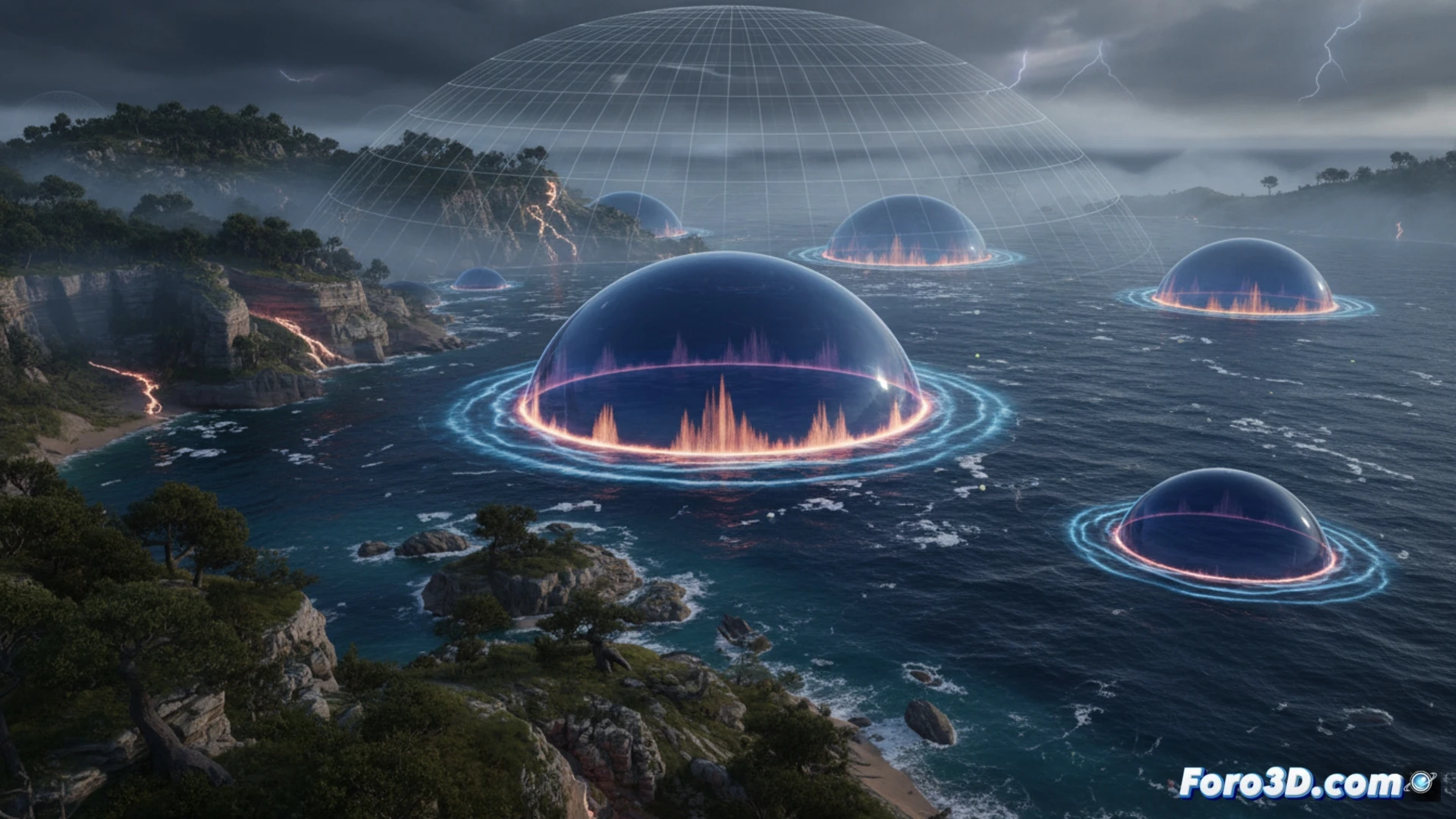
Modeling sonic waves with COMSOL Multiphysics 🌊
COMSOL Multiphysics, in its bio-electromagnetism and acoustics module, allows recreating the propagation of pressure waves in air and water. By simulating specific geographic conditions, such as the topography of the Ganges Delta in India or the coasts of Belgium, it is possible to model how the reflection and refraction of infrasonic waves, generated by micro-earthquakes or atmospheric electrical discharges, are amplified. The software calculates attenuation and interference patterns, visualizing how a distant sound can be heard as a localized burst. In parallel, Volume Graphics VGSTUDIO MAX is used to analyze volumetric data from geological scanners, ruling out seismic or anthropogenic sources by inspecting microfractures in the marine subsoil. Materialise Mimics complements the analysis by segmenting coastal tomography images, identifying cavities or natural conduits that could act as resonance chambers.
Visual hypothesis for a global phenomenon 🔍
The convergence of these tools allows presenting a solid visual hypothesis: Mistpouffers could originate from the sudden release of methane gas trapped in submarine sediments, or from shock waves generated in distant thunderstorms. 3D modeling not only educates but also guides researchers toward new field measurement routes. By simulating the phenomenon, we transform an inexplicable rumble into visualizable data, bringing science closer to the public and validating the power of technical visualization to solve natural mysteries.
Would you use photogrammetry of real specimens or modeling based on studies?