The divertor of an experimental fusion reactor is the component responsible for extracting extreme heat from the plasma, but it suffers from accelerated wear known as ablation. Tungsten, the material chosen for its high melting point, erodes under the bombardment of energetic particles. This phenomenon not only reduces the component's lifespan but also threatens the integrity of the reactor vessel if perforations occur. To prevent this catastrophic failure, engineers rely on 3D mapping of the divertor surface, combining modeling and simulation tools that allow visualizing and predicting wear patterns.
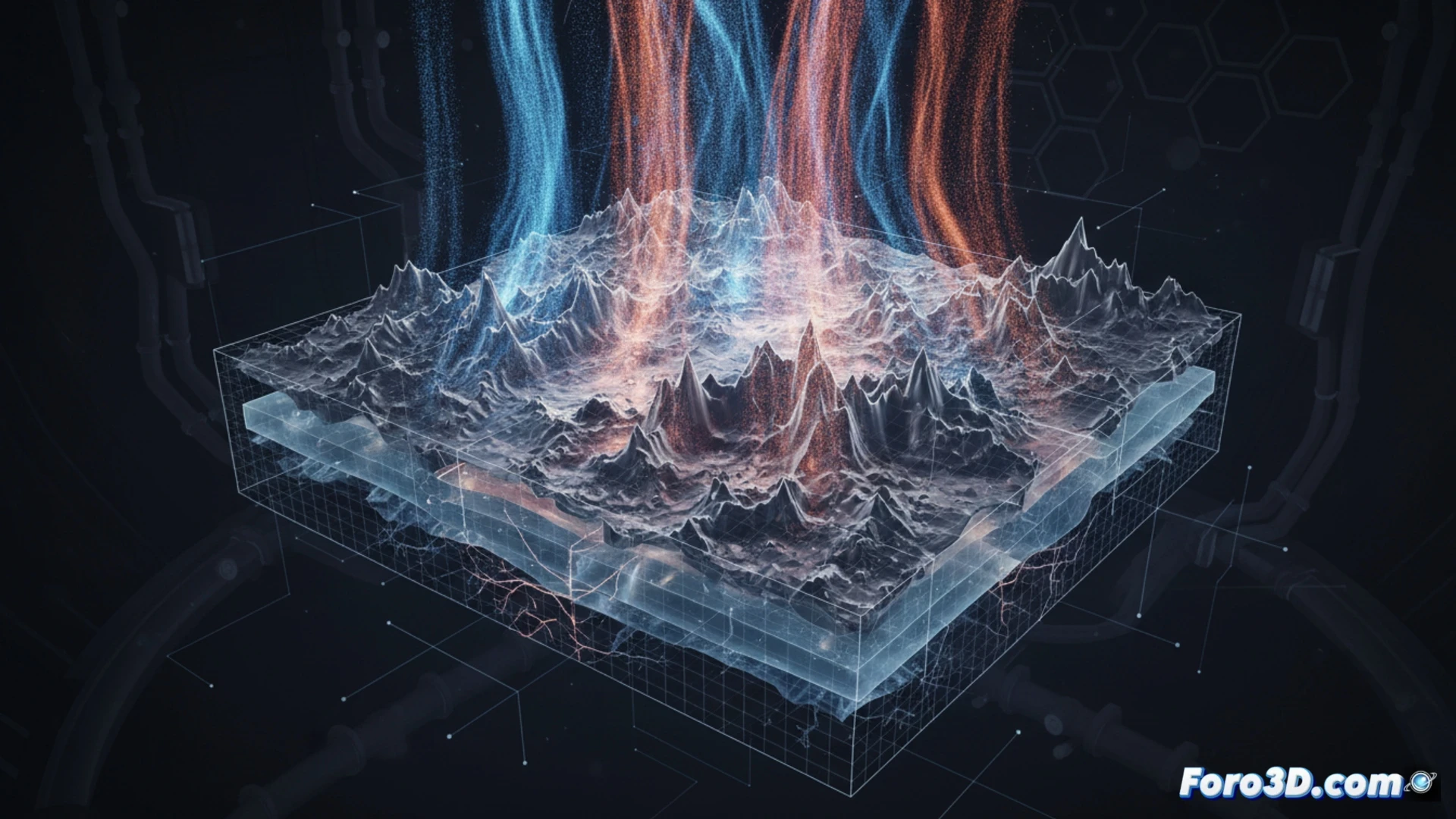
Ablation mapping with SolidWorks and MATLAB 🔥
The process begins with capturing the actual topography of the divertor using laser scanning. This data is imported into SolidWorks to reconstruct a detailed 3D model of the eroded surface, identifying craters and grooves generated by the plasma. Subsequently, MATLAB processes the point clouds to generate height maps and ablation curves, quantifying material loss in microns per hour of operation. These maps reveal critical zones where the particle flow is most intense, allowing analysts to correlate erosion with local magnetic fields. The precision of the mapping is essential for feeding fatigue models and predicting when the tungsten will reach its thickness limit.
ANSYS Fluent and the prediction of tungsten fatigue ⚙️
With the ablation patterns identified, ANSYS Fluent is used to simulate the plasma flow over the divertor surface. Computational fluid dynamics (CFD) models the interaction between charged particles and tungsten, reproducing the reactor's temperature and density conditions. The simulation results are cross-referenced with erosion maps to adjust magnetic confinement parameters, redirecting the plasma flow towards less critical areas. In this way, the simulation not only prevents vessel perforations but also extends the reactor's lifespan by minimizing localized wear, demonstrating that material fatigue is the limiting factor in the design of future fusion reactors.
How can 3D simulation of material fatigue predict the lifespan of tungsten in the fusion divertor under extreme thermal cycles and plasma erosion?
(PS: Material fatigue is like yours after 10 hours of simulation.)