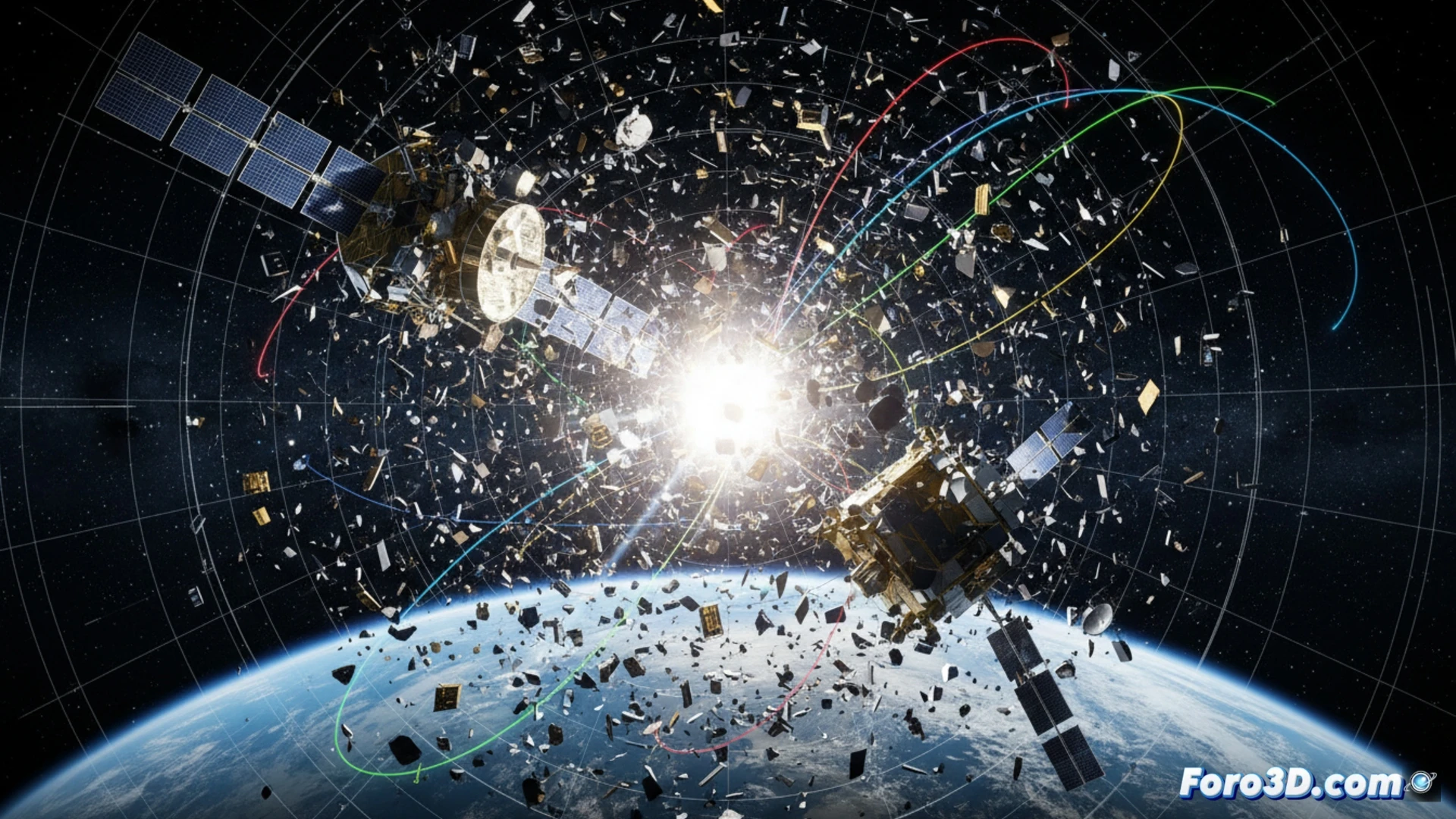
The impact examination between orbital spacecraft has become a critical priority for space safety. When two objects collide at speeds exceeding 7 km/s, the kinetic energy released is devastating. 3D models allow recreating these catastrophic events with millimeter precision, analyzing each generated fragment and its subsequent trajectory. This process is vital for understanding how space debris propagates and predicting future chain collision risks.
Trajectory modeling and kinetic energy calculation 🚀
The process begins with the exact digitization of satellites and orbital debris in 3D environments. Engineers assign physical properties such as mass, density, and ballistic resistance coefficients to each mesh node. Using computational fluid dynamics (CFD) simulations and finite element analysis, the exact kinetic energy at the impact point is calculated. This data feeds fragmentation algorithms that generate virtual debris clouds. 3D visualization allows analysts to observe the evolution of the disaster in real-time, identifying dispersion patterns that would be impossible to detect with manual calculations.
Disaster prevention through digital twins 🛰️
The ability to recreate catastrophic scenarios in virtual environments offers us an invaluable tool for prevention. Each impact simulation reveals vulnerabilities in satellite design and evasion maneuvers. Orbital digital twins allow testing mitigation strategies without risking real assets. Responsible management of space debris depends on these analyses. It is not just about modeling destruction, but about learning to avoid it. The long-term survival of our orbital infrastructure depends on our ability to anticipate and neutralize these threats before they occur.
How can 3D simulations of satellite fragmentation accurately predict the resulting debris cloud to avoid cascade collisions in low Earth orbit?
(PS: Simulating catastrophes is fun until the computer crashes and you are the catastrophe.)