The 3D simulation of a gas leak in a home allows visualizing the fluid mechanics of natural gas, lighter than air, accumulating in blind spots on the ceiling. The model calculates the methane concentration until it reaches 5% of the volume, at which point an electrical spark from a switch detonates the mixture. The shockwave, recreated with particles and mesh deformation, shows how plasterboard partitions collapse while the concrete structure withstands, offering key data for structural prevention.
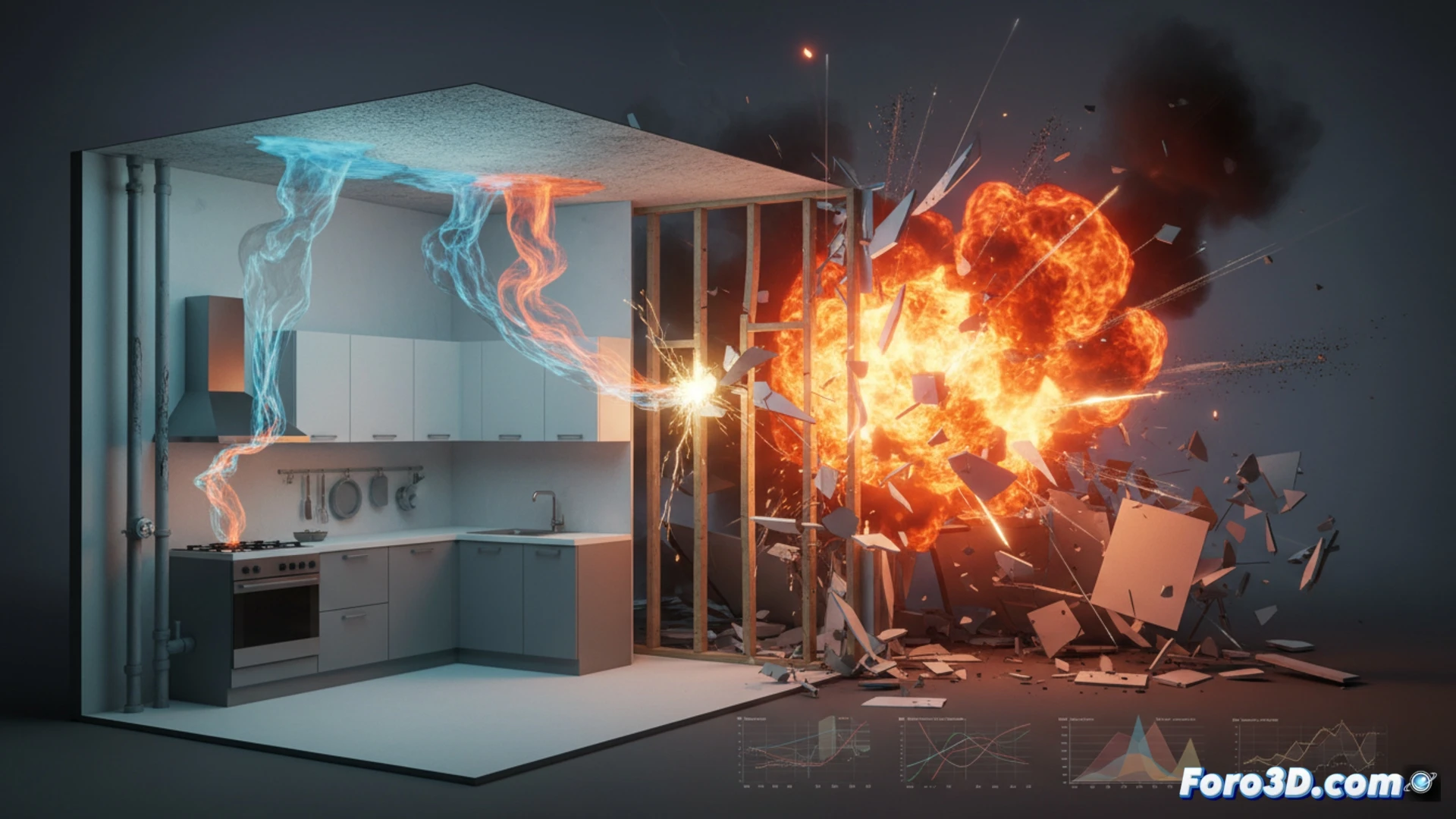
Concentration propagation and ignition point in confined environments 💥
In the 3D model, gas disperses from the joint of a poorly adjusted shut-off valve. Laminar flow becomes turbulent when colliding with obstacles such as furniture. The simulation reveals that, without cross ventilation, the explosive mixture forms in 45 minutes in a 20-square-meter kitchen. The ignition point is activated upon reaching the Lower Explosive Limit (LEL). Simultaneously, carbon monoxide poisoning from a faulty boiler is modeled, where virtual hemoglobin saturates at 70% after 90 minutes, causing simulated loss of consciousness with a free-fall animation from a stepladder.
Active and passive measures to break the disaster chain 🛡️
The 3D comparison contrasts two scenarios: one without protection and another with a gas detector and automatic shut-off valve. In the first, the explosion destroys 80% of the furniture. In the second, the sensor triggers the closure within 2 seconds, preventing critical accumulation. The impact of natural ventilation is also visualized: a 30x30 cm grille reduces risk time by 60%. The simulation concludes that technical training in leak detection and the use of ladders with stabilizers drastically reduce accidents from falls and pressure surges in pipes.
How can 3D simulation of natural gas dispersion reveal blind spots in current domestic explosion prevention protocols?
(PS: Simulating catastrophes is fun until the computer melts down and you are the catastrophe.)