The recent failure at a wave energy converter farm (point absorbers) during a storm has brought the spotlight on accelerated corrosion-fatigue. 3D forensic analysis revealed that the anchor chains failed due to galvanic currents between the metal and the seabed, a phenomenon that predictive modeling could have anticipated. This article breaks down how OrcaFlex and Bentley OpenRoads allowed recreating the material's life cycle.
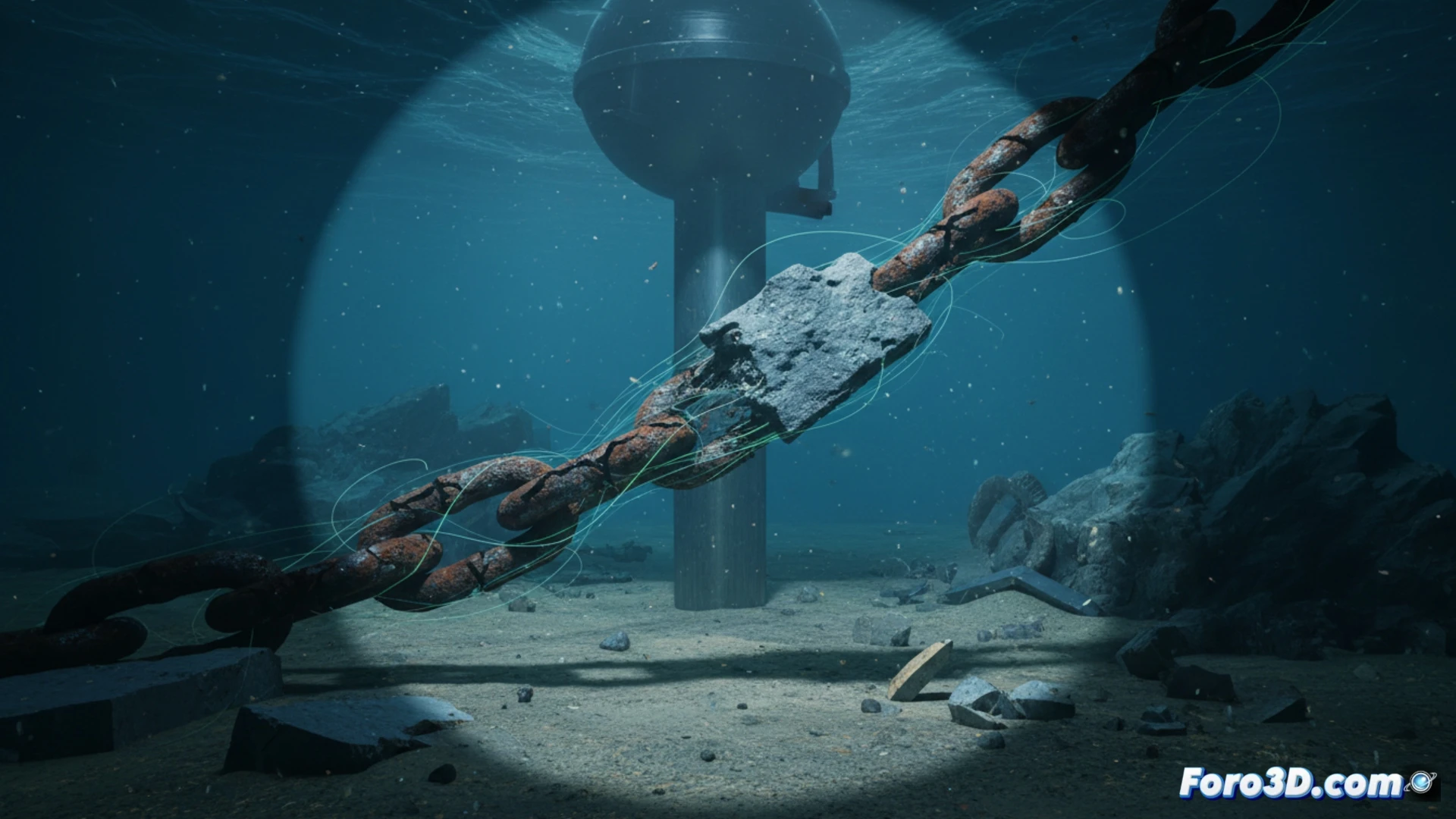
Digital reconstruction of the failure with OrcaFlex and Bentley OpenRoads 🌊
Using OrcaFlex, the non-linear dynamics of the chains under extreme wave conditions were simulated, obtaining residual stress maps for each link. The data was exported to Bentley OpenRoads to model the geotechnical interaction of the seabed, identifying a critical point where the chain rubbed against rock formations rich in conductive minerals. The combination of cyclic fatigue and galvanic corrosion reduced the estimated service life by 40% according to the S-N curves of the DNV-OS-E301 standard. The 3D model showed that the failure was not sudden, but progressive, with microcracks nucleating in areas of high ion concentration.
Lessons for predictive offshore simulation ⚙️
This case demonstrates that fatigue simulation cannot ignore the electrochemical environment. The service life graphs generated in OrcaFlex indicate that, without considering the galvanic couple, the system would have passed standard certifications. The lesson is clear: 3D modeling must integrate seabed resistivity data and corrosion potentials to avoid catastrophic failures. At Foro3D, we believe that the next generation of regulations will require this level of detail in material simulation for offshore infrastructure.
How can the effect of galvanic corrosion on the fatigue life of wave energy buoy anchors under cyclic storm loads be accurately modeled?
(PS: Material fatigue is like yours after 10 hours of simulation.)