The job of a driller exposes the worker to critical risks such as entrapment by rotating equipment, projection of fragments, hand-arm vibrations, and structural fatigue. These hazards depend not only on the operation but also on the behavior of materials under repetitive stress. 3D modeling of the components of a drilling rig allows for anticipating failures and designing safer environments through fatigue simulation.
Modeling of critical components and analysis of cyclic loads 🛠️
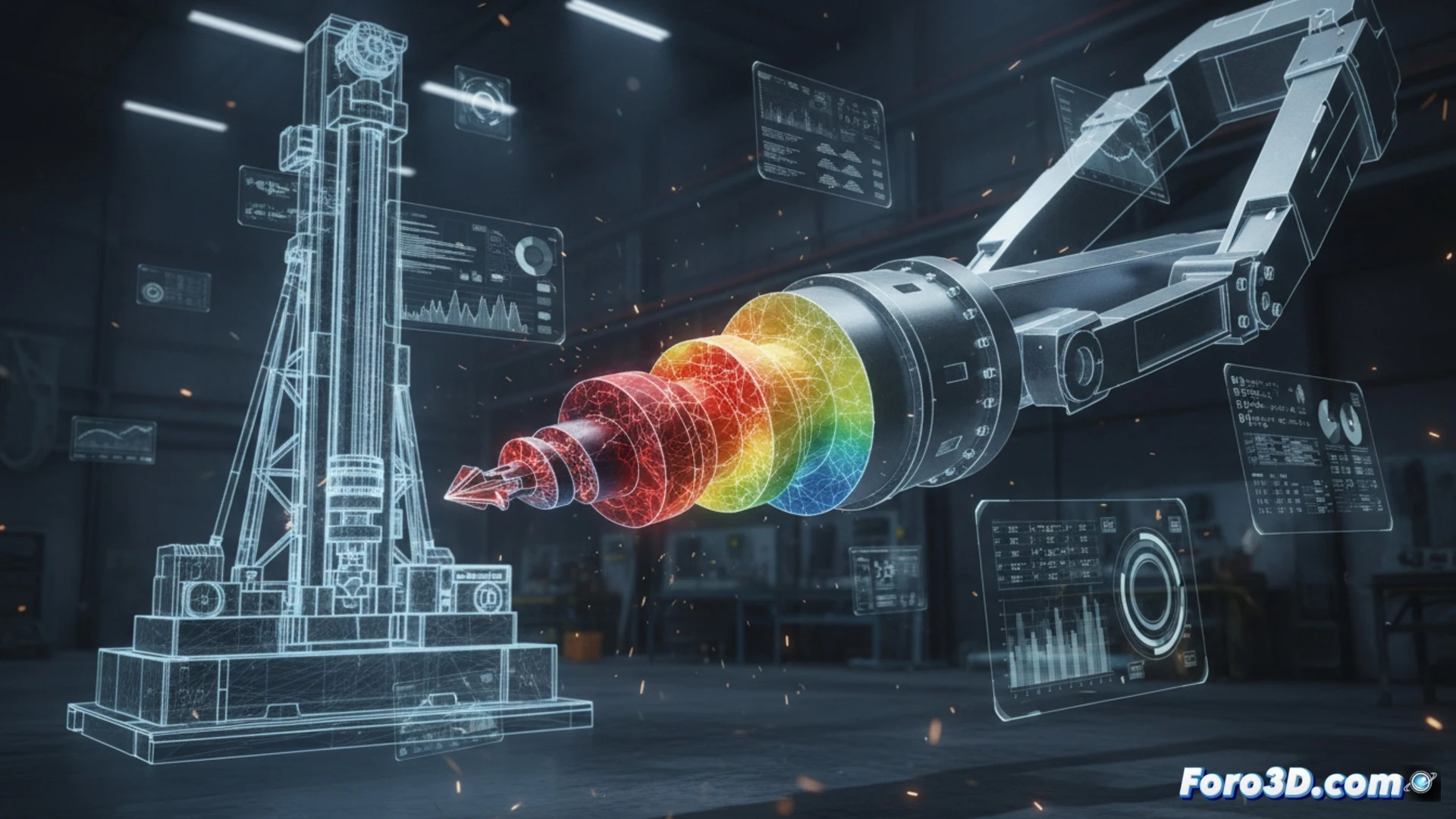
To address these risks, key parts are modeled in 3D: the drill bit, the rotating arms of the head, and the scaffold structures. The simulation applies cyclic loads that replicate high-frequency vibrations, fragment impacts, and repetitive torsion. Finite element software calculates the distribution of stresses and deformations, identifying crack nucleation points. Fragment projection trajectories are visualized to predict impact zones. The comparison between hardened steels, titanium alloys, and ceramic coatings shows a reduction of up to 40% in the formation of microcracks, decreasing the risk of entrapment due to sudden breakage.
Towards a data-driven prevention culture 📊
Fatigue simulation is not a technical luxury; it is a tangible prevention tool. By visualizing failure before it occurs, safety guards can be redesigned, maintenance frequencies optimized, and materials that better absorb vibrations selected. Integrating these 3D models into driller training transforms risk analysis into a predictive process, where technology protects the operator's physical integrity against the mechanical hazards of daily work.
How can 3D simulation of material fatigue in drilling rigs accurately predict the exact point of structural failure to prevent entrapment by rotating equipment before it occurs under real working conditions?
(PS: Material fatigue is like yours after 10 hours of simulation.)