The metal carpenter faces critical risks such as cuts from handling sheets, burns from welding, and particle projection. However, a silent danger is material fatigue: profiles and joints that fail after repetitive load cycles. Finite element simulation allows modeling these stresses, anticipating structural collapses that lead to falls or serious accidents.
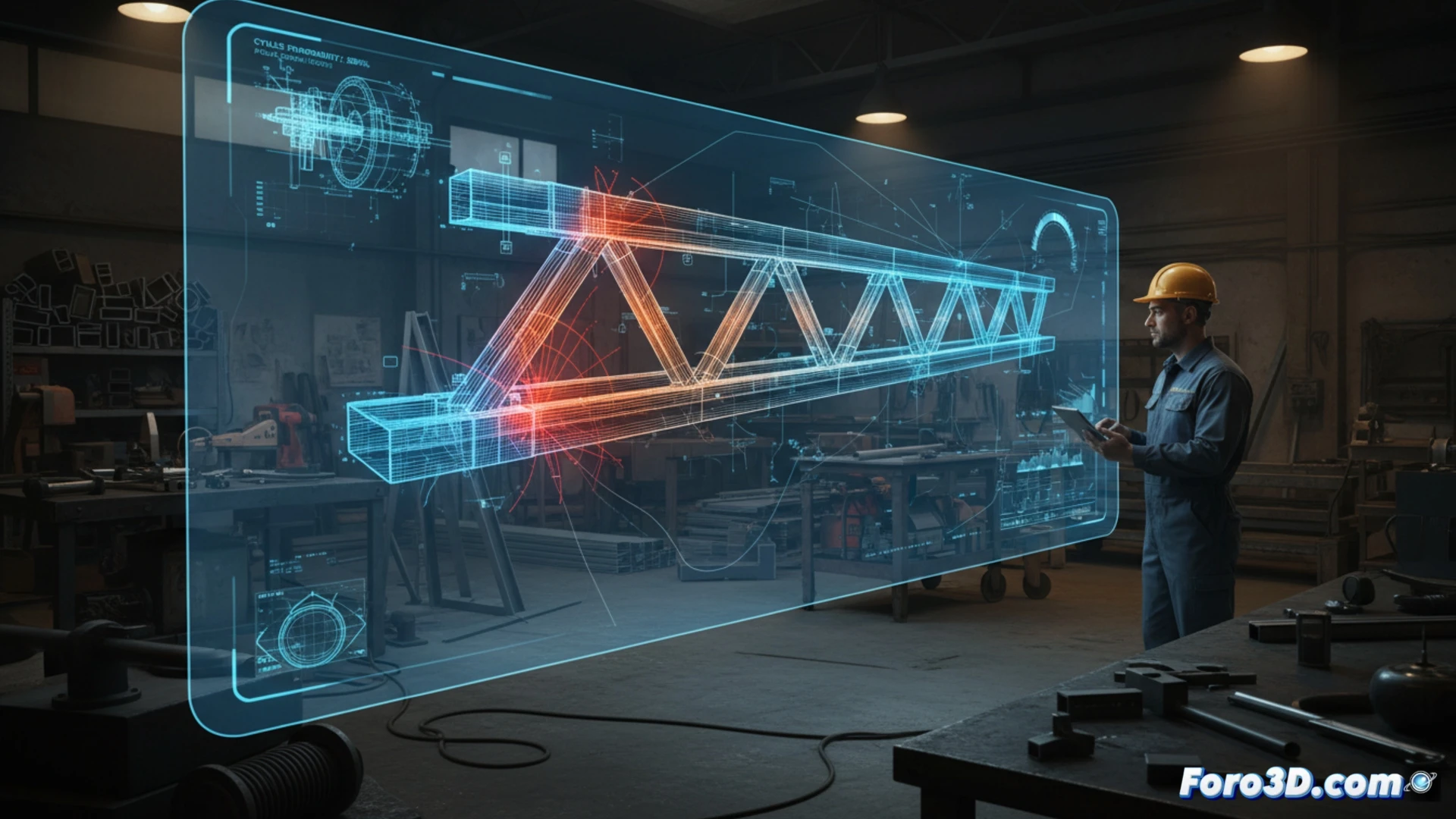
Stress modeling in welded joints and profiles ⚙️
Welded joints are critical points where residual stresses concentrate. Through finite element analysis, the degradation of steel under cyclic loads (such as the weight of structures or the effort of handling profiles) is simulated. The software predicts the propagation of microscopic cracks before they cause fractures. For example, in a steel beam subjected to 10,000 bending cycles, the simulation shows areas of high plastic deformation. This allows redesigning reinforcements or adjusting welding processes to avoid particle projections and cuts from sudden failure.
Active prevention: from theory to the workshop 🛠️
Beyond calculation, these simulations transform workplace safety. By visualizing in 3D how a profile cracks under repetitive stress, the carpenter identifies when to replace parts or reduce loads. The technology not only prevents accidents such as falls from height due to the breakage of metal scaffolding but also optimizes the handling of heavy sheets, minimizing the risk of lower back pain. Material fatigue ceases to be an abstract concept and becomes a tangible prevention tool.
How can 3D simulation of metal fatigue predict failures in metal carpentry structures before they become a risk of cuts or particle projection?
(PS: Material fatigue is like yours after 10 hours of simulation.)