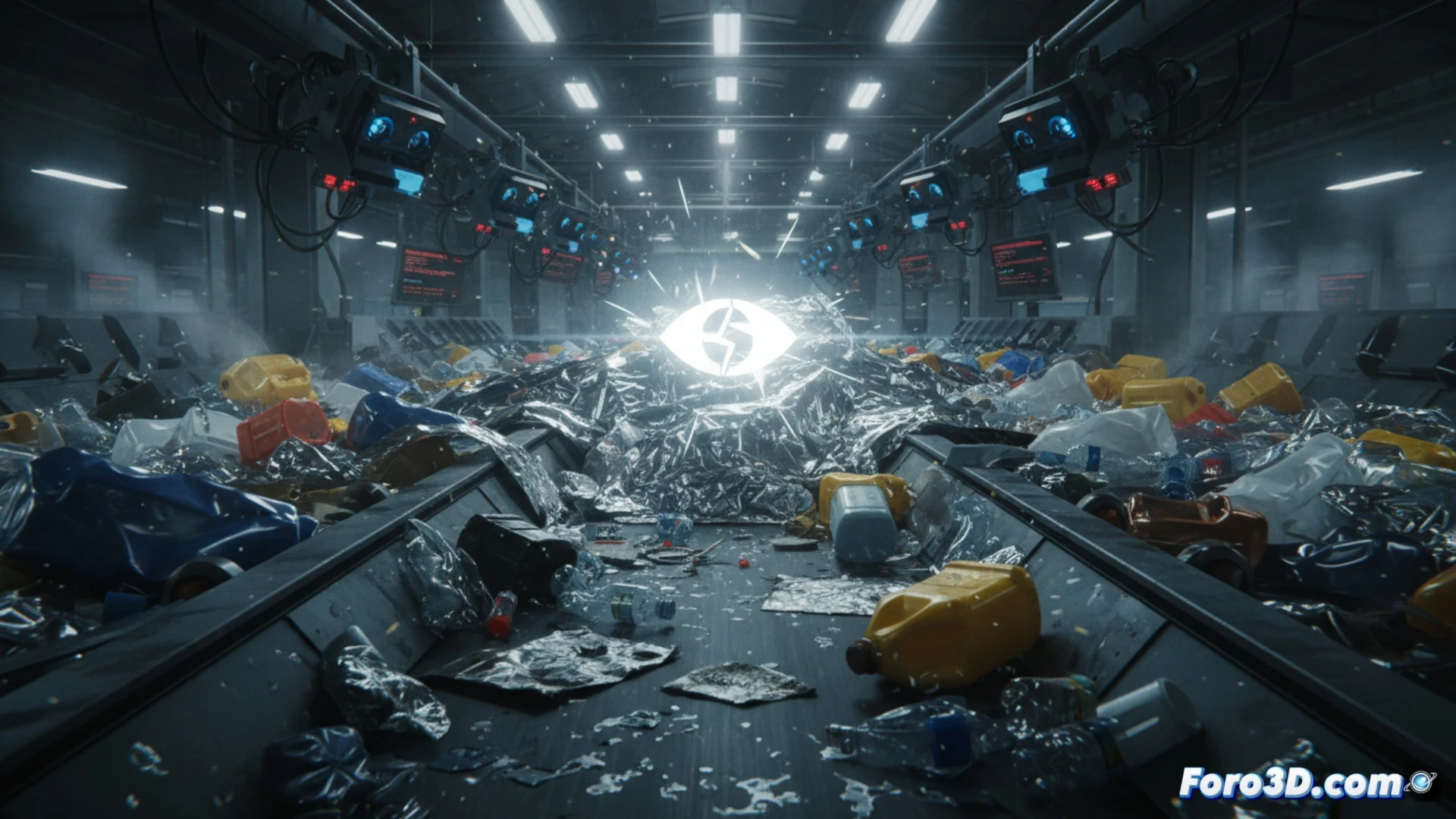
A recycling sorting plant suffered a violent blockage on its main conveyor belt. The incident halted production for eight hours. Preliminary analysis pointed to a mechanical error, but sensor logs revealed a prior anomaly: the hyperspectral cameras lost the ability to distinguish heavy polymers just before the jam. The engineering team suspects that specular reflection from metallized plastics created an optical blind spot that blinded the machine vision system.
Analysis pipeline: From Pix4D to MATLAB to detect the blind spot 🛠️
To verify the hypothesis, the failure scene was reconstructed in a virtual environment. First, Pix4D was used to generate a high-resolution 3D model of the conveyor belt and materials in transit, capturing the exact geometry of the metallized waste. Subsequently, CloudCompare processed the point cloud to identify surfaces with anomalous reflectance. The critical step occurred in MATLAB, where the trajectory of light rays from the hyperspectral cameras to the objects was simulated. The script calculated the incidence and reflection angles, revealing that a batch of metallized containers created a diffuse light cone that saturated the sensor pixels precisely in the heavy material sorting zone.
Lessons for industrial simulation in Unity 🎯
The simulation in Unity allowed recreating the failure in real time. By importing reflectance data from MATLAB, the material shaders were adjusted to replicate the real optical behavior. The conclusion was clear: classification algorithms need a dynamic threshold preprocessing that ignores specular brightness peaks. This case demonstrates that 3D simulation not only predicts mechanical failures but also complex sensory errors, saving millions in costs from unplanned production stoppages.
What key lessons about sensor integration and predictive simulation algorithms can be drawn from a violent optical failure on an automated recycling conveyor belt to prevent future blockages in sorting plants?
(PS: at Foro3D we optimize routes like we optimize polygons: until the computer says enough)