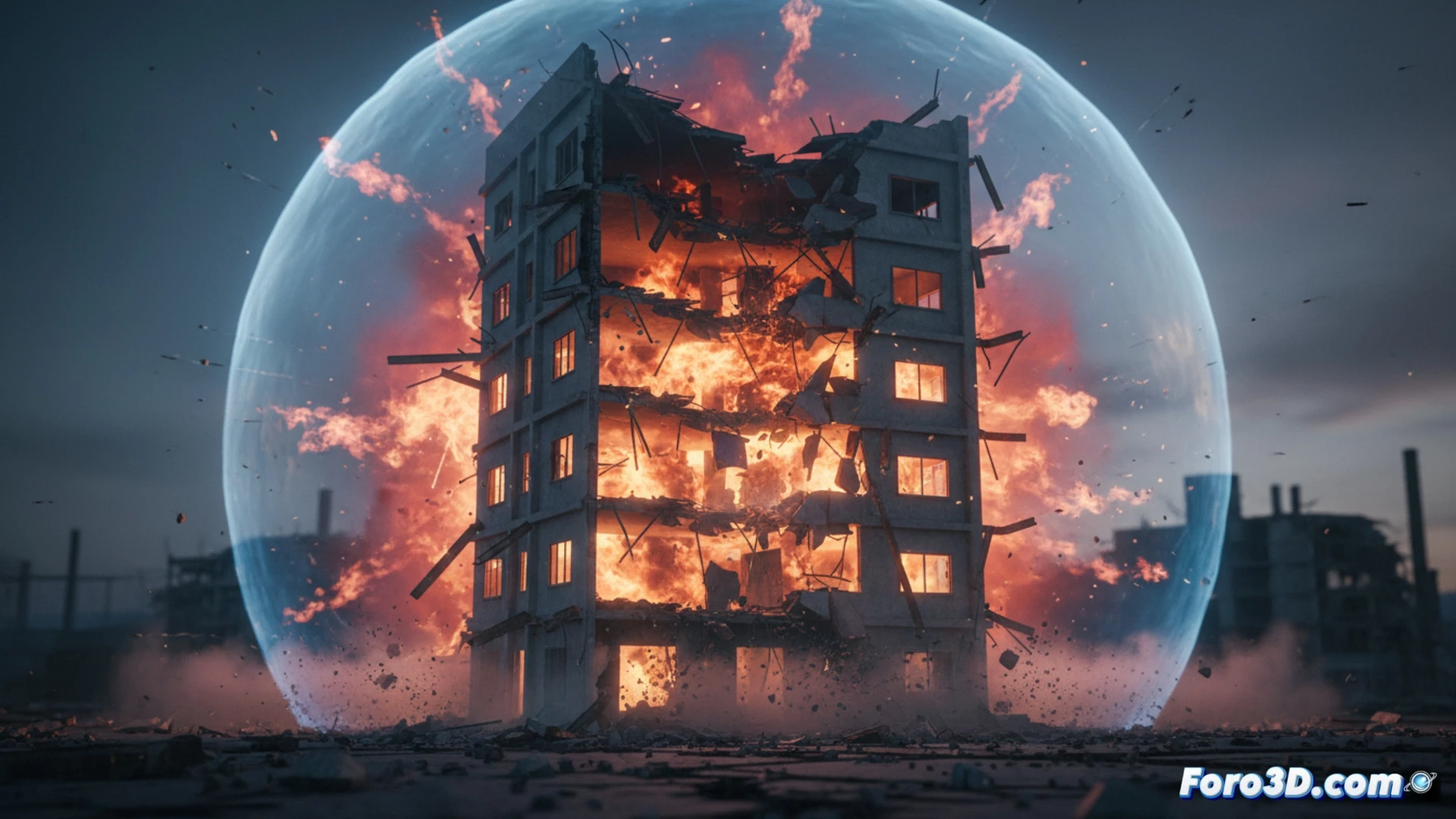
Deflagration, as a subsonic combustion phenomenon, generates an expansive pressure wave and a flame front that compromises the integrity of buildings. Modeling this process in 3D requires integrating computational fluid dynamics (CFD) with physically based rendering engines to visualize the propagation of overpressure, the progressive collapse of load-bearing walls, and the evacuation of toxic smoke—key elements in disaster prevention and forensic analysis.
CFD Workflow and Visualization in Game Engines 🔥
To simulate a deflagration, a BIM model of the building is exported to a CFD solver such as OpenFOAM or Ansys Fluent. Here, the initial conditions are defined: gas concentration, ignition point, and geometry of the openings. The solver calculates the evolution of the flame front and the pressure gradient on hexahedral meshes. Subsequently, pressure and temperature data are imported into Unreal Engine or Unity using temporal data plugins. In the engine, a destructible material is assigned to slabs and partitions, activating failure thresholds when pressure exceeds 50 kPa. The smoke plume is simulated with particle systems that follow the vortex trajectories calculated in CFD, allowing observation of blocked evacuation routes.
The Forensic Value of Temporal Simulation ⏳
In forensic simulations, the ability to rewind the 3D animation allows experts to identify the exact point of origin of the deflagration. By correlating the deformation of steel beams with pressure peaks, electrical causes are ruled out and a gas leak is confirmed. This methodology, which combines the precision of CFD with the visual immersion of game engines, not only clarifies incidents but also refines building codes for future constructions.
How to accurately model the interaction between the subsonic pressure wave and the propagation of the flame front to predict structural collapse in a 3D deflagration simulation?
(PS: Simulating disasters is fun until your computer melts down and you become the disaster.)