The ship is a means of transportation with a low-risk profile, but its relative safety falters in the face of rare events such as extreme storms, onboard fires, or human error. Unlike an airplane, its structural shielding is lower, making it more susceptible to catastrophic failures. At Foro3D, we analyze how three-dimensional simulation allows modeling these scenarios to anticipate a vessel's collapse before it occurs.
Digital twins to assess structural vulnerability 🛳️
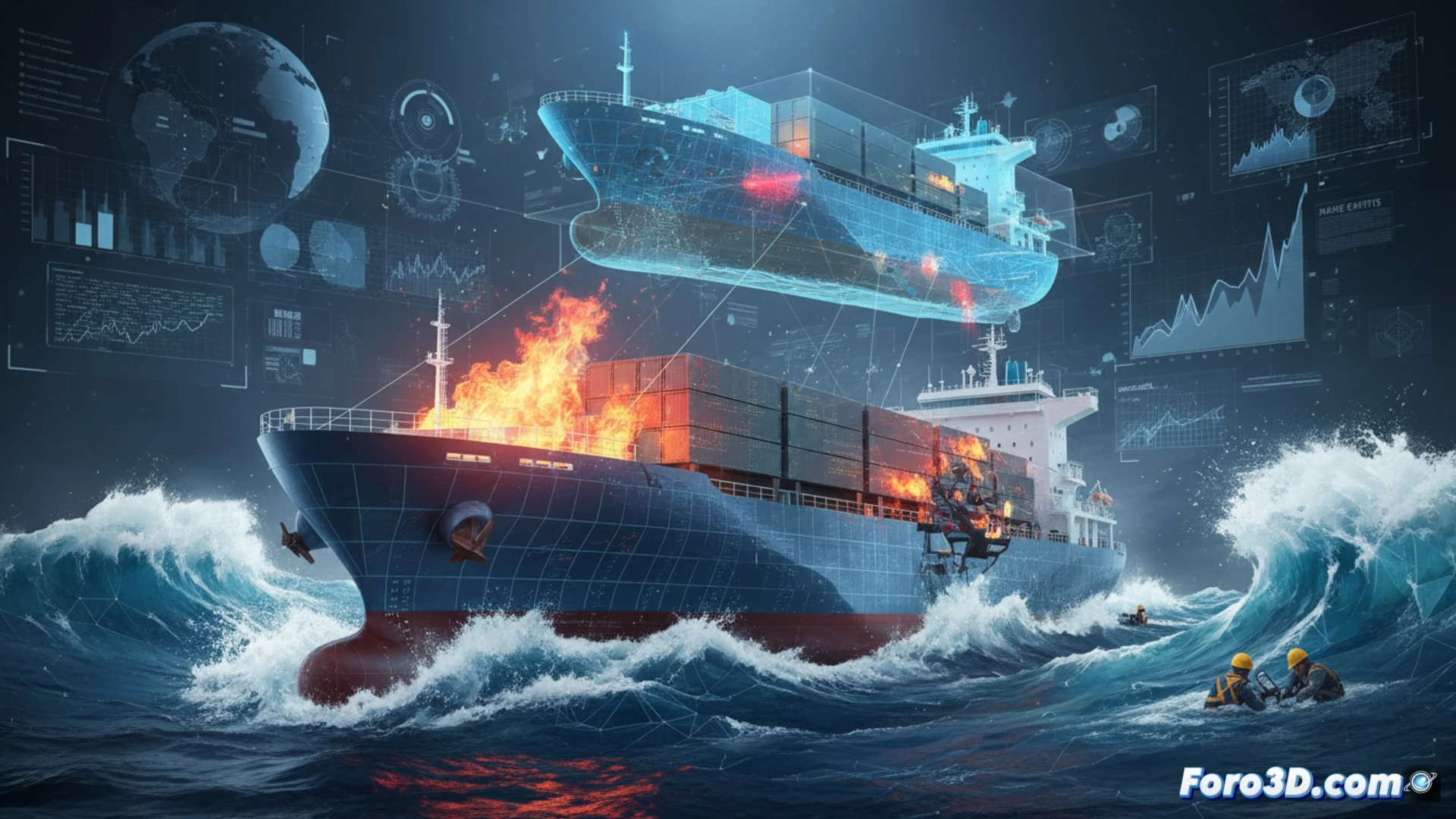
3D simulation applied to naval engineering allows creating digital twins that replicate every steel plate and weld of a ship. By introducing variables such as 15-meter waves, fire sources in the engine room, or erroneous maneuvers on the bridge, algorithms calculate the propagation of damage in real time. Comparison with an airplane fuselage reveals that, although the ship has greater residual buoyancy, its structure lacks the critical redundancy of aeronautical shielding, which accelerates the progression of a catastrophe.
The paradox of safety at sea ⚓
Simulating maritime catastrophes forces us to reconsider what it means to travel safely. A ship can withstand decades of routine navigation, but a perfect storm or a miscalculation in ballast can trigger a sinking in minutes. Modeling these scenarios in 3D not only serves to design better hulls but also to train crews in responding to the improbable, bridging the gap between the perception of safety and the physical reality of the ocean.
Which physical validation criteria should be prioritized in a 3D simulation so that a vessel's structural shielding is realistic against rare events such as extreme storms or object impacts, when historical data is scarce?
(PS: Simulating catastrophes is fun until the computer melts down and you are the catastrophe.)