The trade of a gas fitter is one of the most exposed to technical catastrophes in urban and industrial environments. Explosions due to leaks, silent carbon monoxide poisonings, and collapses of pressurized pipes are scenarios that, although preventable, continue to claim lives. 3D modeling of these risks allows anticipating the propagation of a deflagration in a basement or the dispersion of gas on a facade, offering a vital training tool for professionals.
Digital twins and fluid dynamics for prevention 💻
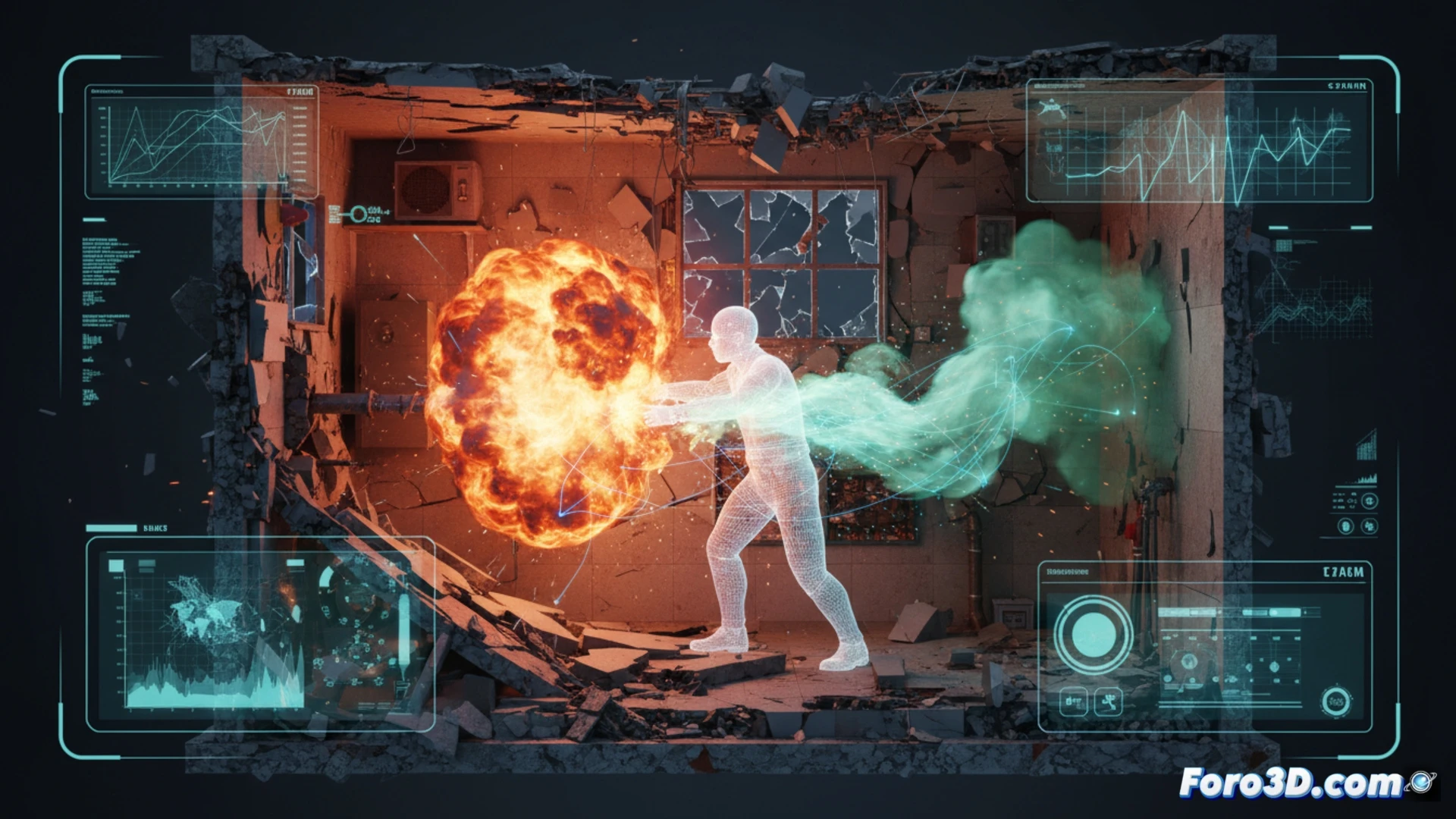
Computational simulation of serious accidents requires integrating fluid dynamics (CFD) data with precise structural models. For a gas fitter, the main risk lies in the accumulation of gas in confined spaces such as manholes or false ceilings. Using a digital twin of the installation, we can recreate a slow leak in a defective joint and visualize how the gas stratifies, reaching the lower explosive limit. The 3D model also allows calculating the pressure waves resulting from an ignition, showing the collapse radius of walls and the shrapnel effect of fractured pipes. This technology is not only useful for forensic analysis but also for designing forced ventilation protocols and specific evacuation routes for each job site.
Training in virtual chaos to avoid real tragedy 🎮
Immersive virtual reality, powered by these digital twins, transforms occupational safety training. A gas fitter can practice closing an emergency valve while a 3D simulation reproduces the pressure increase in the pipe and the risk of immediate burst. Falls from scaffolding while handling tools on facades, or loss of consciousness due to carbon monoxide inhalation in a simulated basement, can also be recreated. By experiencing these catastrophes in a controlled environment, the worker develops automatic reflexes and recognizes danger signals that, in reality, make the difference between an incident and a major catastrophe.
How can a 3D simulation of a gas leak explosion accurately predict dispersion patterns and structural damage to improve safety protocols in the gas fitter trade
(PS: Simulating catastrophes is fun until the computer crashes and you are the catastrophe.)