Chaos in a human avalanche is not random; it responds to physical patterns of fluids and pressure. In 3D catastrophe modeling, we treat people as interactive particles within a closed system. When panic breaks out, critical density is exceeded, and pushing forces generate shockwaves that are impossible to control without prior simulation. Here we analyze how digital twins and predictive particle models can anticipate the point of no return in a stampede.
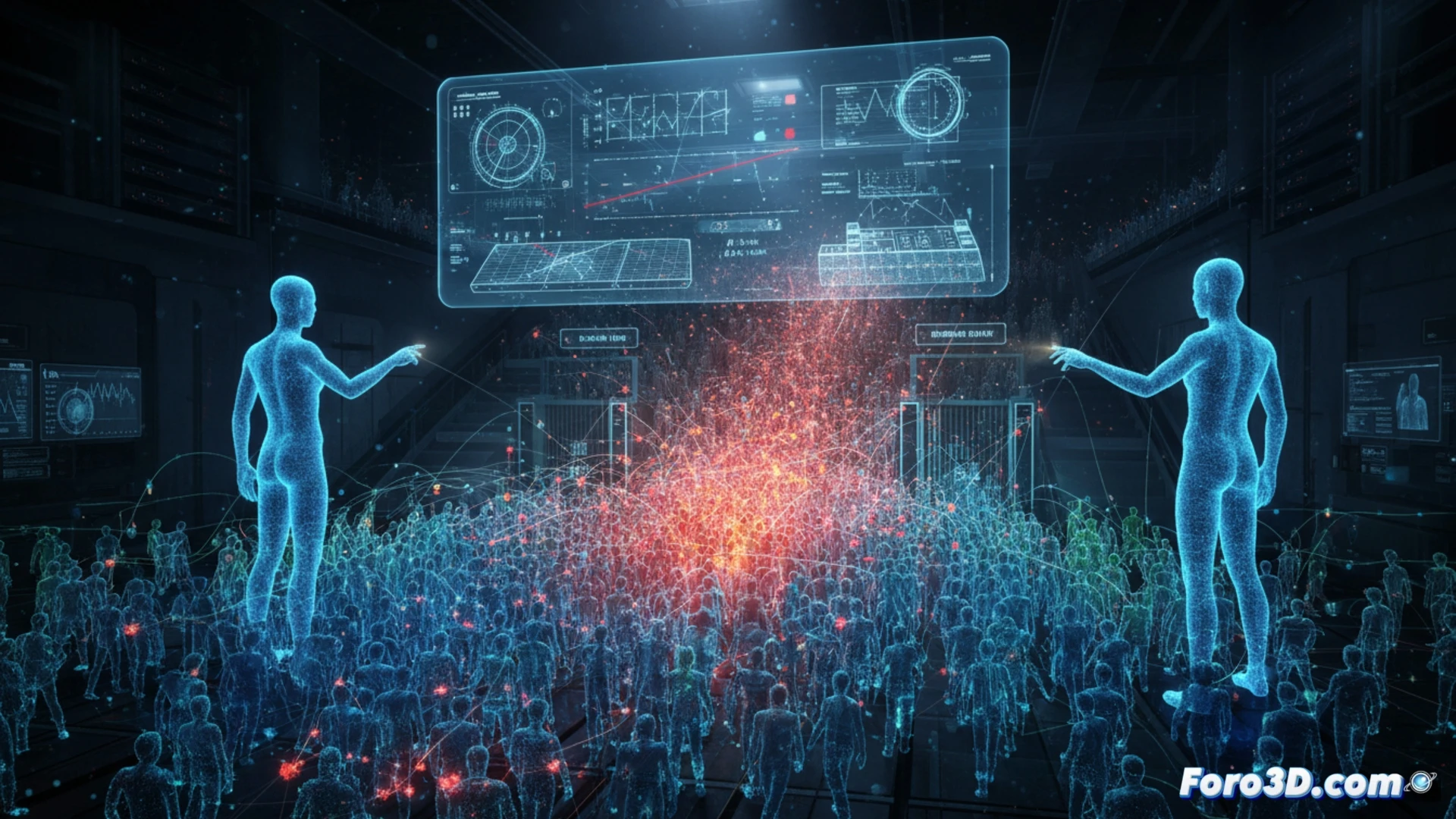
Particle dynamics and contact pressure in crowds 🧪
Current simulation engines use computational fluid dynamics (CFD) models adapted for pedestrians. Each virtual agent has mass, velocity, and an exclusion radius that prevents physical overlap. In panic scenarios, the social friction coefficient and desired speed increase, generating a phenomenon known as lateral crushing pressure. Cases like the Seoul stampede in 2022 or the Hajj pilgrimage in Mecca show that when exceeding 6-7 agents per square meter, lateral forces surpass a human's lung capacity. 3D modeling allows predicting these thresholds by modifying input variables such as exit width or obstacle placement.
Digital twins to prevent the next tragedy 🛡️
Real prevention does not consist of banning mass events, but in designing venues that absorb chaos. Digital twins replicate stadiums, corridors, and subway stations with millimeter precision. By injecting a panic model, the software reveals invisible bottlenecks in 2D plans. The technical solution involves creating pressure dissipation zones and asymmetric evacuation routes. Each simulation is a virtual rehearsal of a catastrophe that, with the right data, will never occur in the real world.
How is the transition from an orderly crowd to a critical human avalanche modeled in 3D without losing the physical precision of compressible fluids?
(PS: Simulating catastrophes is fun until the computer crashes and you are the catastrophe.)