Driving remains the most dangerous daily activity, according to all accident rate indices. The equation is simple: we add high speeds, a massive volume of vehicles on the roads, and the unpredictable nature of human error. The result is a statistical risk that surpasses any other daily routine. Faced with this reality, the automotive industry has found in Advanced Driver-Assistance Systems (ADAS) and 3D simulations its best ally to mitigate the human factor.
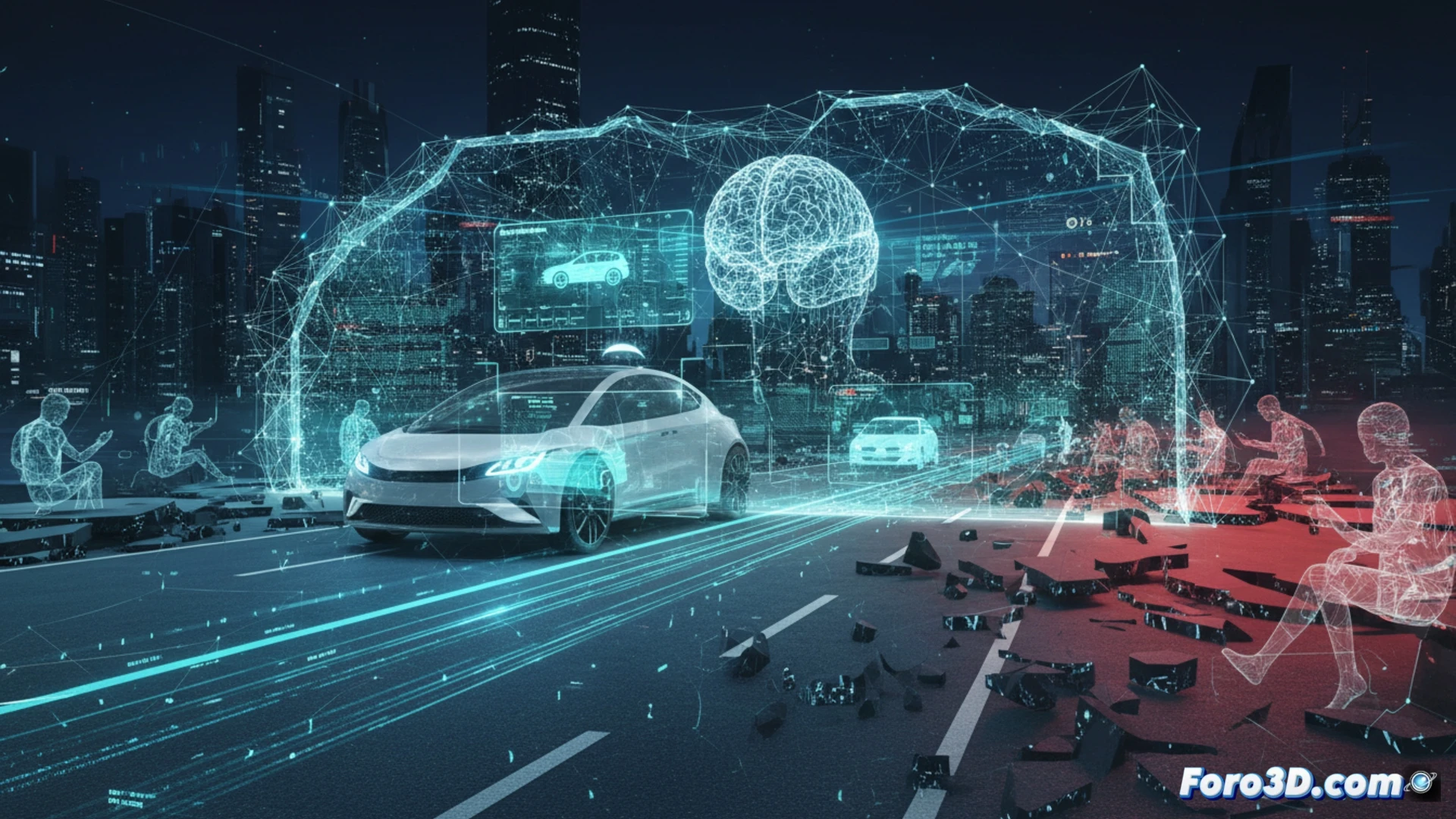
3D Modeling of Critical Scenarios and Sensor Architecture 🚗
The key to reducing accidents lies in anticipating the error before it occurs. 3D modeling platforms allow recreating high-risk scenarios, such as pedestrians crossing unexpectedly or sudden braking on the highway, to test autonomous braking algorithms. Complete architectures of LiDAR sensors, radar, and cameras integrated into the Electronic Control Unit (ECU) are visualized. These digital twins allow iterating on adaptive cruise control software or lane-keeping assistance without the need for a physical prototype, accelerating the design of vehicles that react faster than a distracted driver.
The Safety Paradox: More Technology, Less Blind Trust ⚠️
While 3D simulation allows us to fine-tune systems that correct human error, a critical reflection arises. We must not fall into the trap of delegating all responsibility to the machine. Technology should be a safety net, not a substitute for attention. The visualization of accident data in 3D shows us that the best ECU in the world cannot foresee total irresponsibility. The ultimate goal is not to eliminate the driver, but to design systems that assist them intelligently, reminding us that driving will remain dangerous if we forget that the steering wheel is still in our hands.
Is it possible to simulate with absolute fidelity in 3D environments the millions of unpredictable micro-scenarios that the human eye and instinct resolve in milliseconds, or will ADAS technology remain as vulnerable as the driver it aims to replace?
(PS: simulating an ECU is like programming a toaster: it seems easy until you order a croissant)