Silverclaw, the alter ego of Maria De Guadalupe Santiago, burst into the Marvel universe like a breath of fresh air. Created by Kurt Busiek and George Pérez, this young woman from Costa Verde not only possessed the power to transform into silver animals; her essence lay in a deep connection to her Mexican and Indigenous roots. More than a superheroine, she represented an act of cultural resistance within the mainstream, a character who defended her own with an identity forged in tradition and the magic of magical realism.
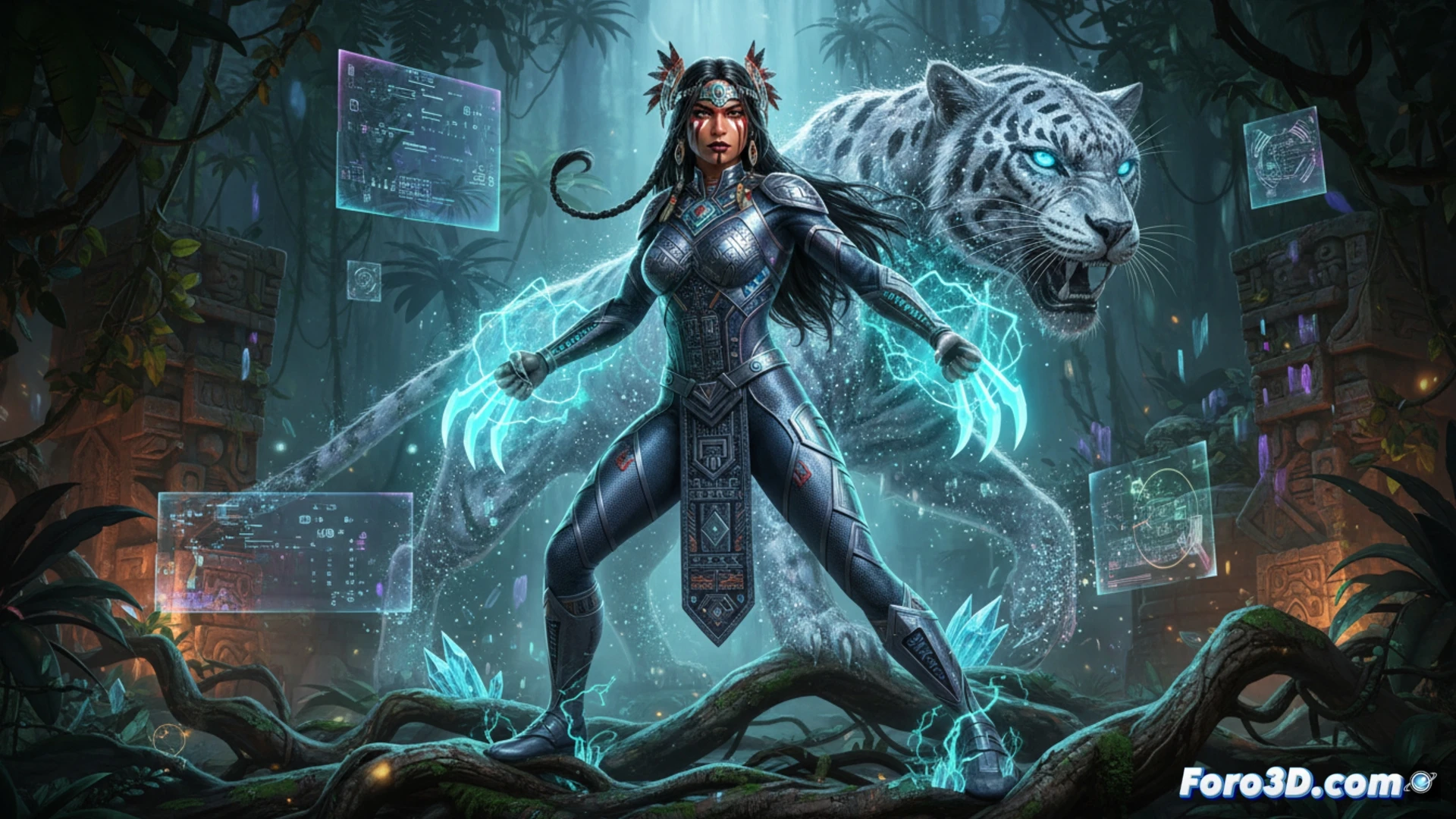
Production pipeline: Digital sculpting and rigging for metamorphosis 🐆
For a digital artist, Silverclaw presents a fascinating technical challenge. Her ability to channel the essence of jaguars, eagles, or snakes into a metallic form demands mastery of organic modeling and digital sculpting in software like ZBrush or Blender. The rigging must be dynamic to support smooth transitions between human and animal anatomy, requiring bone systems and blend shapes that respond to a logic of transformation. Texturing, with silver and reflective finishes, allows for exploring PBR materials that capture light realistically, while particle animation can simulate the dispersion of liquid silver during shape changes—a workflow ideal for concept art portfolios or virtual reality cinematics.
Digital narratives: Activism through 3D animation 🎨
The true potential of Silverclaw in the digital realm transcends technique. By modeling and animating a superheroine who carries pre-Hispanic symbols and an Indigenous worldview, creators can generate content that challenges the visual homogeneity of entertainment. 3D short films or immersive virtual reality experiences allow for telling stories from the perspective of a marginalized community, using digital art as a tool for activism. Each render becomes a manifesto: a statement that technology can and should be a vehicle for inclusion, bringing visibility to female and Latina figures who deserve a central place in the collective imagination.
As a 3D modeler, what specific techniques or workflows would you implement to capture cultural authenticity and Indigenous representation in the digital design of a character like Silverclaw, avoiding falling into visual stereotypes?
(PS: political digital art is like an NFT: everyone talks about it but no one really knows what it is)