The work of Donny Cates and Tradd Moore, Silver Surfer: Black, transcends conventional comics to become a visual manifesto of contemporary digital art. After being sucked into a black hole, Norrin Radd confronts the void and the darkness of Knull, but the true protagonist is the linework. The pages are not read; they are experienced like a cosmic hallucination in constant motion, where each panel seems like a frame from experimental 3D animation.
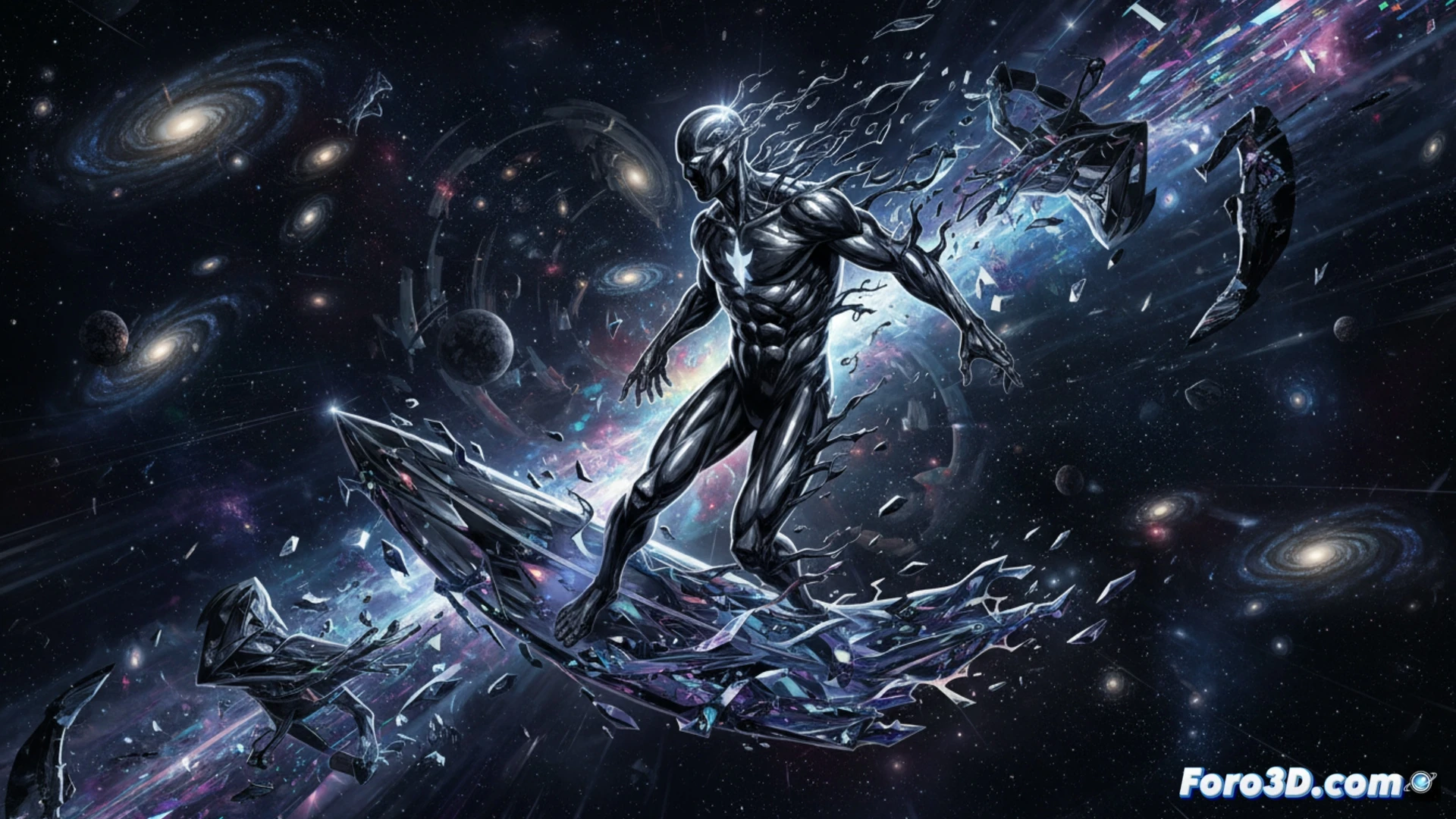
Fluid Composition and Digital Morphology in Comics 🌀
Tradd Moore's style employs an anatomical distortion that directly recalls generative art and experimental character rigging in 3D software. Limbs elongate, torsos curve, and backgrounds dissolve into swirls of ink and color, creating a sense of continuous morphing. This visual technique, far from being an aesthetic whim, replicates the deformation algorithms used in digital animation to represent fluids and energy fields. Moore does not draw bodies; he simulates particles in a gravity-free space, where organic matter behaves like real-time visual data. The narrative of the cosmic void is thus translated into an exploration of the limits of visual representation, where the printed page competes with the immersion of a virtual reality screen.
The Void as a Canvas for Visual Activism 🌌
Beyond technique, Silver Surfer: Black proposes a reflection on darkness and digital silence. In a world saturated with stimuli, Moore's work uses absolute emptiness not as an absence, but as an active canvas for artistic expression. This approach resonates with contemporary visual activism, where digital artists use immersive environments and virtual reality to denounce technological alienation. The comic becomes a tool to reclaim darkness as a space for creation, an act of aesthetic resistance against the constant visual noise of the digital age.
How does anatomical distortion in Silver Surfer: Black function as a tool of digital activism by subverting the traditional visual narrative of the superhero?
(PS: pixels also have rights... or at least that's what my latest render says)