The recent observation of the siphonophore Bathyphysa sp. on unexplored seamounts has captured the attention of the scientific community. Known as the Flying Spaghetti Monster, this colonial organism challenges our understanding of life in the deep sea. Its structure, reminiscent of a mass of floating threads, hides a fascinating biological complexity that deserves to be visualized with precision.
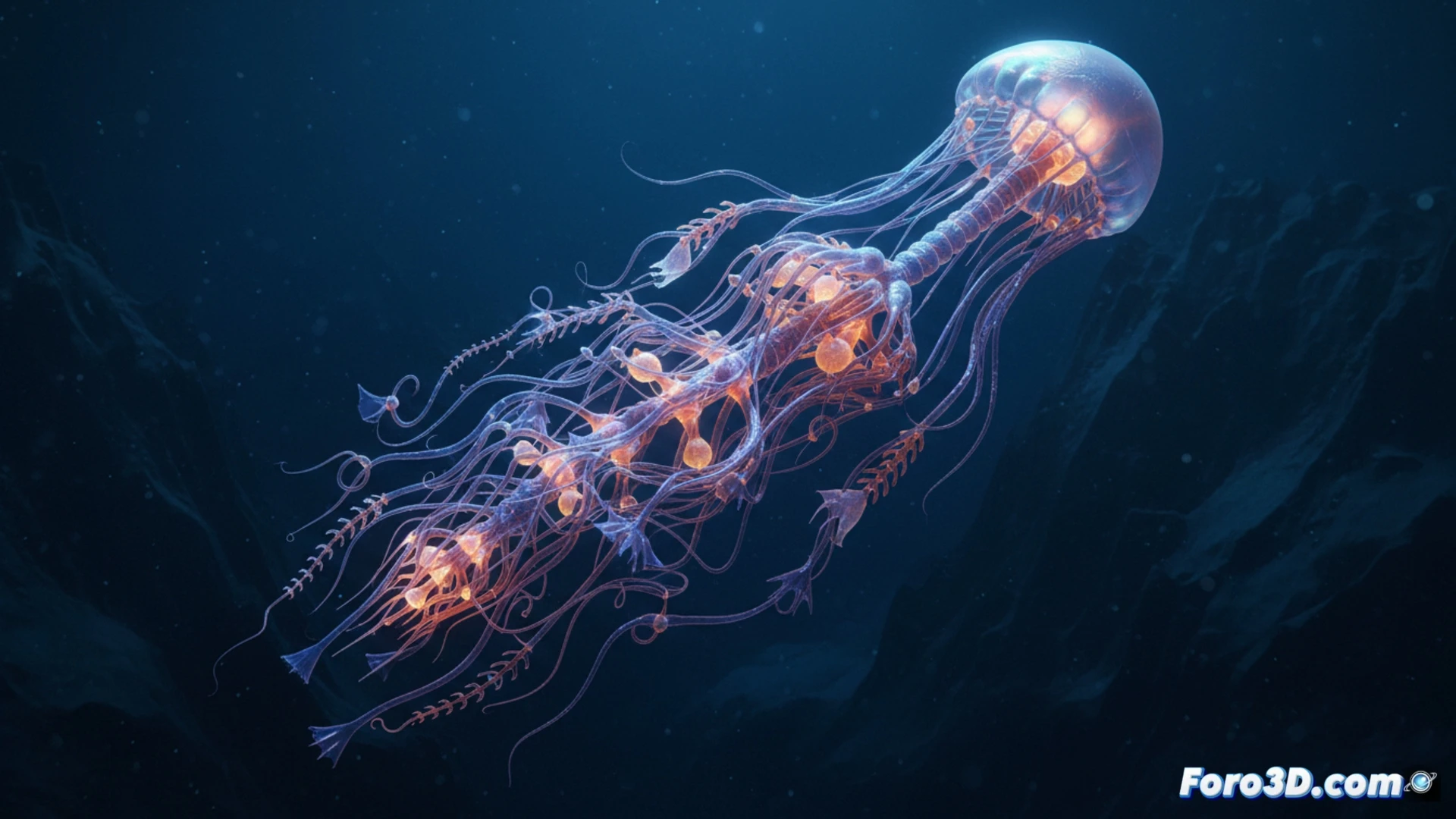
Colonial architecture and biomechanical animation 🐙
For a faithful 3D representation, we must model the colony as an assembly of specialized zooids connected by a central stolon. Each zooid fulfills a specific function: nectophores for propulsion, gastrozooids for feeding, and dactylozooids for defense. The animation must simulate passive movement in ocean currents, with tentacles extended like fishing nets. Bioluminescence can be implemented using emission maps and dynamic particles, replicating the flashes it uses to attract prey in the abyssal darkness. A technical challenge is representing the partial transparency of the body, using subsurface scattering shaders to achieve a realistic gelatinous appearance.
Visualization for scientific outreach 🌊
The 3D model of Bathyphysa sp. serves not only for research but also to bring the wonders of the deep ocean to the public. By integrating this siphonophore into a recreation of its seamount habitat, we can show how it interacts with other species. This visual tool allows marine biologists to explain complex concepts such as coloniality and symbiosis in an intuitive way, transforming a strange creature into a didactic example of evolution in extreme environments.
How the colonial structure and bioluminescence of the siphonophore Bathyphysa sp. can be modeled to achieve a visually accurate representation that facilitates the study of its behavior in the abyssal depths
(PS: fluid physics to simulate the ocean is like the sea: unpredictable and you always run out of RAM)