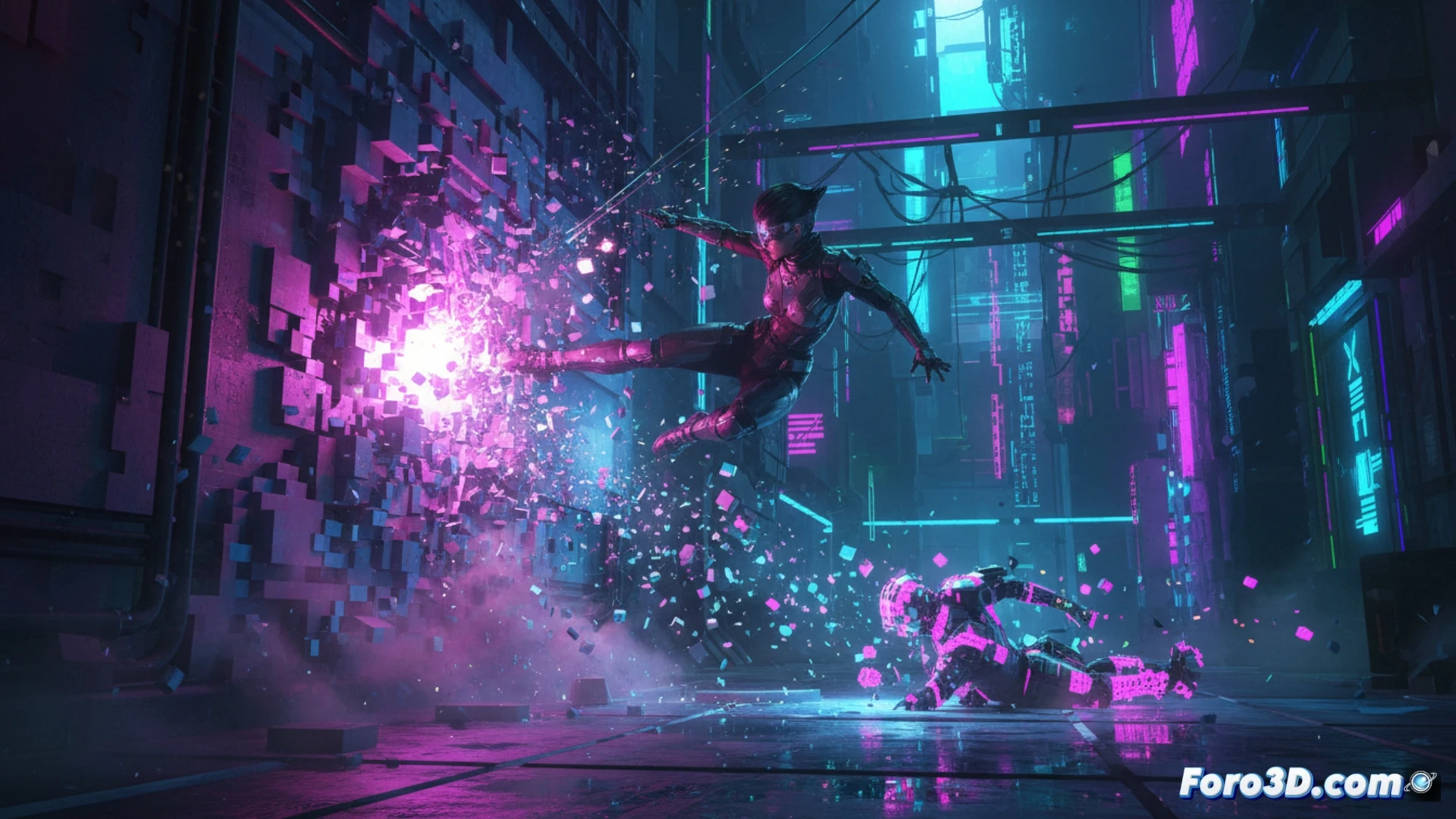
The first-person shooter Severed Steel proves that total destruction doesn't require hyper-realistic textures. Its engine, Unreal Engine 4, manages environments composed entirely of voxels that disintegrate under enemy fire. This minimalist approach, bathed in cyberpunk neon, offers a crucial lesson for indie developers: visual optimization can be the best ally of gameplay.
Workflow: From MagicaVoxel to Dynamic Lighting 🛠️
The technical pipeline of Severed Steel begins in MagicaVoxel, where environments are sculpted as cube matrices. Each voxel functions as an independent unit that Unreal Engine 4 recognizes through a pre-calculated fracturing system. Character and weapon assets, modeled in Autodesk Maya, are integrated as standard meshes. The magic happens in the material: when destroying a voxel, the engine triggers an event that recalculates global illumination in real-time, using point lights that react to the hole left by the block. To emulate this, use a blueprint that detects the deactivation of a voxel actor and activates a neon-colored light (cyan or magenta) with high attenuation to avoid overloading the render.
Fewer Polygons, More Impact: The Indie Lesson 💡
The key to Severed Steel's technical success lies in embracing limitations. By using voxels, the developer sacrifices geometric detail to gain precise and cheap-to-process destruction physics. The cyberpunk visual style is not a whim: flat colors and neon hide the grid-like nature of voxels, transforming a technical constraint into an artistic identity. For an indie studio, this game demonstrates that it's better to have a destruction system that works 100% with simple graphics than a detailed world that breaks unconvincingly. Invest time in polishing reactive lighting events, not in increasing the polygon count.
As a developer, what technical considerations and key optimizations in Unreal Engine 4 allow Severed Steel to achieve total destruction of voxelized environments without compromising performance, despite forgoing hyper-realistic textures?
(PS: game jams are like weddings: everyone is happy, no one sleeps, and you end up crying)