Serial Cleaners is not just a stealth game with crime scene cleaning mechanics; it is a visual manifesto that directly draws from 1990s New York independent cinema and street art. Its isometric approach, which simulates a modern oil painting with high-contrast shadows, is not a coincidence but the result of a very specific technical pipeline. We analyze how the trinity formed by Unity, Blender, and Photoshop achieves this distinctive aesthetic. 🎨
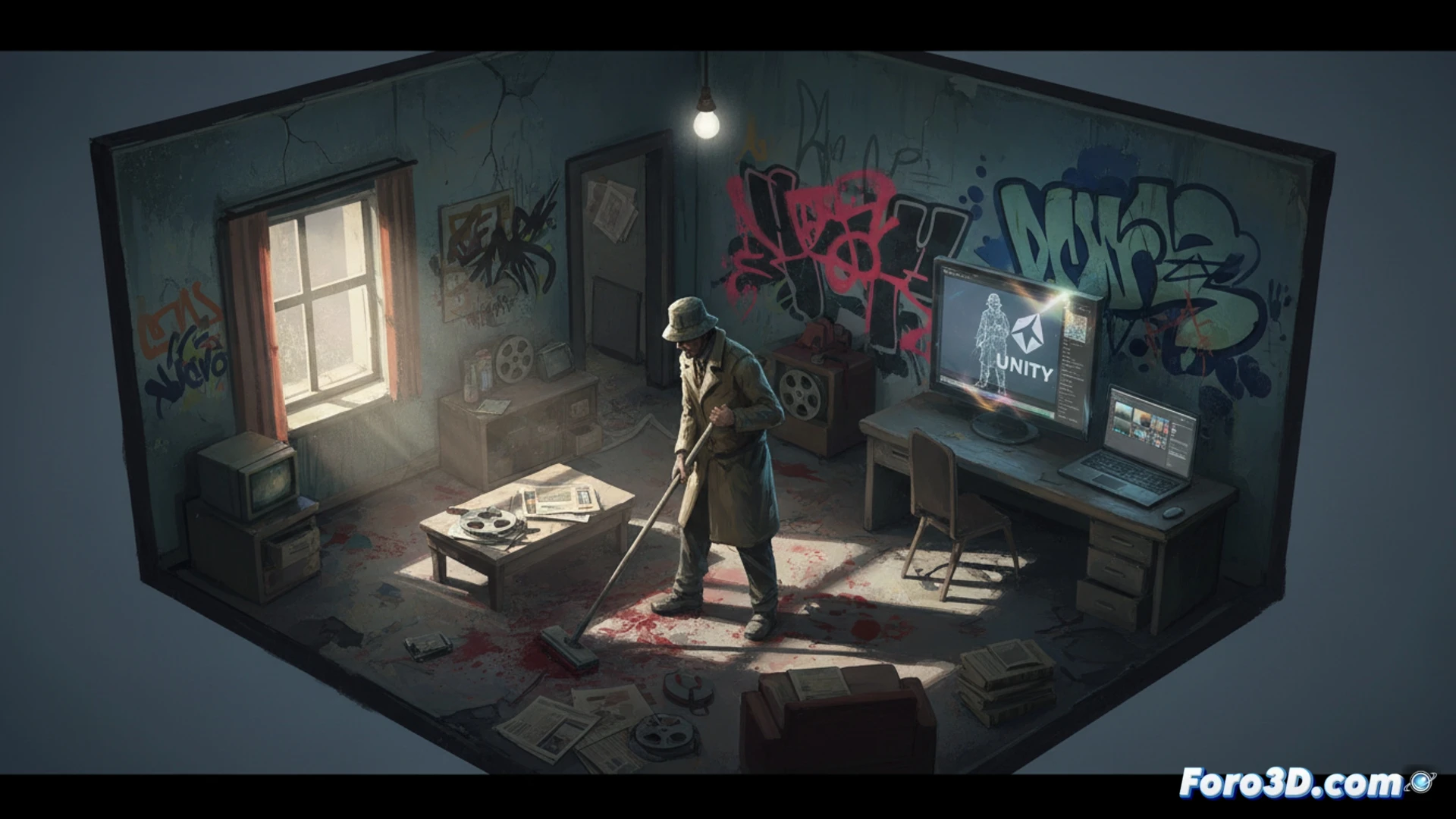
Technical Pipeline: Modeling, Texturing, and Isometric Lighting 🖌️
The artistic workflow begins in Blender, where 3D models are built with simplified, planimetric geometry, avoiding hyper-realistic details to prioritize a legible silhouette from the top-down perspective. Once exported, texturing in Adobe Photoshop applies digital brushstrokes that mimic the texture of oil paint, using noise layers and dirty gradients to avoid a plastic feel. The qualitative leap occurs in Unity: the engine receives these assets and applies hard directional lighting, with very pronounced clamp shadows (lightmap baking with adjusted resolution). The game's custom shader forces an 80% shadow contrast, eliminating mid-tones to emulate the neon light of 1990s New York streets, where each lamppost creates a violent cutout on the scene.
Cinema as a Narrative and Visual Engine 🎬
The inspiration from 1990s cinema (Scorsese, Tarantino, garage film noir) is not just aesthetic but functional. The isometric perspective in Serial Cleaners forces the player to read the scene like a storyboard, where every shadow hides a witness or a corpse. The art direction, which looks like an oil painting in motion, uses color saturation to narrate emotions: cool tones for tension and warm tones for action. Thus, Unity not only renders polygons but executes a cinematic filter that turns every level into a frame from a cult film, demonstrating that technique in service of visual narrative is the true engine of the game.
What technical and creative challenges did the Serial Cleaners team face when integrating the Unity and Blender artistic pipeline to emulate the cinematic aesthetic of the 1990s without sacrificing real-time performance?
(PS: 90% of development time is polishing, the other 90% is fixing bugs)