Last Tuesday, a next-generation robotic delivery truck became immobilized at an urban intersection following a critical failure of one of its main sensors. The incident, which left no injuries, exposed a key vulnerability in level 4 autonomous driving systems. The vehicle, designed to operate without human intervention, misinterpreted a traffic light signal due to erratic sensor readings, stopping abruptly and blocking traffic for over two hours.
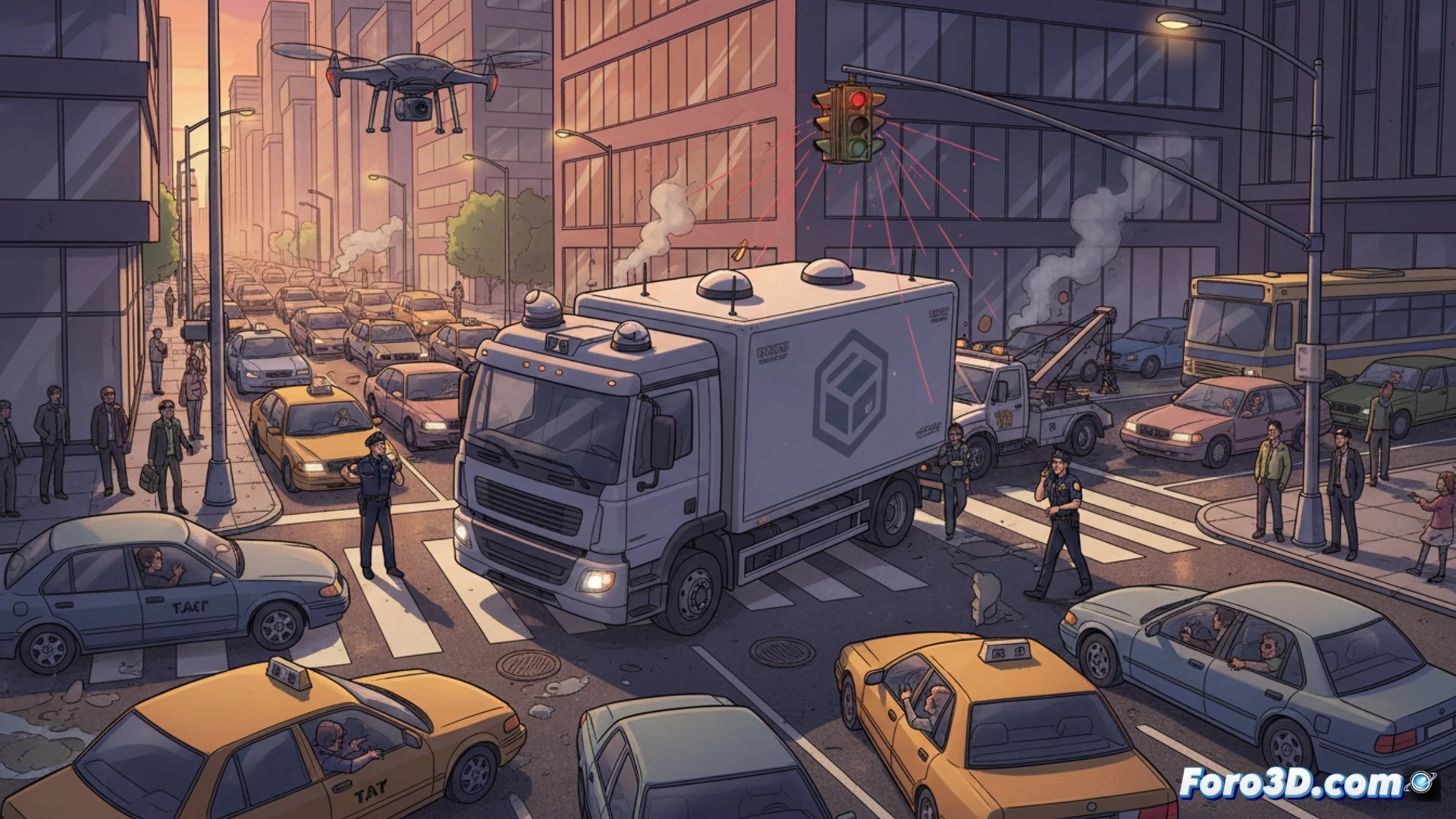
Failed sensor architecture and error simulation 🛠️
Technical analysis points to a failure in the rotating beam LIDAR module mounted on the truck's roof. This sensor emits 64 lasers to generate a 3D point cloud of the environment. In our simulation, we modeled the system architecture diagram, which includes a 2-out-of-3 redundancy between the LIDAR, a millimeter-wave radar, and three stereo cameras. The failure was replicated by injecting Gaussian noise into the LIDAR return signal, generating a false positive of a static object. The data fusion system, by prioritizing the LIDAR over the radar, overrode the correct decision from the cameras, ordering an emergency brake. The 3D visualization shows how the point cloud becomes distorted, creating a phantom wall in front of the truck.
Smart redundancy as a solution to the digital blind spot 💡
This incident demonstrates that simple hardware duplication is not enough. The technical solution involves implementing a weighted voting system where each sensor's weight varies according to environmental conditions. For example, in an urban intersection with good lighting, cameras should have greater authority than LIDAR. Additionally, a continuous self-diagnosis loop should be modeled to compare the temporal coherence of data from each sensor. If the LIDAR reports an object that the radar does not see for more than 200 milliseconds, the system should degrade its vote to zero and activate a reduced safety mode until the sensor is recalibrated.
Considering that a single sensor failure stopped an autonomous truck in the middle of an intersection, what safety protocols should be implemented at the hardware and software level in 3D systems to ensure sensory redundancy and prevent a total vehicle collapse in the event of a critical failure?
(PS: ADAS systems are like in-laws: always watching what you do)