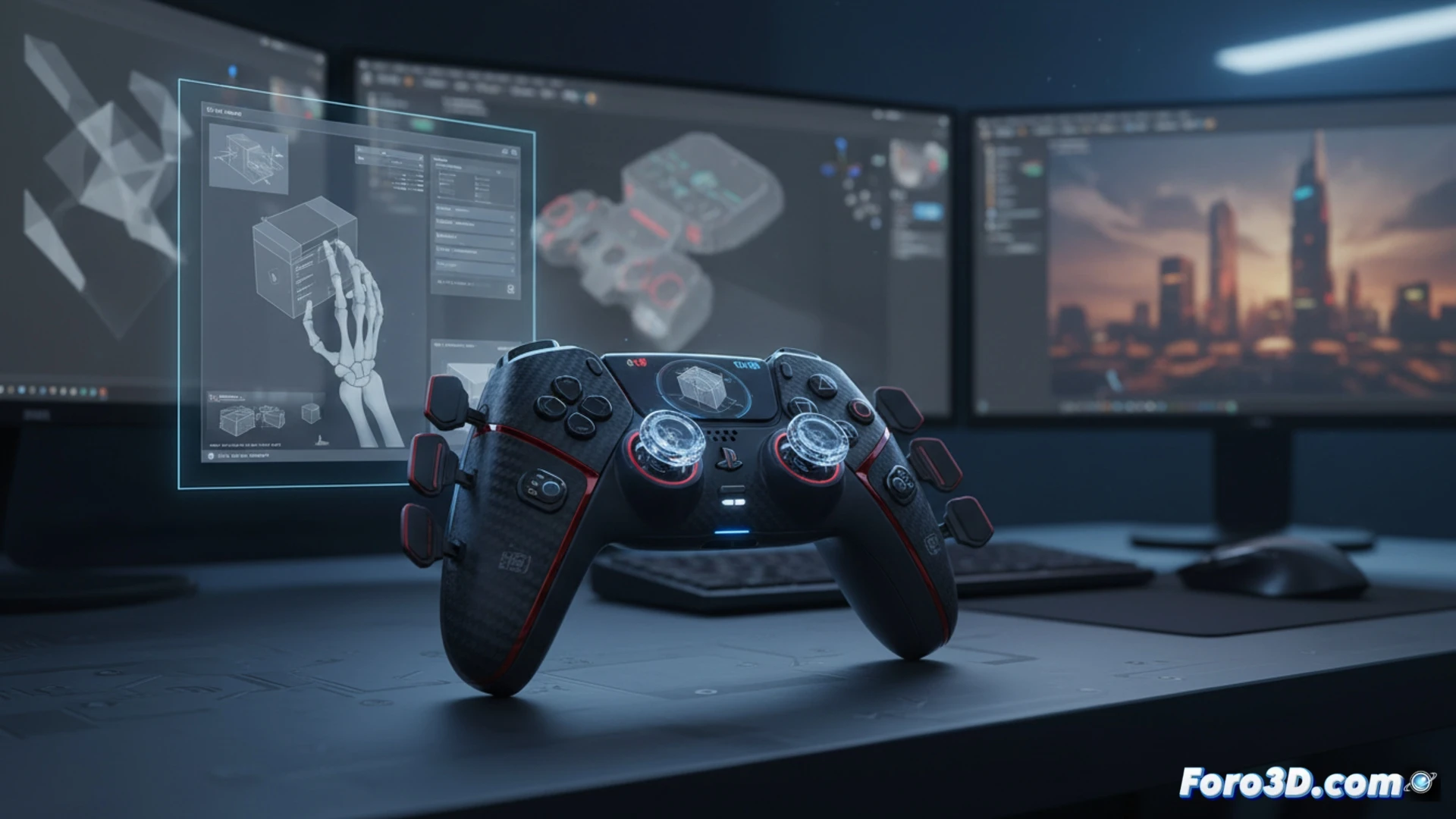
Sony and Scuf Gaming have launched the Scuf Omega, a professional controller with official license for PS5 that arrives with a price tag of 239.99 euros. At first glance, it is a peripheral for competitive gamers, but under the hood it hides an input architecture that deserves the attention of any 3D professional. With 28 total inputs, of which 11 are fully customizable, and TMR magnetic stick technology that promises to eliminate dreaded drift, this controller positions itself as a serious alternative for navigating viewports, controlling cameras in real-time, or handling complex simulations without constraints.
Technical Analysis: Omron Switches, TMR Sticks, and Reduced Latency 🎮
The Scuf Omega incorporates Omron mechanical switches in the triggers, D-pad, and action buttons, offering a quick-click mode for shots or a full analog travel. This is relevant for 3D applications because it allows switching between binary actions (like activating an extrusion command in Blender) and precise movements (like smooth zoom in a viewport). The Endurance TMR sticks use contactless magnetic technology, which eliminates mechanical wear and drift, a critical issue when needing to keep a camera fixed during hours of modeling. Additionally, low latency and multiplatform integration (PS5, PC, Mac, iOS, and Android) allow using the controller in environments like Unreal Engine or ZBrush without complex setups. The four rear paddles, two side buttons, and five G-Keys can be remapped directly from the controller or via the Scuf mobile app, where response curves can also be adjusted and sticks calibrated to adapt to the sensitivity required for working with polygon meshes or digital sculptures.
A Gamepad for CAD? Ergonomics as an Advantage Over the Keyboard 🖱️
In a traditional 3D workflow, the mouse and keyboard reign, but for tasks like orbital navigation, camera rotation, or real-time simulation control, a well-designed controller can surpass them in ergonomics and fluidity. The Scuf Omega allows assigning camera rotation to a stick and zoom to the analog trigger, freeing the dominant hand to work with a digital pen or mouse. The ability to create specific profiles for Blender, Maya, or Unreal Engine from the mobile app speeds up switching between projects. While it does not replace the precision of a SpaceMouse for parametric CAD, it does become a powerful complementary tool for long digital sculpting sessions or virtual reality navigation, where wrist fatigue is a real factor. The lingering question is whether the 3D software ecosystem will natively adopt these configurations or if the user will always have to resort to manual remapping.
Can a professional controller like the Scuf Omega, with its ergonomics and customization, truly surpass the precision of a mouse in complex modeling and 3D sculpting tasks, or is its utility limited to navigation and presentations?
(PS: remember that a powerful GPU won't make you a better modeler, but at least you'll render your mistakes faster)