The discovery of the Sanxingdui statues in Sichuan province has redefined the ancient history of China. These bronze figures, with facial features that defy the Asian canon and disproportionately large eyes, belong to a technologically advanced culture that vanished without leaving a single written record. Faced with this mystery, digital archaeology offers a crucial tool: the ability to preserve and analyze every detail without touching the fragile metal.
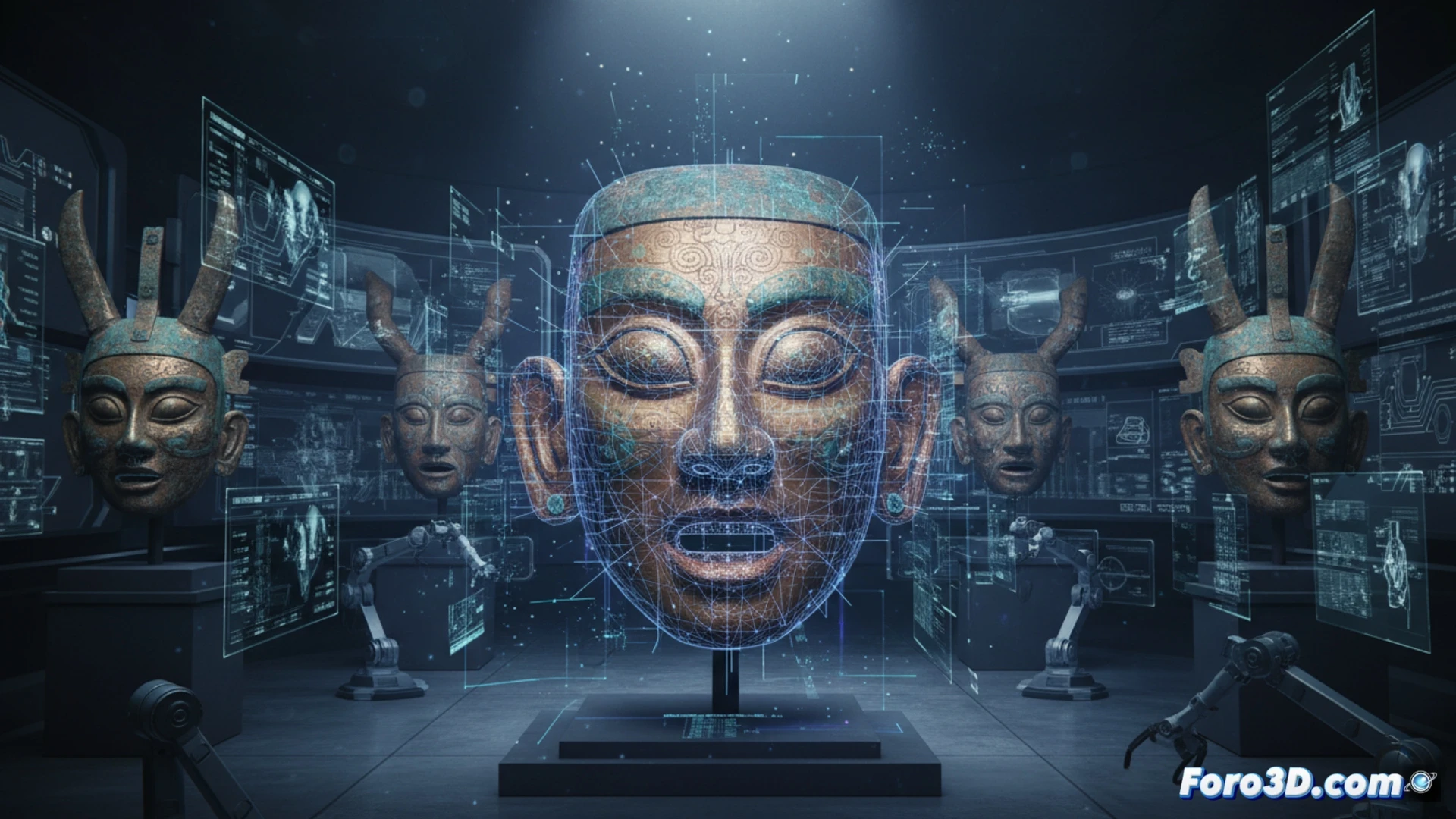
High-resolution photogrammetry for anomalous features 🔍
To document the bronze masks and heads, conservation teams are applying multi-angle photogrammetry. Hundreds of images are taken with cross-polarized light to capture the textures of the patina and polished surfaces. Structure from Motion (SfM) software generates point clouds with submillimeter precision. This 3D model allows digital anthropologists to isolate the almond-shaped eyes and wide jaws, measuring their exact proportions and comparing them with databases of human skulls. Thus, it is possible to study whether the non-Asian features are artistic stylization or evidence of remote contact.
Virtual reconstruction of the lost altar 🏛️
Beyond facial analysis, 3D technology allows for rigorous speculation. By digitally assembling the fragmented pieces and placing the statues in a rendered virtual environment, we can simulate how they were illuminated by torches inside a temple. This contextual reconstruction helps decipher the ritual function of the figures. The interactive model, published on open heritage platforms, allows any researcher or enthusiast to explore these bronze faces that stare out from a wordless past from their own home.
What technical and methodological challenges does the 3D scanning of the Sanxingdui bronze statues present for preserving their unique details and deciphering their enigmatic ritual function?
(PS: If you dig at a site and find a USB stick, don't plug it in: it could be Roman malware.)