Bloodstain pattern analysis (BPA) is a cornerstone of forensic reconstruction. However, traditional documentation with 2D photographs has critical limitations by distorting perspective and eliminating depth. The integration of photogrammetry and three-dimensional scanning allows each droplet to be captured in its exact spatial context, opening the door to trajectory and origin calculations that were previously merely speculative.
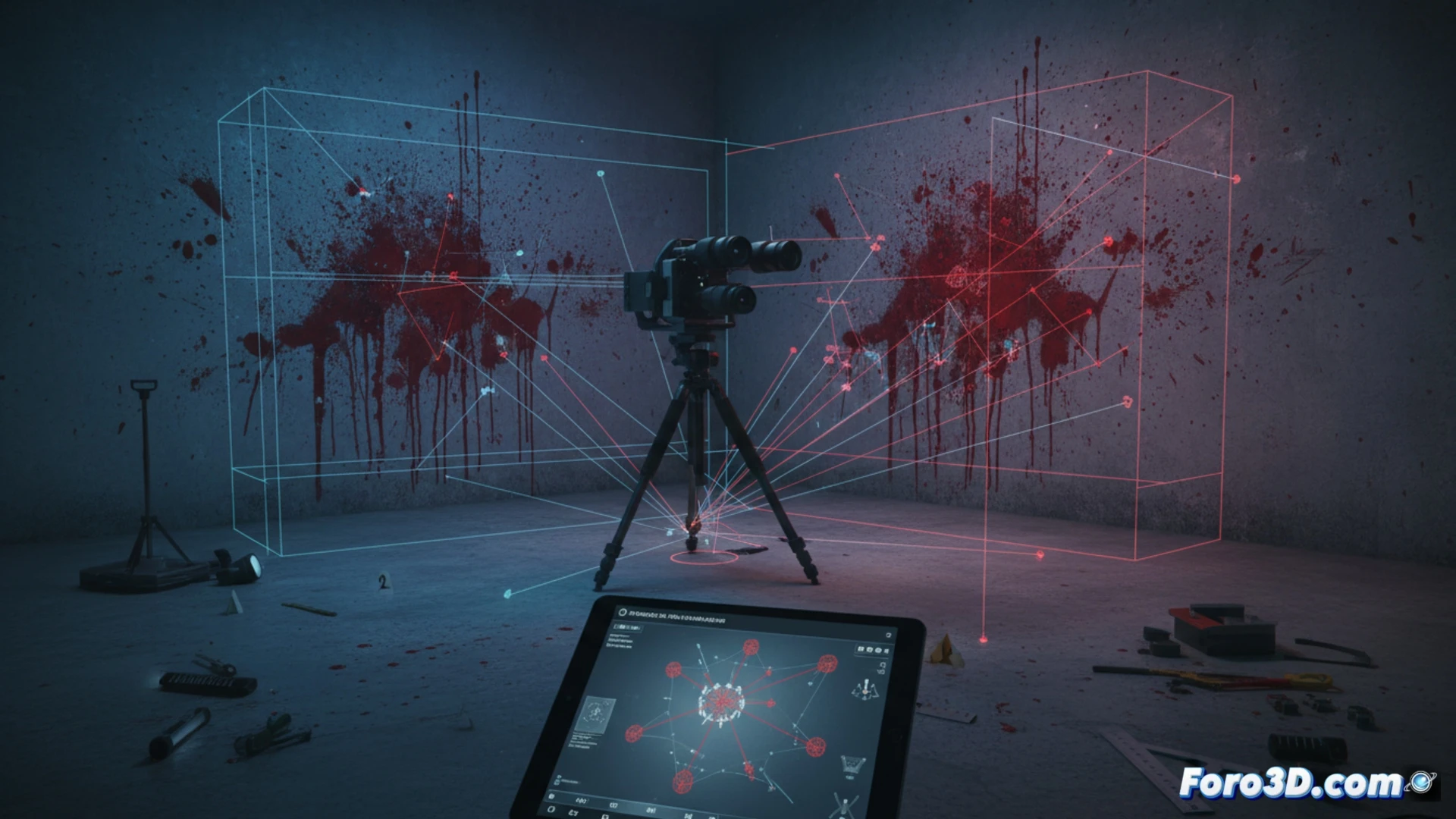
Technical Workflow: Capture and Three-Dimensional Modeling 🧬
The process begins with the acquisition of high-resolution images, taken from multiple angles with chromatic reference scales. Using Structure from Motion (SfM) software, a dense point cloud is generated that reproduces the texture and morphology of each spatter. The critical step is the segmentation of individual droplets in the 3D model. From the ellipticity of the droplets and their orientation in space, impact vectors are calculated. The convergence of these vectors in forensic analysis software (such as HemoSpat or FARO Zone 3D) allows determining the point of origin of the bleeding in three-dimensional space, drastically reducing the margin of error of 2D techniques.
The Digital Perspective as a Silent Witness 🔍
Beyond mathematical calculation, the 3D model offers an invaluable qualitative advantage: the ability to re-examine the scene from any angle without contaminating the evidence. Juries and investigators can take immersive virtual tours, understanding the dynamics of the violent event. This approach not only improves the accuracy of the reconstruction but also democratizes technical evidence, allowing an untrained eye to visualize the three-dimensional logic of an impact that a flat photograph could never convey.
How can 3D photogrammetry improve accuracy in determining the impact angle of a blood droplet compared to the traditional manual method of bloodstain pattern analysis?
(PS: don't forget to calibrate the laser scanner before documenting the scene... or you might be modeling a ghost)