Crime Scene Cleaner is not just a dirty job simulator; it is a technical testbed for real-time fluid rendering. Using Unity as the base engine and Substance Painter for material creation, the game achieves a level of detail in blood representation that challenges the conventions of cleaning simulators. Each splash, puddle, or stain is not a simple static decal, but a dynamic system that reacts to friction, absorption, and chemical agents, offering a physical simulation that transcends mere entertainment.
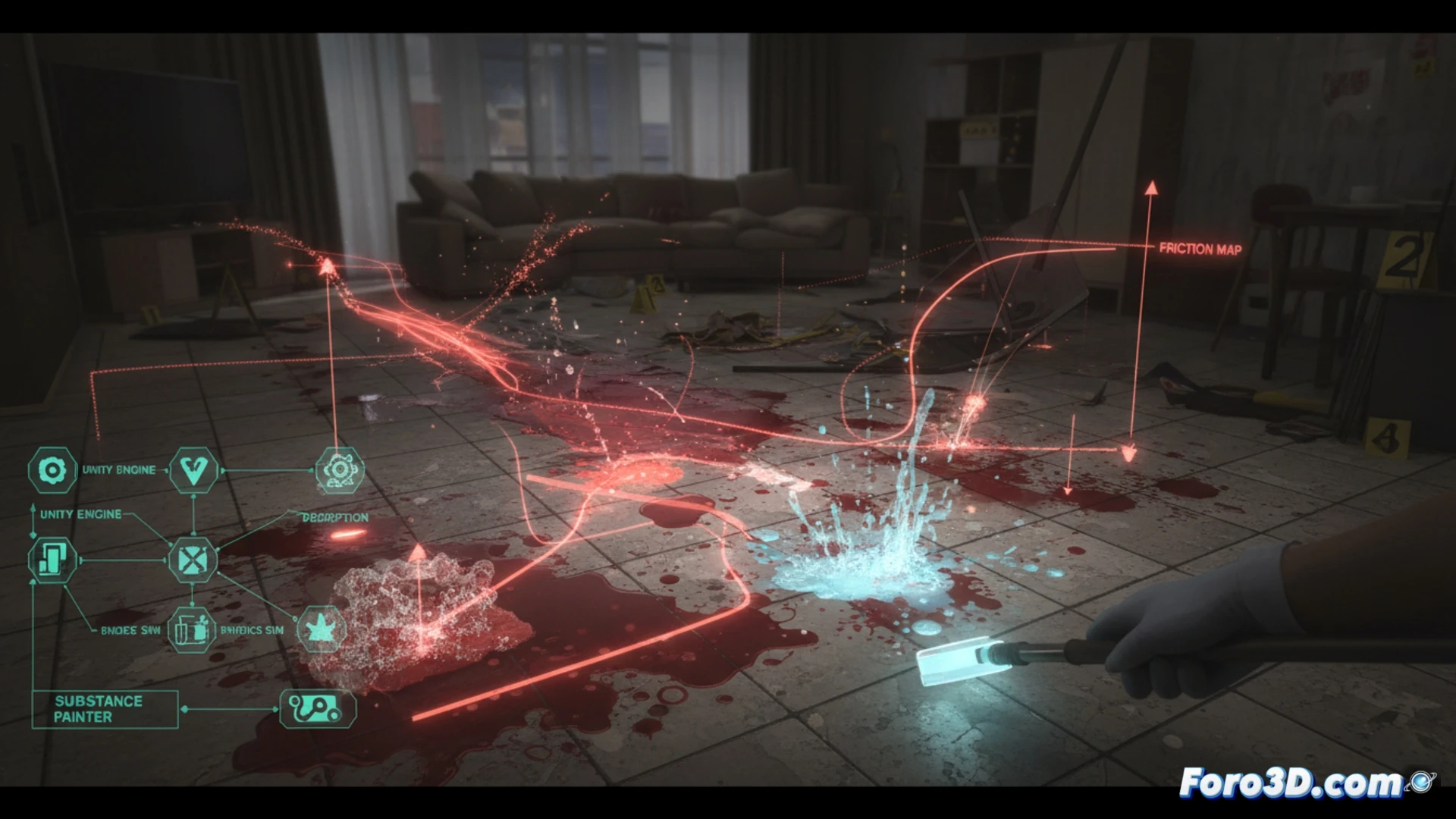
Fluid shaders and procedural textures in real time 🩸
The technical core lies in Unity's advanced shaders that manage the state transition of fluids. Instead of a binary mask texture, the game implements a layer system where blood behaves like a non-Newtonian viscous fluid. The materials created in Substance Painter are not static; mask maps are generated that allow shaders to calculate the porosity of each surface (wood, tile, fabric) and modify reflectance and roughness in real time as the player cleans. This allows blood to dry, dilute, or adhere differently on each material, replicating the real physical behavior an expert would find at a scene.
From simulation to forensic training 🔍
Beyond the video game, this technical pipeline offers an invaluable tool for forensic reconstruction. The ability to simulate fluid cleaning on surfaces with varied physical properties allows criminal investigation teams to train in identifying spatter patterns and the effectiveness of different cleaning methods. By integrating Unity's fluid physics with the material precision of Substance Painter, Crime Scene Cleaner positions itself as a functional prototype for 3D documentation of crime scenes, where evidence alteration can be modeled and analyzed without contaminating the real scene.
How would you integrate this finding into an existing forensic pipeline?